## Diagram: Procedural Character Generation from Primitives
### Overview
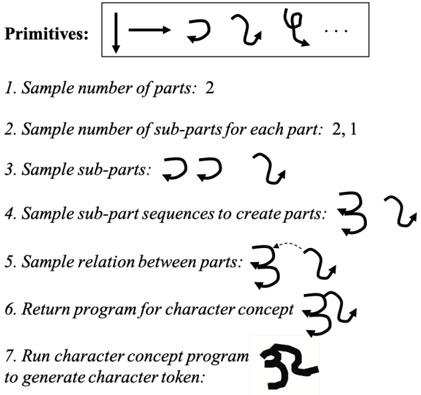
The image is a black-and-white technical diagram illustrating a seven-step procedural process for generating a unique character token from a set of basic graphical primitives. The process is hierarchical, involving sampling parts, sub-parts, sequences, and relations to construct a final composite symbol.
### Components/Axes
The diagram is structured as a vertical list of steps, each with a textual description and, in most cases, accompanying visual examples.
**Header (Top):**
* **Label:** `Primitives:`
* **Content:** A rectangular box containing five distinct hand-drawn symbols, followed by an ellipsis (`...`). The symbols are:
1. A vertical line with an arrowhead pointing down (`↓`).
2. A horizontal line with an arrowhead pointing right (`→`).
3. A curved arrow forming a near-complete clockwise loop.
4. A wavy, tilde-like line (`~`).
5. A more complex curved symbol resembling a cursive 'l' or a loop with a tail.
6. The ellipsis (`...`) indicates the set of primitives is not exhaustive.
**Main Process (Numbered Steps 1-7):**
Each step is presented as a numbered line of text. Steps 3, 4, 5, and 7 include visual examples placed to the right of the text.
### Detailed Analysis
**Step-by-Step Process Transcription:**
1. **Text:** `1. Sample number of parts: 2`
* **Action:** The process begins by selecting the number of primary components (parts) for the final character. The example value is 2.
2. **Text:** `2. Sample number of sub-parts for each part: 2, 1`
* **Action:** For each of the 2 parts from Step 1, a number of sub-parts is selected. The example shows the first part will have 2 sub-parts, and the second part will have 1 sub-part.
3. **Text:** `3. Sample sub-parts:`
* **Visual Example (to the right):** Three primitive symbols are shown: two instances of the curved arrow (from the Primitives box) and one instance of the wavy line.
* **Action:** Specific primitive symbols are chosen to serve as the sub-parts. The example uses two curved arrows and one wavy line.
4. **Text:** `4. Sample sub-part sequences to create parts:`
* **Visual Example (to the right):** Two composite symbols are shown.
* The first is a new symbol formed by combining two curved arrows (likely the two sub-parts for Part 1). It resembles a numeral '3' with a curled tail.
* The second is the single wavy line (the sub-part for Part 2).
* **Action:** The sampled sub-parts are arranged into sequences to form the primary parts. The example creates one part from a sequence of two curved arrows and another part from a single wavy line.
5. **Text:** `5. Sample relation between parts:`
* **Visual Example (to the right):** The two parts from Step 4 (the '3'-like symbol and the wavy line) are shown with a dotted, curved line connecting the top of the first to the left side of the second.
* **Action:** A spatial or relational rule (e.g., connection, overlap, alignment) is chosen to define how the parts combine. The example shows a connecting relation.
6. **Text:** `6. Return program for character concept`
* **Action:** This step outputs the complete procedural "program" or set of instructions (the choices made in steps 1-5) that defines the abstract concept of the character.
7. **Text:** `7. Run character concept program to generate character token:`
* **Visual Example (to the right):** A single, final composite symbol is shown. It is the result of executing the program: the '3'-like part is connected to the wavy line part according to the relation from Step 5, forming a unified glyph.
* **Action:** The program is executed to produce the final, concrete character token (the glyph).
### Key Observations
* **Hierarchical Construction:** The process builds complexity from the bottom up: Primitives → Sub-parts → Parts → Character Token.
* **Stochastic Nature:** The use of the word "Sample" in steps 1, 2, 3, 4, and 5 indicates that each parameter is chosen randomly or according to a distribution, allowing for the generation of many unique characters from the same primitive set.
* **Visual Consistency:** The visual examples accurately reflect the textual descriptions at each step, providing a clear walkthrough of one possible generation instance.
* **Final Output:** The character token in Step 7 is a direct visual synthesis of the components and relations defined in the preceding steps.
### Interpretation
This diagram outlines a **generative grammar or algorithm for symbol creation**. It is likely used in fields like computational typography, procedural asset generation for games, or the study of writing systems. The process formalizes how complex glyphs can be decomposed into a finite set of primitives and a set of rules for their combination.
The key insight is that meaning or identity (the "character concept") resides not in the final shape alone, but in the **program that generates it**. Two different programs could produce visually similar tokens, while the same program, if sampling is involved, could produce variations. This method allows for the systematic exploration of a "design space" of possible characters, ensuring variety while maintaining a coherent underlying structure derived from the shared primitive set. The dotted relation line in Step 5 is particularly important, as it moves beyond simple juxtaposition to define interactive spatial relationships between components.