\n
## Puzzle: Partially Filled Grid
### Overview
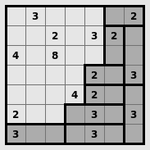
The image presents a partially filled grid, resembling a logic puzzle or a simplified Sudoku-like structure. The grid is composed of cells, some of which contain numerical values. The grid is outlined with a thick black border.
### Components/Axes
The image consists of a grid with dimensions approximately 7x7 cells. The cells are arranged in rows and columns. Some cells are filled with the following numbers: 2, 3, 4, and 8. The grid does not have explicit axis labels or a legend.
### Detailed Analysis or Content Details
The grid contains the following numerical values at these approximate locations:
* Row 1, Column 3: 3
* Row 2, Column 3: 2
* Row 2, Column 4: 3
* Row 2, Column 5: 2
* Row 3, Column 1: 4
* Row 3, Column 2: 8
* Row 5, Column 3: 4
* Row 5, Column 4: 2
* Row 6, Column 1: 2
* Row 6, Column 2: 3
* Row 7, Column 1: 3
* Row 7, Column 3: 3
* Row 1, Column 6: 2
* Row 5, Column 6: 3
* Row 6, Column 5: 3
The remaining cells are empty (represented by a light gray color).
### Key Observations
The numbers are scattered throughout the grid with no immediately obvious pattern. The number 3 appears most frequently. The number 8 appears only once. The grid is not fully populated, suggesting it is a puzzle to be solved.
### Interpretation
The image depicts a partially completed logic puzzle. The goal of the puzzle is likely to fill the remaining cells with numbers following specific rules (e.g., each row, column, or region must contain unique numbers). The provided numbers serve as constraints for solving the puzzle. Without knowing the specific rules of the puzzle, it is difficult to determine the intended solution or the underlying logic. The puzzle appears to be a simplified version of a Sudoku or similar number-placement game.