## Diagram: Sudoku Grid Layout
### Overview
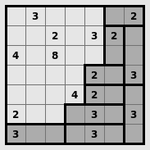
The image depicts a partially filled 9x9 Sudoku grid with pre-filled numbers and shaded regions. Numbers are placed in specific cells, and certain 3x3 subgrids are highlighted in gray.
### Components/Axes
- **Grid Structure**:
- 9 rows and 9 columns, divided into nine 3x3 subgrids.
- No explicit axes or legends; cells are labeled by row (top to bottom) and column (left to right).
- **Shaded Regions**:
- Top-right subgrid (rows 1–3, columns 7–9).
- Middle-center subgrid (rows 4–6, columns 4–6).
- Bottom-left subgrid (rows 7–9, columns 1–3).
### Detailed Analysis
- **Pre-filled Numbers**:
- **Row 1**: 3 (column 2), 2 (column 8).
- **Row 2**: 2 (column 3), 3 (column 5).
- **Row 3**: 4 (column 1), 8 (column 3).
- **Row 4**: 2 (column 5), 3 (column 6).
- **Row 5**: 4 (column 4), 2 (column 5), 2 (column 6).
- **Row 6**: 2 (column 1), 3 (column 4).
- **Row 7**: 3 (column 1), 3 (column 4), 3 (column 7).
- **Row 8**: 3 (column 4), 3 (column 7).
- **Row 9**: 3 (column 4), 3 (column 7).
- **Shaded Cells**:
- Top-right subgrid: Contains 2 (row 1, column 7), 2 (row 1, column 8), 2 (row 2, column 7), 2 (row 3, column 7).
- Middle-center subgrid: Contains 2 (row 4, column 4), 2 (row 4, column 5), 2 (row 5, column 4), 2 (row 5, column 5), 2 (row 6, column 4), 2 (row 6, column 5).
- Bottom-left subgrid: Contains 3 (row 7, column 1), 3 (row 7, column 2), 3 (row 7, column 3), 3 (row 8, column 1), 3 (row 8, column 2), 3 (row 8, column 3), 3 (row 9, column 1), 3 (row 9, column 2), 3 (row 9, column 3).
### Key Observations
1. **Duplicate Values**:
- The number **3** appears multiple times in the same column (e.g., column 4 in rows 7–9) and row (row 7, columns 1–3), violating Sudoku rules.
- The number **2** repeats in the same row (row 5, columns 5–6) and column (column 5, rows 4–6).
2. **Shading Pattern**:
- Shaded subgrids are diagonally offset, covering the top-right, center, and bottom-left regions.
3. **Incomplete Grid**:
- Many cells remain empty, indicating an unsolved puzzle.
### Interpretation
- The grid appears to be a **Sudoku puzzle** with pre-filled numbers and shaded regions, likely to guide solvers. However, the presence of duplicate values (e.g., multiple 3s in column 4 and row 7) suggests either an error in the puzzle design or intentional misdirection for a variant Sudoku variant.
- The shaded subgrids may highlight regions where numbers must be placed without repetition, but the existing duplicates contradict standard Sudoku logic.
- The incomplete grid requires further input to resolve conflicts and complete the puzzle.