## Table: Question Answering Reasoning Chains
### Overview
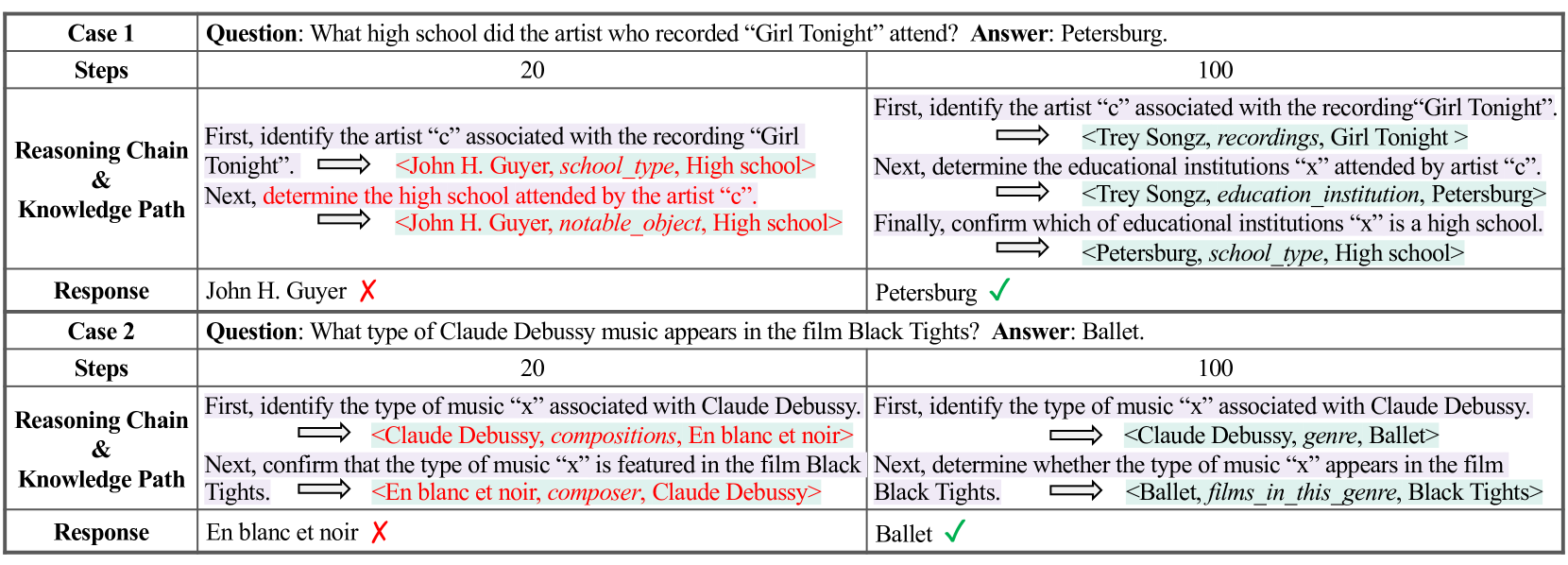
The image presents a table illustrating two cases of question answering, detailing the reasoning chain and knowledge path used to arrive at the answer. Each case is broken down into "Steps", "Reasoning Chain & Knowledge Path", and "Response". The table is structured with columns for Steps (20 & 100), Reasoning Chain & Knowledge Path, and Response.
### Components/Axes
The table has three main columns:
1. **Steps:** Contains numerical values "20" and "100" in each case, likely representing a scale or weighting.
2. **Reasoning Chain & Knowledge Path:** This column contains text describing the logical steps taken to answer the question, represented using arrows (⇒) and angle brackets (< >).
3. **Response:** Contains the final answer to the question, with a checkmark (✓) or cross (X) indicating correctness.
The table is divided into two rows, representing "Case 1" and "Case 2".
### Detailed Analysis or Content Details
**Case 1:**
* **Question:** "What high school did the artist who recorded “Girl Tonight” attend? Answer: Petersburg."
* **Steps:** 20, 100
* **Reasoning Chain & Knowledge Path:**
* "First, identify the artist “c” associated with the recording “Girl Tonight”." ⇒ <Trey Songz, recordings, Girl Tonight>
* "Next, determine the educational institutions “x” attended by artist “c”." ⇒ <Trey Songz, education_institution, Petersburg>
* "Finally, confirm which of educational institutions “x” is a high school." ⇒ <Petersburg, school_type, High school>
* **Response:** John H. Guyer X, Petersburg ✓
**Case 2:**
* **Question:** "What type of Claude Debussy music appears in the film Black Tights? Answer: Ballet."
* **Steps:** 20, 100
* **Reasoning Chain & Knowledge Path:**
* "First, identify the type of music “x” associated with Claude Debussy." ⇒ <Claude Debussy, compositions, En blanc et noir>
* "Next, confirm that the type of music “x” is featured in the film Black Tights." ⇒ <Ballet, films_in_this_genre, Black Tights>
* **Response:** En blanc et noir X, Ballet ✓
### Key Observations
* The "Steps" column values (20 and 100) appear consistently across both cases, potentially indicating a scoring or weighting system for the reasoning steps.
* The Reasoning Chain & Knowledge Path uses a specific notation with arrows and angle brackets to represent relationships between entities.
* The responses include both the initially proposed answer (marked with X) and the correct answer (marked with ✓).
* The knowledge path uses specific tags like "recordings", "education_institution", "compositions", and "films_in_this_genre" to categorize the relationships.
### Interpretation
The table demonstrates a structured approach to question answering, breaking down the process into logical steps and utilizing a knowledge path to connect entities. The use of a knowledge graph-like structure (represented by the angle brackets) suggests a system that relies on pre-defined relationships between concepts. The inclusion of both incorrect and correct answers, along with the checkmarks, indicates a validation or correction mechanism within the system. The "Steps" column might represent confidence scores or the complexity of each step. The notation used in the Reasoning Chain & Knowledge Path is a formal way to represent the inference process, potentially for debugging or analysis of the system's behavior. The table highlights a system designed to not only provide answers but also to explain *how* those answers were derived.