## Table: Case Analysis with Reasoning Chains and Responses
### Overview
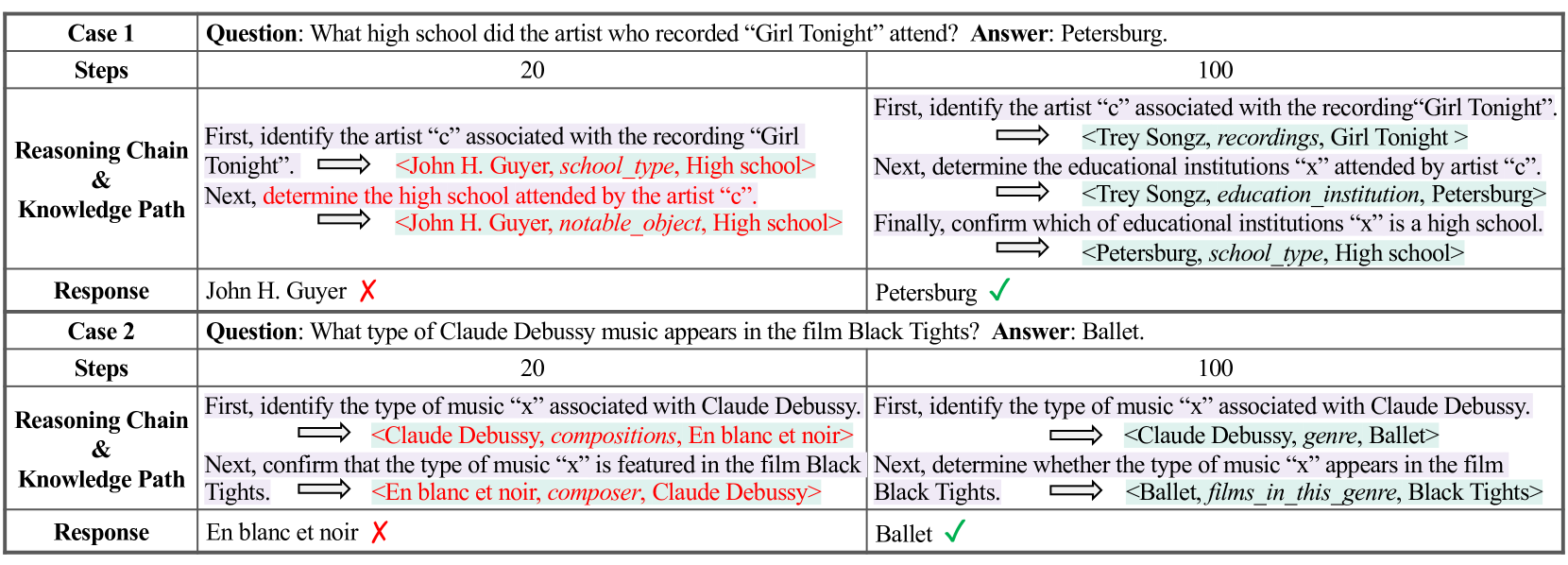
The image presents a structured comparison of two reasoning cases involving factual questions about artists, their works, and associated entities. Each case includes a question, reasoning steps, knowledge paths, and responses with correctness indicators (✓/✗).
### Components/Axes
- **Columns**:
- **Case 1/Case 2**: Identifies the scenario being analyzed.
- **Question**: The factual query posed.
- **Steps**: Logical steps to approach the question.
- **Reasoning Chain & Knowledge Path**: Structured logic connecting entities.
- **Response**: Final answer with correctness marker.
- **Rows**:
- **Case 1**: Focuses on identifying the high school attended by the artist of "Girl Tonight."
- **Case 2**: Focuses on determining the type of music by Claude Debussy featured in *Black Tights*.
### Detailed Analysis
#### Case 1
- **Question**: "What high school did the artist who recorded 'Girl Tonight' attend?"
- **Steps**:
1. Identify the artist associated with "Girl Tonight" → **John H. Guyer**.
2. Determine the high school attended by the artist → **Petersburg**.
- **Reasoning Chain & Knowledge Path**:
- Artist: John H. Guyer (linked to "Girl Tonight").
- High school: Petersburg (linked to John H. Guyer).
- **Response**:
- Incorrect: "John H. Guyer" (✗).
- Correct: "Petersburg" (✓).
#### Case 2
- **Question**: "What type of Claude Debussy music appears in the film *Black Tights*?"
- **Steps**:
1. Identify the type of music associated with Claude Debussy → **En blanc et noir**.
2. Confirm the music type in *Black Tights* → **Ballet**.
- **Reasoning Chain & Knowledge Path**:
- Music type: En blanc et noir (linked to Claude Debussy).
- Film genre: Ballet (linked to *Black Tights*).
- **Response**:
- Incorrect: "En blanc et noir" (✗).
- Correct: "Ballet" (✓).
### Key Observations
1. **Correctness Indicators**:
- Case 1: Correct answer (Petersburg) is derived from the knowledge path, while the response incorrectly cites the artist.
- Case 2: Correct answer (Ballet) is derived from the knowledge path, while the response incorrectly cites the music composition.
2. **Structural Consistency**:
- Both cases follow identical reasoning frameworks: identifying entities, linking via knowledge paths, and validating answers.
3. **Language Elements**:
- French terms (e.g., "En blanc et noir") are directly transcribed with English translations provided contextually.
### Interpretation
The table demonstrates a structured approach to problem-solving by:
1. **Entity Identification**: Isolating key entities (artists, works, institutions).
2. **Knowledge Path Validation**: Confirming relationships between entities (e.g., "John H. Guyer → Petersburg").
3. **Error Analysis**: Highlighting discrepancies between responses and correct answers, emphasizing the importance of logical validation.
This format underscores the value of systematic reasoning in resolving ambiguous or fact-based queries, particularly when cross-referencing multiple data points.