\n
## Diagram: Automated Code Evaluation Pipeline
### Overview
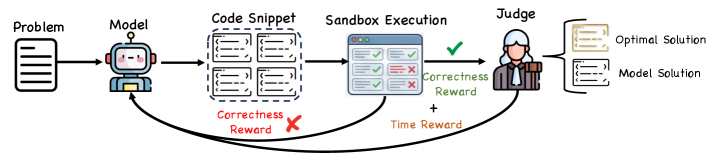
The image depicts a diagram illustrating an automated code evaluation pipeline. It shows the flow of a "Problem" through a "Model" that generates a "Code Snippet", which is then executed in a "Sandbox Execution" environment. A "Judge" evaluates the "Model Solution" against an "Optimal Solution" and provides rewards based on correctness and time.
### Components/Axes
The diagram consists of the following components, arranged horizontally from left to right:
1. **Problem:** Represented as a stack of documents.
2. **Model:** A robotic figure.
3. **Code Snippet:** A grid of code blocks.
4. **Sandbox Execution:** A window displaying code execution results with checkmarks and crosses.
5. **Judge:** A human figure holding a box.
6. **Optimal Solution & Model Solution:** Two document icons.
The diagram also includes feedback loops:
* A red arrow labeled "Correctness Reward" with a cross symbol, going from the Judge back to the Model.
* A gray arrow labeled "Time Reward" going from the Judge back to the Model.
* A green arrow indicating the flow from Sandbox Execution to the Judge.
### Detailed Analysis or Content Details
The diagram illustrates a process flow.
* **Problem:** The input to the system. No specific details about the problem are provided.
* **Model:** Receives the problem and generates a code snippet. The model is depicted as a robot.
* **Code Snippet:** The output of the model, represented as a 2x2 grid of code blocks. The code itself is not visible.
* **Sandbox Execution:** The code snippet is executed in a sandbox environment. The results are shown as a grid with checkmarks (indicating successful tests) and crosses (indicating failed tests). There are 4 checkmarks and 2 crosses.
* **Judge:** Evaluates the "Model Solution" against the "Optimal Solution".
* **Optimal Solution:** The ideal solution to the problem.
* **Model Solution:** The solution generated by the model.
* **Correctness Reward:** A negative reward (indicated by the red color and cross symbol) is given to the model if the solution is incorrect.
* **Time Reward:** A reward is given to the model based on the execution time.
### Key Observations
The diagram highlights a reinforcement learning loop where the model is rewarded or penalized based on the correctness and efficiency of its generated code. The presence of both correctness and time rewards suggests that the system aims to optimize for both accuracy and speed. The sandbox execution environment is crucial for safely evaluating the generated code.
### Interpretation
This diagram represents a system for automated code evaluation, likely used in the training of a code-generating model. The model receives a problem, generates code, and receives feedback from a judge based on the code's correctness and execution time. This feedback is then used to improve the model's performance through a reinforcement learning process. The use of a sandbox environment is essential for security and preventing malicious code from causing harm. The diagram suggests a focus on iterative improvement and optimization of code generation capabilities. The visual representation emphasizes the cyclical nature of the process, where the model continuously learns and refines its solutions based on the feedback received.