## Flow Diagram: Paper Selection Process
### Overview
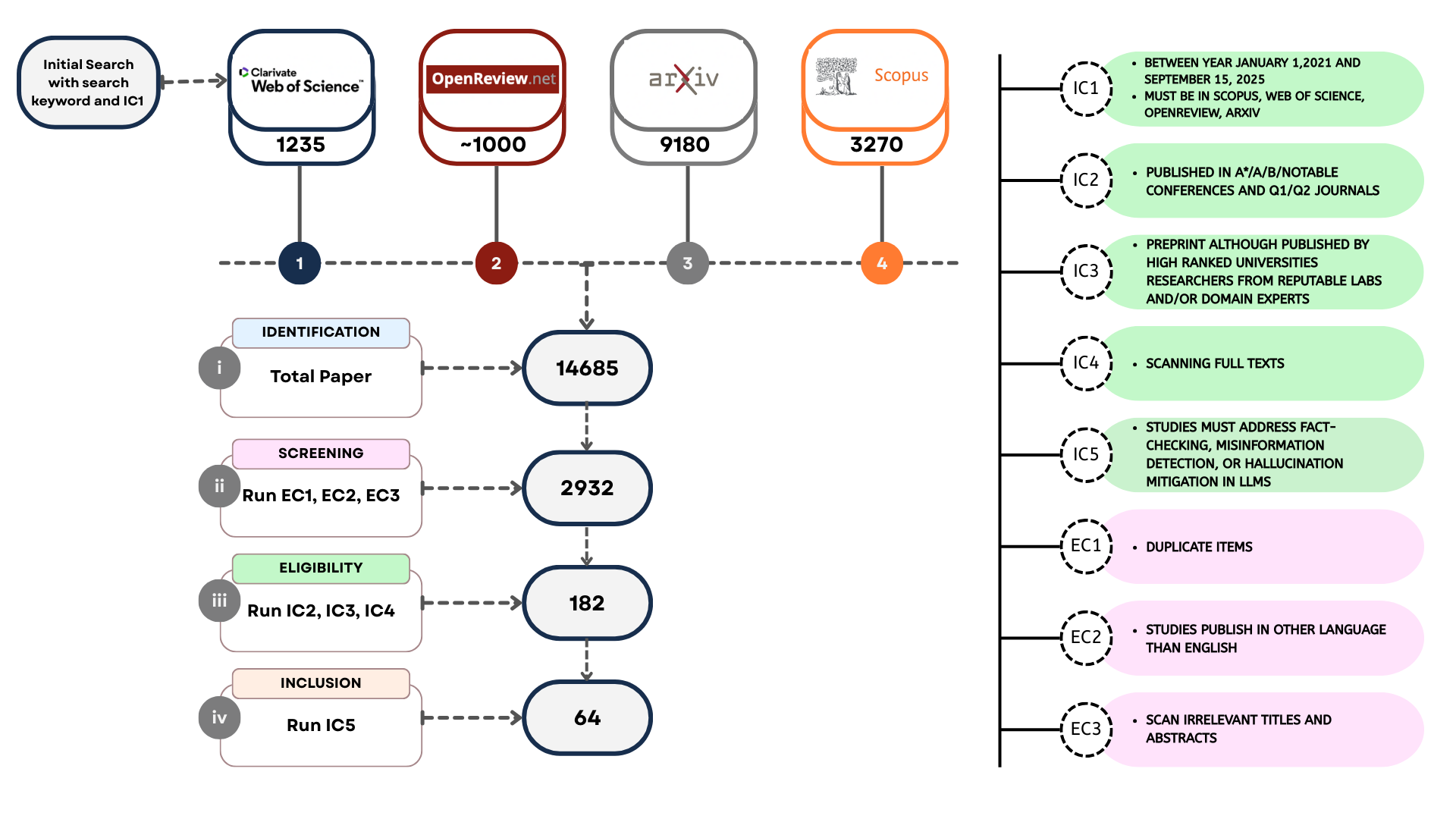
The image is a flow diagram illustrating the process of selecting papers based on specific criteria. It starts with an initial search and progresses through stages of identification, screening, eligibility, and inclusion, with the number of papers decreasing at each stage. The diagram also outlines inclusion and exclusion criteria.
### Components/Axes
* **Initial Search:** "Initial Search with search keyword and IC1"
* Flows into four databases: Clarivate Web of Science, OpenReview.net, arXiv, and Scopus.
* Clarivate Web of Science: 1235 papers
* OpenReview.net: ~1000 papers
* arXiv: 9180 papers
* Scopus: 3270 papers
* **Identification:**
* Label: i
* Text: "Total Paper"
* Value: 14685
* **Screening:**
* Label: ii
* Text: "Run EC1, EC2, EC3"
* Value: 2932
* **Eligibility:**
* Label: iii
* Text: "Run IC2, IC3, IC4"
* Value: 182
* **Inclusion:**
* Label: iv
* Text: "Run IC5"
* Value: 64
* **Inclusion Criteria (IC):**
* IC1: "Between year January 1, 2021 and September 15, 2025. Must be in Scopus, Web of Science, OpenReview, ArXiv"
* IC2: "Published in A*/A/B/Notable Conferences and Q1/Q2 Journals"
* IC3: "Preprint although published by high ranked universities researchers from reputable labs and/or domain experts"
* IC4: "Scanning full texts"
* IC5: "Studies must address fact-checking, misinformation detection, or hallucination mitigation in LLMs"
* **Exclusion Criteria (EC):**
* EC1: "Duplicate items"
* EC2: "Studies publish in other language than English"
* EC3: "Scan irrelevant titles and abstracts"
### Detailed Analysis or ### Content Details
The diagram starts with an initial search, which yields different numbers of papers from four databases: Clarivate Web of Science (1235), OpenReview.net (~1000), arXiv (9180), and Scopus (3270). These papers are then combined, resulting in a total of 14685 papers at the "Identification" stage.
The papers then undergo "Screening" based on exclusion criteria EC1, EC2, and EC3, reducing the number to 2932. Next, "Eligibility" is assessed using inclusion criteria IC2, IC3, and IC4, further reducing the number to 182. Finally, "Inclusion" is determined by applying inclusion criterion IC5, resulting in a final selection of 64 papers.
### Key Observations
* The number of papers decreases significantly at each stage of the selection process.
* The initial search yields the most papers from arXiv (9180), followed by Scopus (3270).
* The exclusion criteria (EC1, EC2, EC3) have a substantial impact on reducing the number of papers during the screening stage.
* The inclusion criteria (IC2, IC3, IC4, IC5) further refine the selection process, leading to a final set of 64 papers.
### Interpretation
The flow diagram illustrates a systematic approach to paper selection, starting with a broad search and narrowing down the results based on specific inclusion and exclusion criteria. The significant reduction in the number of papers at each stage highlights the importance of these criteria in identifying relevant and high-quality studies. The diagram also demonstrates the relative contribution of different databases to the initial pool of papers. The process ensures that the final selection of papers meets the defined requirements for the research or analysis being conducted.