## Bar Chart: Overlap Ratio vs. Percentage
### Overview
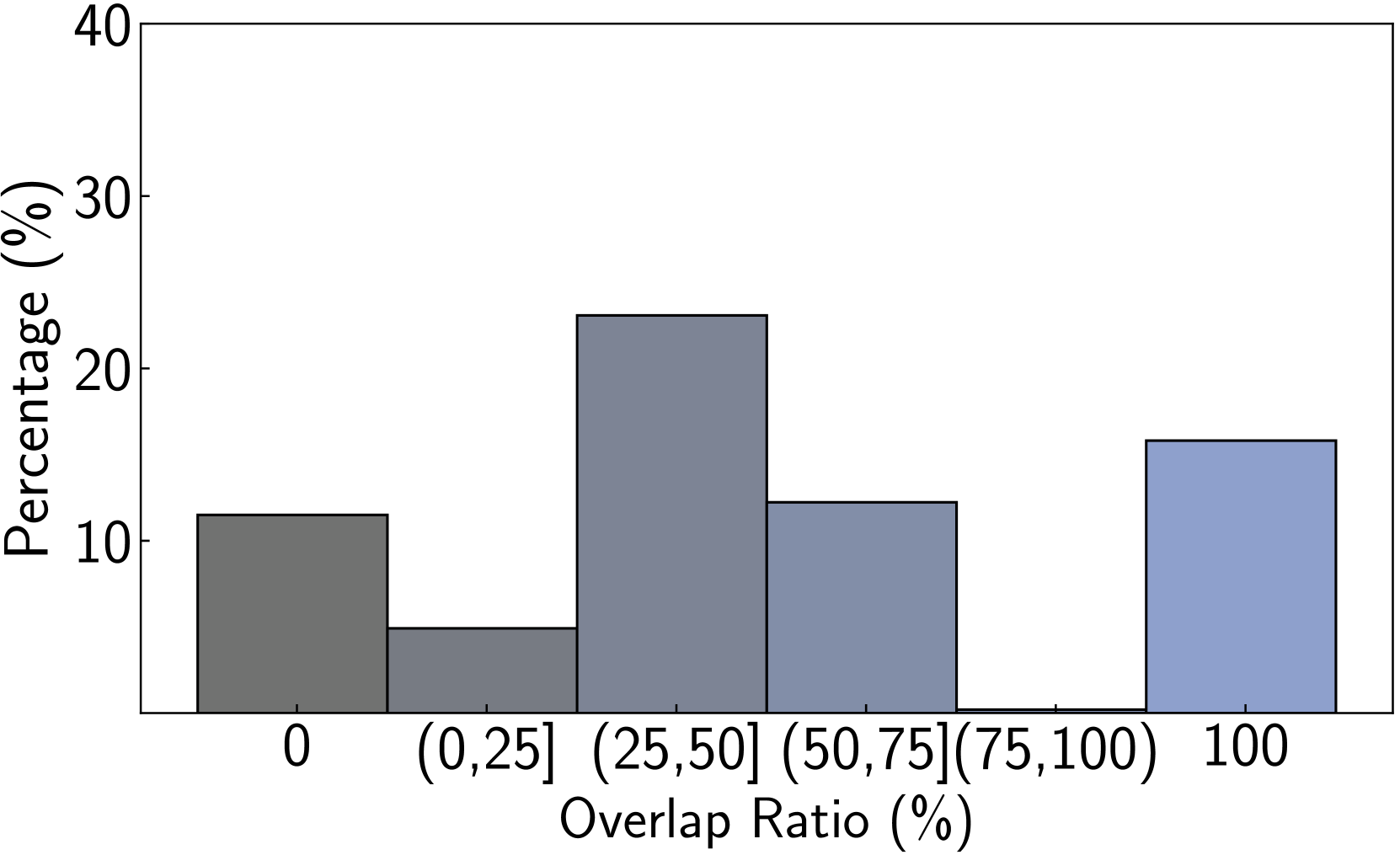
The image is a bar chart showing the distribution of data across different overlap ratio ranges. The x-axis represents the overlap ratio in percentage, divided into bins, and the y-axis represents the percentage of data falling into each bin.
### Components/Axes
* **X-axis:** Overlap Ratio (%), with categories: 0, (0,25], (25,50], (50,75], (75,100], 100
* **Y-axis:** Percentage (%), with a scale from 0 to 40, incrementing by 10.
### Detailed Analysis
* **Category 0:** The bar extends to approximately 11.5%. The bar is dark gray.
* **Category (0,25]:** The bar extends to approximately 5%. The bar is dark gray.
* **Category (25,50]:** The bar extends to approximately 23%. The bar is gray.
* **Category (50,75]:** The bar extends to approximately 12%. The bar is gray.
* **Category (75,100]:** There is no bar for this category, so the percentage is 0%.
* **Category 100:** The bar extends to approximately 16%. The bar is light blue.
### Key Observations
* The (25,50] overlap ratio range has the highest percentage, indicating that most of the data falls within this range.
* The (0,25] overlap ratio range has the lowest percentage.
* There is no data for the (75,100] overlap ratio range.
### Interpretation
The bar chart illustrates the distribution of data based on overlap ratios. The peak at the (25,50] range suggests that a significant portion of the data exhibits this level of overlap. The absence of data in the (75,100] range could indicate a lack of instances with very high overlap ratios. The presence of data at 0 and 100 suggests that there are instances with no overlap and complete overlap, respectively, although in smaller proportions compared to the (25,50] range.