## Code Snippet: Theorem Definition
### Overview
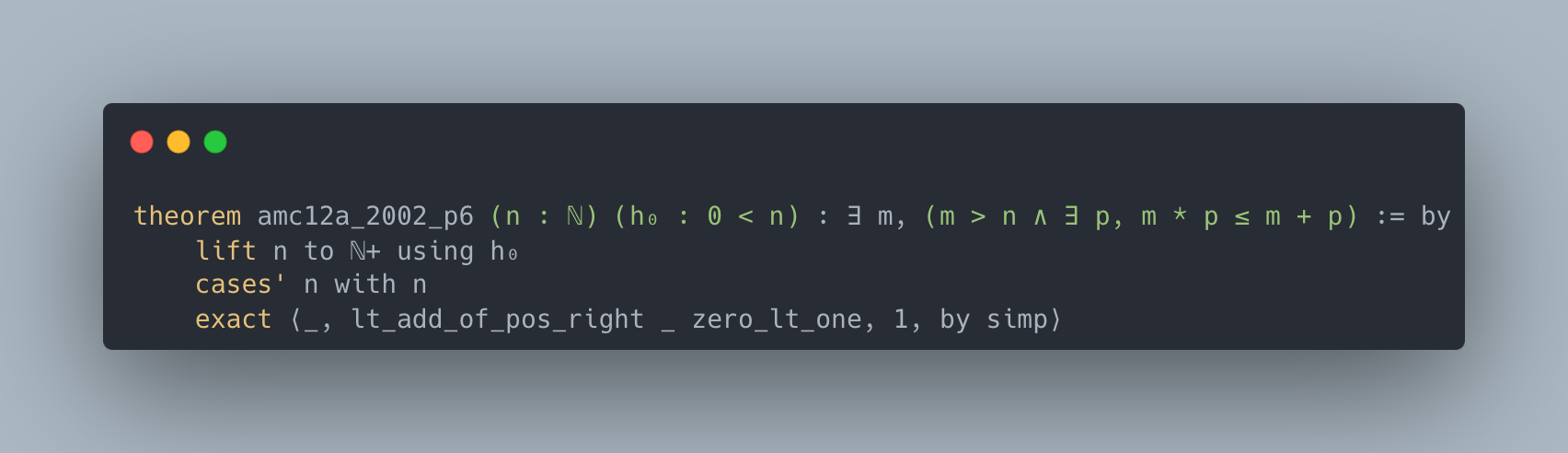
The image shows a code snippet defining a theorem named `amc12a_2002_p6`. The theorem takes a natural number `n` and a proof `h0` that `0 < n` as input. It asserts the existence of `m` and `p` such that `m > n`, `m >= p`, and `m * p <= m + p`. The proof is constructed using tactics like `lift`, `cases'`, and `exact`.
### Components/Axes
* **Theorem Name:** `amc12a_2002_p6`
* **Input Parameters:**
* `n : N` (n is a natural number)
* `h0 : 0 < n` (h0 is a proof that 0 is less than n)
* **Goal:** `∃ m, (m > n ∧ ∃ p, m * p ≤ m + p)` (There exists an m such that m > n and there exists a p such that m * p <= m + p)
* **Proof Strategy:**
* `lift n to N+ using h0` (Lift n to the positive natural numbers using the proof h0)
* `cases' n with n` (Perform case analysis on n)
* `exact (_, lt_add_of_pos_right _ zero_lt_one, 1, by simp)` (Provide the exact proof term)
### Detailed Analysis or ### Content Details
The code snippet defines a theorem and provides a proof using a tactic-based approach. The theorem states that for any natural number `n` greater than 0, there exist numbers `m` and `p` satisfying certain conditions. The proof involves lifting `n` to the positive natural numbers, performing case analysis, and providing an exact proof term.
The proof term `(_, lt_add_of_pos_right _ zero_lt_one, 1, by simp)` suggests that the proof relies on the lemma `lt_add_of_pos_right` and the fact that `0 < 1`. The `by simp` tactic likely simplifies the goal to complete the proof.
### Key Observations
* The theorem is named `amc12a_2002_p6`, which suggests it might be related to a problem from the AMC 12A competition in 2002.
* The proof uses tactics like `lift`, `cases'`, and `exact`, which are common in interactive theorem provers.
* The proof term involves lemmas related to inequalities and simplification.
### Interpretation
The code snippet demonstrates a formal proof of a mathematical theorem. The theorem states that for any natural number `n` greater than 0, there exist numbers `m` and `p` such that `m > n` and `m * p <= m + p`. The proof is constructed using a combination of tactics and lemmas, showcasing a typical workflow in interactive theorem proving. The specific lemmas used in the proof term suggest that the proof relies on basic properties of inequalities and natural numbers. The theorem and its proof might be related to a problem from a mathematical competition, indicating its potential relevance to problem-solving in mathematics.