## Diagram: Quantum State Manipulation and Correlation Analysis
### Overview
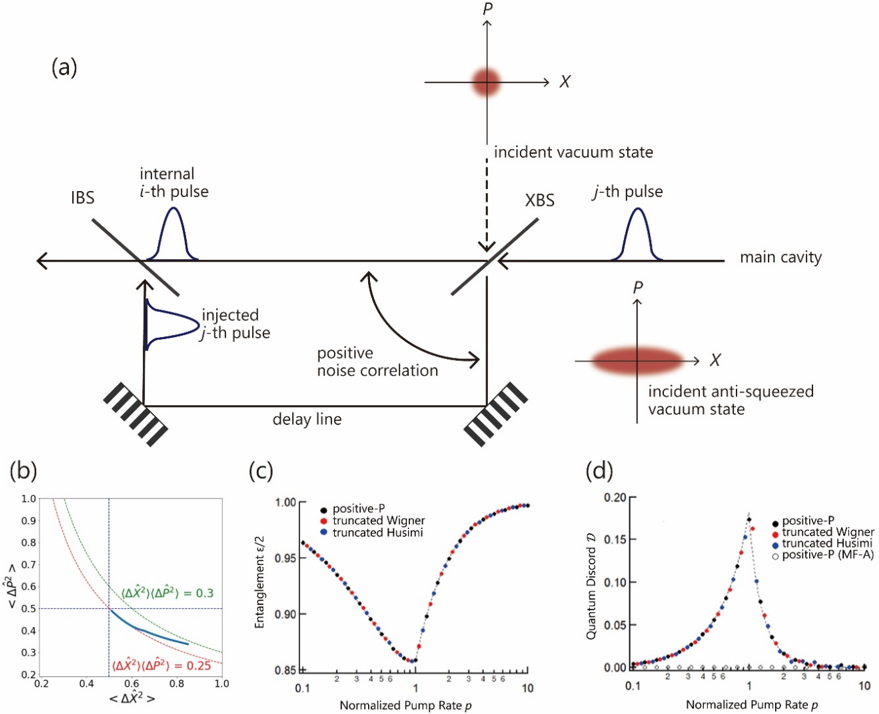
The image depicts a quantum optical setup for manipulating vacuum states and analyzing correlations between position (X) and momentum (P) quadratures. It includes a schematic diagram (a) and three graphs (b, c, d) showing relationships between quantum uncertainties, entanglement, and quantum discord as functions of pump rate.
---
### Components/Axes
#### (a) Schematic Diagram
- **Components**:
- **Main cavity**: Right side, labeled with "incident vacuum state" (red ellipse) and "incident anti-squeezed vacuum state" (red ellipse with arrow).
- **Delay line**: Horizontal line at the bottom, with striped patterns indicating phase shifts.
- **IBS (Intra-Cavity Beam Splitter)**: Left side, with an incoming "internal i-th pulse" (blue curve).
- **XBS (Crossed Beam Splitter)**: Center, with an outgoing "injected j-th pulse" (blue curve) and "positive noise correlation" (arrow).
- **Pulses**:
- "internal i-th pulse" (blue curve) above IBS.
- "j-th pulse" (blue curve) above XBS.
- **Axes**:
- Horizontal axis labeled "X" (position).
- Vertical axis labeled "P" (momentum).
#### (b) Graph: Uncertainty Product vs. Position Uncertainty
- **Axes**:
- X-axis: `<ΔX̂²>` (position uncertainty squared), range 0.2–1.0.
- Y-axis: `<ΔP̂²>` (momentum uncertainty squared), range 0.2–1.0.
- **Curves**:
- Green dashed line: `(ΔX̂²)(ΔP̂²) = 0.3`.
- Red dashed line: `(ΔX̂²)(ΔP̂²) = 0.25`.
- **Legend**: Located at bottom-left, associating colors with uncertainty products.
#### (c) Graph: Entanglement vs. Normalized Pump Rate
- **Axes**:
- X-axis: Normalized Pump Rate `p` (log scale, 0.1–10).
- Y-axis: Entanglement `ε/2`, range 0.85–1.0.
- **Data Series**:
- **Positive-P** (black dots): Peaks at `p=1`, drops to ~0.85 at `p=10`.
- **Truncated Wigner** (red circles): Similar trend to Positive-P but slightly lower.
- **Truncated Husimi** (blue squares): Smoother curve, peaks at `p=1`.
- **Legend**: Top-right, associating markers with states.
#### (d) Graph: Quantum Discord vs. Normalized Pump Rate
- **Axes**:
- X-axis: Normalized Pump Rate `p` (log scale, 0.1–10).
- Y-axis: Quantum Discord `D`, range 0–0.2.
- **Data Series**:
- **Positive-P** (black dots): Peaks at `p=1` (~0.15).
- **Truncated Wigner** (red circles): Similar peak but lower amplitude.
- **Truncated Husimi** (blue squares): Lower peak (~0.1).
- **Positive-P (MF-A)** (open circles): Overlaps with Positive-P but slightly lower.
- **Legend**: Top-right, associating markers with states.
---
### Detailed Analysis
#### (b) Uncertainty Product
- The green and red curves represent the product of position and momentum uncertainties. As `<ΔX̂²>` increases, `<ΔP̂²>` decreases, consistent with quantum squeezing. The red curve (0.25) lies below the green curve (0.3), indicating tighter squeezing.
#### (c) Entanglement
- All states show maximum entanglement at `p=1`, with entanglement dropping as `p` increases. The Positive-P state maintains the highest entanglement across all pump rates.
#### (d) Quantum Discord
- Quantum Discord peaks at `p=1` for all states, with Positive-P (MF-A) showing the highest value. Discord decreases as `p` increases, suggesting reduced quantum correlations at higher pump rates.
---
### Key Observations
1. **Optimal Pump Rate**: All metrics (entanglement, discord) peak at `p=1`, indicating optimal quantum state manipulation at this pump rate.
2. **State Differences**:
- Positive-P states exhibit higher entanglement and discord than truncated states.
- Truncated Husimi states show smoother trends compared to truncated Wigner.
3. **Uncertainty Trade-off**: The uncertainty product curves in (b) confirm the Heisenberg limit, with squeezing achievable for specific pump rates.
---
### Interpretation
The setup in (a) uses pulsed interactions to generate squeezed and entangled states from an incident vacuum. The graphs (b–d) quantify how pump rate affects quantum properties:
- **Entanglement** and **quantum discord** are maximized at `p=1`, suggesting this is the optimal operating point for quantum information tasks.
- The **Positive-P state** outperforms truncated states in both entanglement and discord, highlighting its utility for quantum communication.
- The uncertainty product in (b) demonstrates that squeezing (reduced uncertainty product) is achievable, aligning with quantum optics principles.
This analysis underscores the importance of pump rate optimization in quantum state engineering and the trade-offs between different quantum metrics.