\n
## Bar Chart: AUROC Scores for Hallucination Types
### Overview
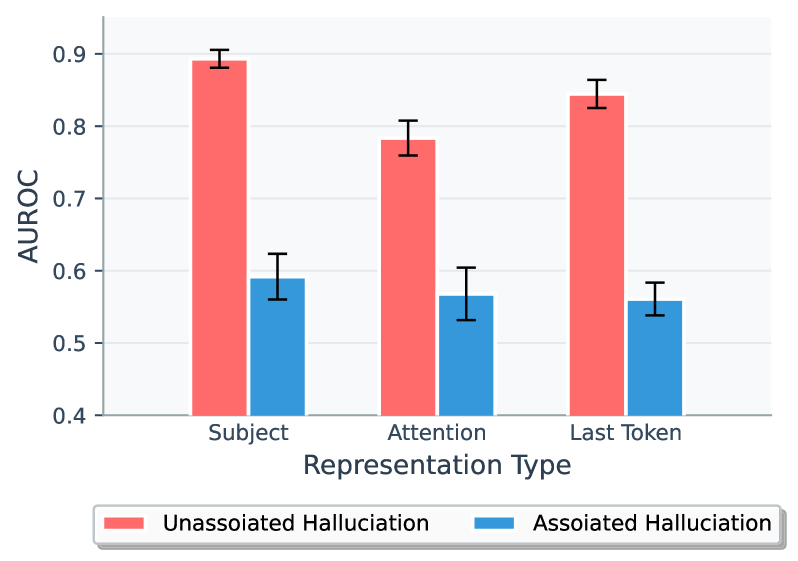
This bar chart compares the Area Under the Receiver Operating Characteristic curve (AUROC) scores for two types of hallucinations – "Unassociated Hallucination" and "Associated Hallucination" – across three different "Representation Types": "Subject", "Attention", and "Last Token". Error bars are included for each data point, indicating the variability or confidence interval around the mean AUROC score.
### Components/Axes
* **X-axis:** "Representation Type" with categories: "Subject", "Attention", "Last Token".
* **Y-axis:** "AUROC" with a scale ranging from approximately 0.4 to 0.9.
* **Legend:** Located in the bottom-left corner.
* "Unassociated Hallucination" – represented by a red color.
* "Associated Hallucination" – represented by a blue color.
### Detailed Analysis
The chart consists of six bars, grouped by Representation Type and Hallucination Type. Each bar has an error bar extending vertically.
* **Subject:**
* Unassociated Hallucination (Red): The bar is approximately 0.87 high, with an error bar extending from roughly 0.84 to 0.90.
* Associated Hallucination (Blue): The bar is approximately 0.57 high, with an error bar extending from roughly 0.53 to 0.61.
* **Attention:**
* Unassociated Hallucination (Red): The bar is approximately 0.78 high, with an error bar extending from roughly 0.74 to 0.82.
* Associated Hallucination (Blue): The bar is approximately 0.56 high, with an error bar extending from roughly 0.52 to 0.60.
* **Last Token:**
* Unassociated Hallucination (Red): The bar is approximately 0.84 high, with an error bar extending from roughly 0.80 to 0.88.
* Associated Hallucination (Blue): The bar is approximately 0.55 high, with an error bar extending from roughly 0.51 to 0.59.
The red bars (Unassociated Hallucination) are consistently higher than the blue bars (Associated Hallucination) across all three Representation Types.
### Key Observations
* Unassociated hallucinations consistently achieve higher AUROC scores than associated hallucinations, indicating better discrimination performance.
* The AUROC scores for Unassociated Hallucinations are relatively stable across the three Representation Types, ranging from approximately 0.78 to 0.87.
* The AUROC scores for Associated Hallucinations are also relatively stable, ranging from approximately 0.55 to 0.57.
* The error bars suggest a reasonable degree of confidence in the reported AUROC scores, although there is some variability.
### Interpretation
The data suggests that it is easier to detect unassociated hallucinations compared to associated hallucinations, as evidenced by the consistently higher AUROC scores. This could be because unassociated hallucinations are more readily identifiable as deviations from expected behavior, while associated hallucinations might be more subtle or context-dependent. The representation type (Subject, Attention, Last Token) does not appear to significantly impact the ability to distinguish between these two types of hallucinations, as the AUROC scores remain relatively consistent across all three. The relatively small error bars indicate that the observed differences are likely statistically significant. This information is valuable for developing and evaluating hallucination detection methods in language models, suggesting that focusing on identifying unassociated hallucinations might be a more effective strategy.