## Bar Chart: AUROC Comparison by Representation Type and Hallucination Type
### Overview
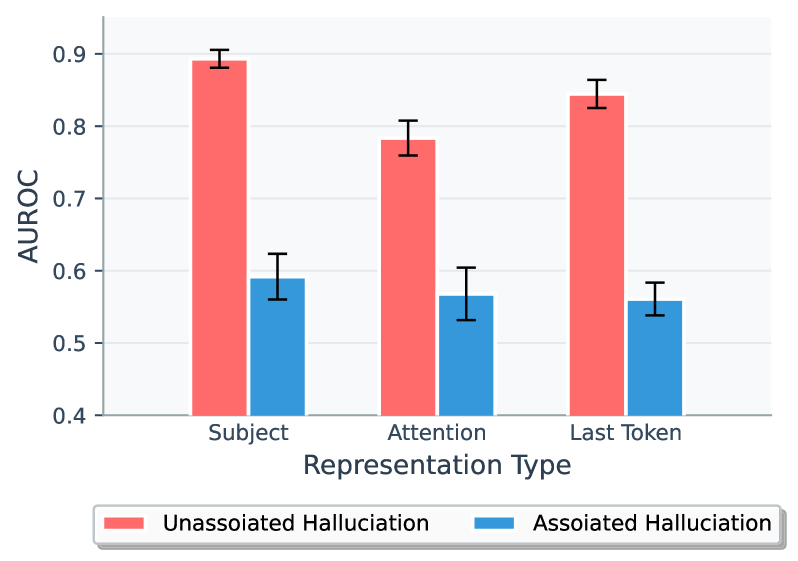
The chart compares Area Under the Receiver Operating Characteristic Curve (AUROC) values for three representation types ("Subject," "Attention," "Last Token") across two hallucination conditions: "Unassociated Hallucination" (red bars) and "Associated Hallucination" (blue bars). Error bars indicate measurement uncertainty.
### Components/Axes
- **X-axis**: Representation Type (Subject, Attention, Last Token)
- **Y-axis**: AUROC (0.4–0.9)
- **Legend**:
- Red = Unassociated Hallucination
- Blue = Associated Hallucination
- **Error Bars**: Vertical lines atop bars showing ± uncertainty
### Detailed Analysis
1. **Subject Representation Type**:
- Unassociated Hallucination: 0.89 ± 0.02
- Associated Hallucination: 0.59 ± 0.03
2. **Attention Representation Type**:
- Unassociated Hallucination: 0.78 ± 0.03
- Associated Hallucination: 0.56 ± 0.04
3. **Last Token Representation Type**:
- Unassociated Hallucination: 0.84 ± 0.02
- Associated Hallucination: 0.55 ± 0.03
### Key Observations
- Unassociated Hallucination consistently outperforms Associated Hallucination across all representation types.
- The largest AUROC gap occurs in the "Subject" representation type (0.89 vs. 0.59).
- Error margins are smaller for Unassociated Hallucination (avg. ±0.025) vs. Associated Hallucination (avg. ±0.035).
- AUROC values for Associated Hallucination cluster tightly between 0.55–0.59.
### Interpretation
The data demonstrates that Unassociated Hallucination maintains significantly higher discriminative power (AUROC) across all representation types compared to Associated Hallucination. The "Subject" representation type shows the strongest performance for Unassociated Hallucination, suggesting it captures more robust features for this condition. The smaller error margins for Unassociated Hallucination imply more reliable measurements, potentially due to clearer signal separation. The consistent underperformance of Associated Hallucination across all categories indicates a fundamental limitation in its ability to distinguish between classes, regardless of representation type. This pattern suggests that representation type optimization may be more impactful for Unassociated Hallucination than for its associated counterpart.