## Chart: Cumulative Solving + Checking Time
### Overview
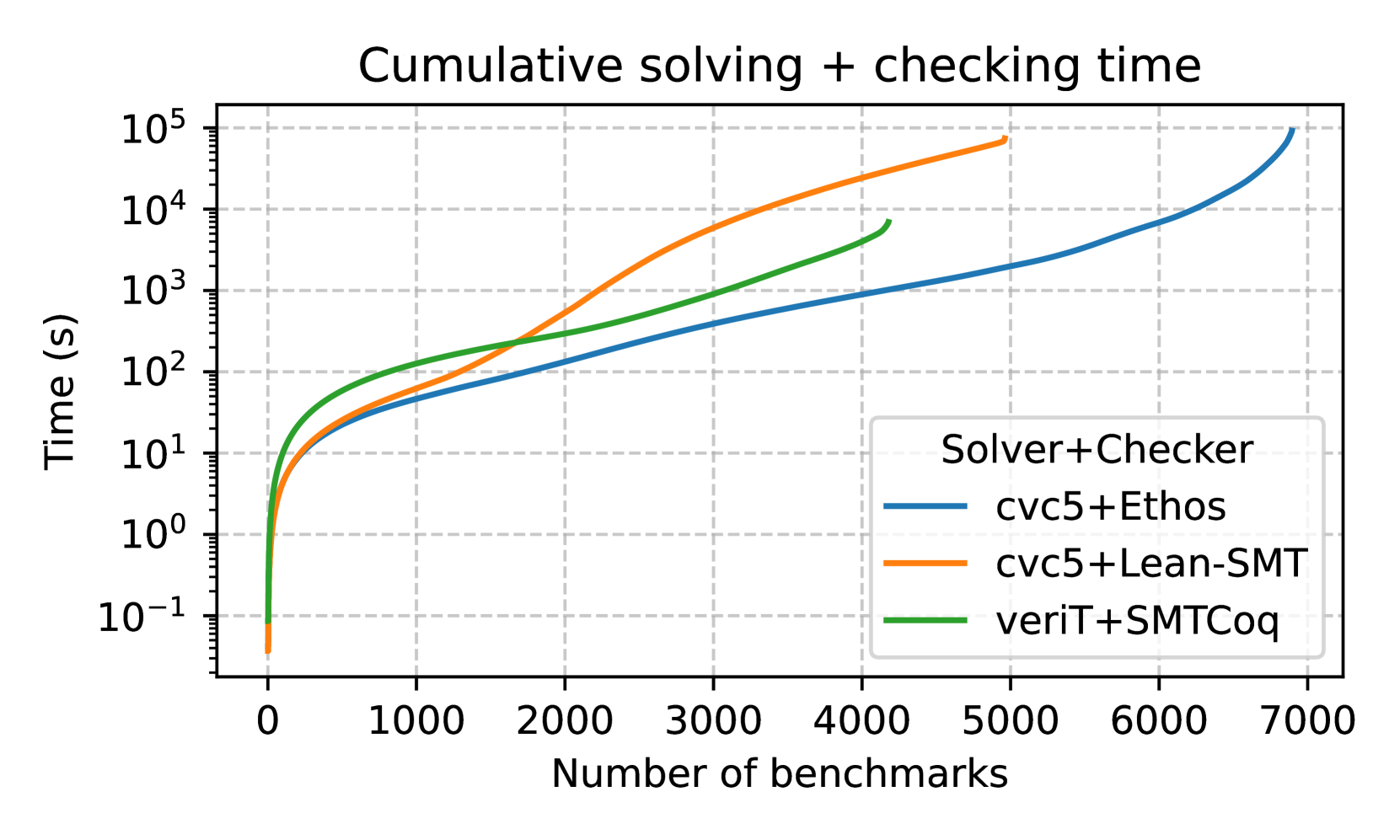
The image is a line chart comparing the cumulative solving and checking time for three different solver-checker combinations across a varying number of benchmarks. The x-axis represents the number of benchmarks, and the y-axis represents the time in seconds on a logarithmic scale.
### Components/Axes
* **Title:** Cumulative solving + checking time
* **X-axis:** Number of benchmarks, ranging from 0 to 7000.
* **Y-axis:** Time (s), ranging from 10^-1 to 10^5 on a logarithmic scale.
* **Legend (located in the bottom-right):**
* Blue line: cvc5+Ethos
* Orange line: cvc5+Lean-SMT
* Green line: veriT+SMTCoq
### Detailed Analysis
* **cvc5+Ethos (Blue):**
* The blue line starts at approximately 10^-1 seconds at 0 benchmarks.
* The line slopes upward gradually until approximately 4000 benchmarks, reaching approximately 10^2 seconds.
* After 4000 benchmarks, the line slopes upward more sharply, reaching approximately 10^5 seconds at 7000 benchmarks.
* **cvc5+Lean-SMT (Orange):**
* The orange line starts at approximately 10^-1 seconds at 0 benchmarks.
* The line slopes upward sharply until approximately 1000 benchmarks, reaching approximately 10^2 seconds.
* The line slopes upward gradually from 1000 to 5000 benchmarks, reaching approximately 10^4 seconds.
* The line stops at approximately 5000 benchmarks.
* **veriT+SMTCoq (Green):**
* The green line starts at approximately 10^-1 seconds at 0 benchmarks.
* The line slopes upward sharply until approximately 500 benchmarks, reaching approximately 10^2 seconds.
* The line slopes upward gradually from 500 to 4000 benchmarks, reaching approximately 5*10^3 seconds.
* The line stops at approximately 4000 benchmarks.
### Key Observations
* All three solver-checker combinations start with very low cumulative times for a small number of benchmarks.
* The cvc5+Ethos combination has the longest runtime, scaling to the highest cumulative time for the largest number of benchmarks.
* The veriT+SMTCoq combination has the shortest runtime, stopping at 4000 benchmarks.
* The cvc5+Lean-SMT combination stops at 5000 benchmarks.
### Interpretation
The chart compares the performance of three different solver-checker combinations in terms of cumulative solving and checking time as the number of benchmarks increases. The logarithmic scale on the y-axis indicates that the differences in time are substantial. The cvc5+Ethos combination appears to be the most scalable, handling the largest number of benchmarks, but also takes the longest time overall. The veriT+SMTCoq combination is the fastest for a smaller number of benchmarks but does not scale as well as the other two. The cvc5+Lean-SMT combination falls in between the other two in terms of both scalability and time. The data suggests that the choice of solver-checker combination depends on the number of benchmarks and the desired trade-off between speed and scalability.