\n
## Screenshot: Answer Form
### Overview
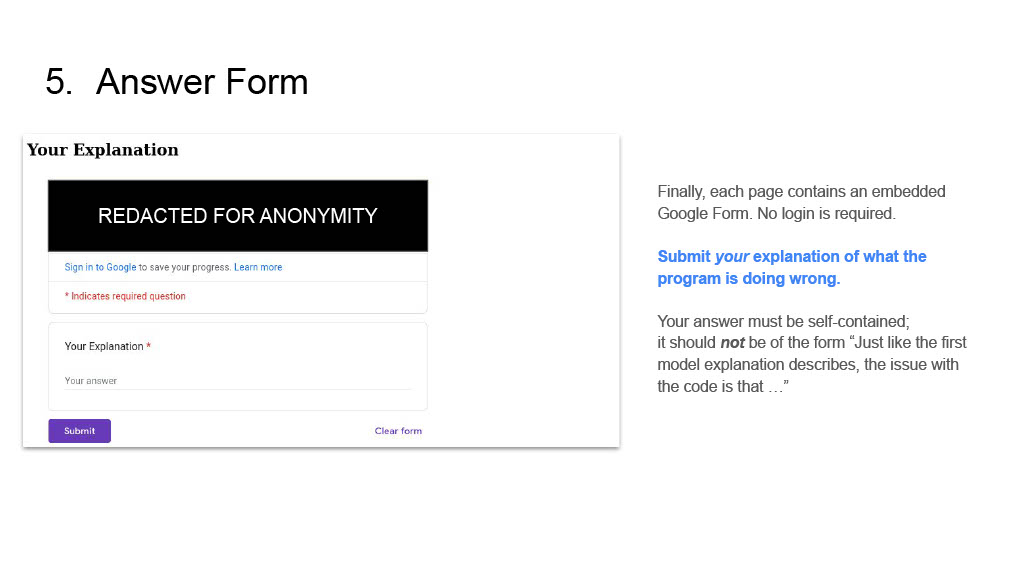
The image is a screenshot of a Google Form titled "Answer Form". It displays a text input field for a user's explanation, along with accompanying instructions. The form is designed to collect explanations of what a program is doing wrong.
### Components/Axes
The screenshot contains the following elements:
* **Title:** "5. Answer Form" (top-left)
* **Section Header:** "Your Explanation"
* **Placeholder Text:** "REDACTED FOR ANONYMITY" (within a black rectangle)
* **Sign-in Prompt:** "Sign in to Google to save your progress. Learn more"
* **Required Field Indicator:** "\* Indicates required question"
* **Input Field Label:** "Your Explanation \*"
* **Input Field Placeholder:** "Your answer"
* **Submit Button:** "Submit" (purple)
* **Clear Form Button:** "Clear form"
* **Instructional Text:** "Finally, each page contains an embedded Google Form. No login is required. Submit your explanation of what the program is doing wrong. Your answer must be self-contained; it should not be of the form “Just like the first model explanation describes, the issue with the code is that …”"
### Detailed Analysis or Content Details
The form is structured as a single required text input field. The placeholder text within the input field has been redacted for anonymity. The form explicitly requests a self-contained explanation of a program's error, discouraging referencing previous explanations.
### Key Observations
The form is simple and straightforward, focusing on collecting a textual explanation. The redaction suggests a concern for user privacy. The instructions emphasize the need for a complete and independent explanation.
### Interpretation
The image depicts a mechanism for gathering feedback or debugging information related to a program. The form's design suggests that the developers are seeking detailed, self-contained explanations of errors, rather than simple confirmations or references to previous reports. The redaction of the placeholder text indicates a commitment to user anonymity. The form is likely part of a larger process involving multiple models or iterations, where each explanation is expected to stand on its own. The emphasis on avoiding references to previous explanations suggests a desire to understand each user's independent perspective on the problem.