\n
## Screenshot: Technical Assessment Answer Form
### Overview
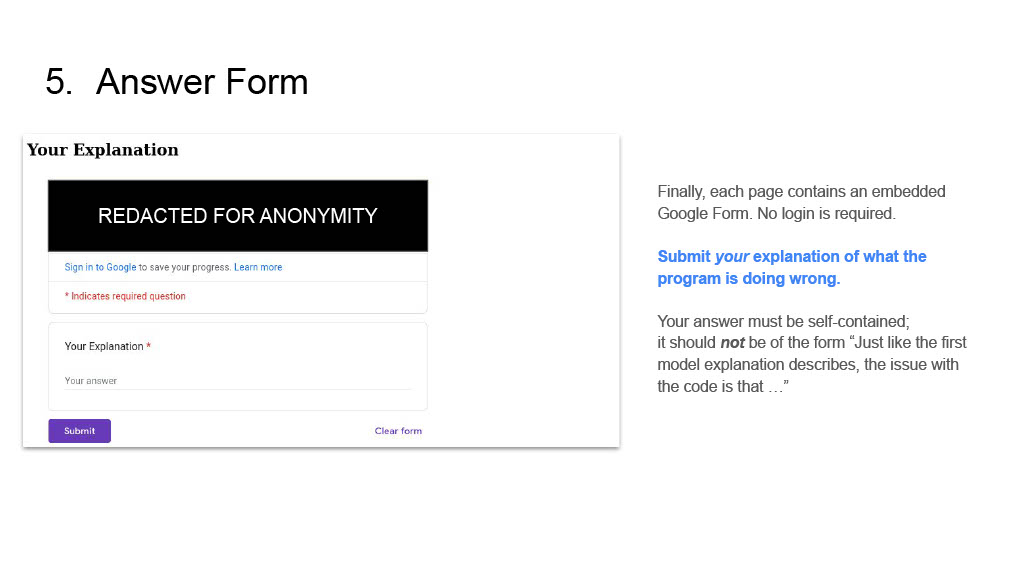
The image is a screenshot of a digital document or webpage section, specifically step "5. Answer Form." It displays an embedded Google Form for user submission alongside explanatory text. The primary purpose is to instruct a user to submit a self-contained explanation of a program's error.
### Components/Axes
The image is divided into two main spatial regions:
1. **Left Region (Approx. 60% width):** Contains the embedded Google Form.
2. **Right Region (Approx. 40% width):** Contains instructional text.
**Left Region - Google Form Elements:**
* **Form Header:** "Your Explanation" (bold, top-left of form frame).
* **Redacted Block:** A black rectangle with white text: "REDACTED FOR ANONYMITY".
* **Sign-in Prompt:** "Sign in to Google to save your progress. Learn more" (blue text, below redacted block).
* **Required Question Indicator:** "* Indicates required question" (red text).
* **Form Field Label:** "Your Explanation *" (asterisk denotes required field).
* **Text Input Field:** Contains placeholder text "Your answer".
* **Action Buttons:**
* "Submit" (purple button, bottom-left).
* "Clear form" (text link, bottom-right).
**Right Region - Instructional Text:**
* **Paragraph 1:** "Finally, each page contains an embedded Google Form. No login is required."
* **Instruction (Blue Text):** "Submit *your explanation* of what the *program is doing wrong*."
* **Paragraph 2:** "Your answer must be self-contained; it should *not* be of the form 'Just like the first model explanation describes, the issue with the code is that …'"
### Content Details
* **Primary Language:** English.
* **Text Transcription (Complete):**
* **Title:** "5. Answer Form"
* **Form Header:** "Your Explanation"
* **Redacted Text:** "REDACTED FOR ANONYMITY"
* **Form UI Text:** "Sign in to Google to save your progress. Learn more", "* Indicates required question", "Your Explanation *", "Your answer", "Submit", "Clear form"
* **Instructional Text:** "Finally, each page contains an embedded Google Form. No login is required.", "Submit *your explanation* of what the *program is doing wrong*.", "Your answer must be self-contained; it should *not* be of the form 'Just like the first model explanation describes, the issue with the code is that …'"
### Key Observations
1. **Anonymity Measure:** A significant portion of the form's header is explicitly "REDACTED FOR ANONYMITY," suggesting the form or its context is part of a process where participant or content identification is deliberately obscured.
2. **Explicit Submission Instructions:** The instructions are highly specific. The answer must be **self-contained** and must **not** reference or defer to a prior "model explanation." This indicates the assessment values independent analysis.
3. **Low Barrier to Entry:** The form explicitly states "No login is required," lowering the friction for submission.
4. **Visual Hierarchy:** The key instruction ("Submit your explanation...") is highlighted in blue and uses italics for emphasis on "your explanation" and "program is doing wrong."
### Interpretation
This image captures a component of a technical evaluation or exercise, likely related to code analysis or debugging. The structure suggests a multi-step process ("5. Answer Form") where the participant has reviewed material (a program, code snippet, or model output) and is now required to articulate their independent diagnosis of its flaw.
The **redaction for anonymity** is a critical detail. It implies the form submissions might be reviewed by multiple parties or used in a context where blinding is necessary to prevent bias—common in research studies, peer reviews, or competitive assessments.
The **strict instruction against referencing a "first model explanation"** is the most revealing element. It frames the task as a test of the user's own reasoning capability, not their ability to summarize or agree with a provided analysis. This is a common design in assessments meant to gauge genuine understanding versus mimicry. The requirement for a "self-contained" answer ensures the evaluator receives the participant's raw, unfiltered thought process.
In essence, this is not just a form; it is the final step in a structured analytical task designed to elicit and capture an independent technical judgment.