## Diagram: Expert Selection Process in a Mixture of Experts Model
### Overview
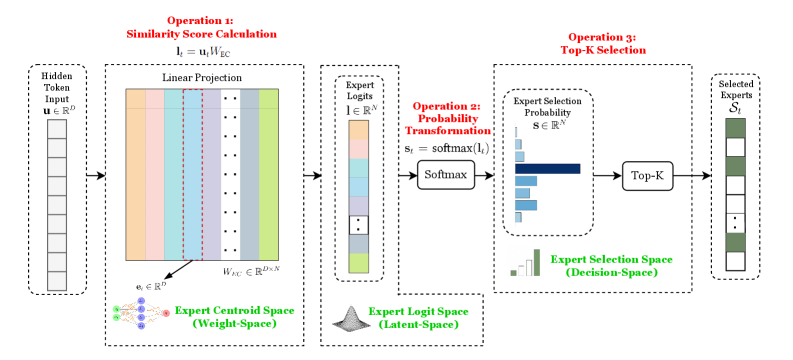
This diagram illustrates a three-stage process for selecting experts in a Mixture of Experts (MoE) architecture. It shows how input tokens are transformed through linear projections, probability calculations, and final expert selection. The process involves three key spaces: Weight-Space (Expert Centroid Space), Latent-Space (Expert Logit Space), and Decision-Space (Expert Selection Space).
### Components/Axes
1. **Input**: Hidden Token Input vector **u** ∈ ℝ<sup>D</sup>
2. **Operation 1: Similarity Score Calculation**
- Linear Projection: **l**_i = **u**_iW_IC
- Visualized as a matrix with colored columns (orange, blue, green, etc.)
3. **Operation 2: Probability Transformation**
- Softmax function: **s**_t = softmax(**l**_i)
- Expert Logits visualized as a color gradient (pink to gray)
4. **Operation 3: Top-K Selection**
- Expert Selection Space (Decision-Space) with probability bars
- Top-K Selected Experts output
**Legend Colors**:
- Orange: Expert 1
- Blue: Expert 2
- Green: Expert 3
- Purple: Expert 4
- Gray: Expert 5
- Pink: High logit values
- Dark Gray: Low logit values
### Detailed Analysis
1. **Similarity Score Calculation**
- Input vector **u** is linearly projected through weight matrix W_IC
- Produces similarity scores **l**_i for each expert
- Visualized as vertical bars with varying heights (expert 1 has highest score)
2. **Probability Transformation**
- Softmax converts logits to probabilities (0-1 range)
- Probability distribution shows expert 1 with highest probability (~0.4)
- Other experts have progressively lower probabilities
3. **Top-K Selection**
- Top-K experts selected based on probability distribution
- Visualized as selected experts (experts 1 and 2 in this case)
- Remaining experts excluded from final selection
### Key Observations
1. Expert 1 consistently has the highest similarity score and probability
2. Probability distribution follows a clear decay pattern across experts
3. Top-K selection creates a binary decision space (selected vs excluded)
4. Color coding maintains consistency across all three operations
### Interpretation
This diagram demonstrates how MoE models dynamically route input tokens to specialized experts. The process shows:
1. **Weight-Space** transformations create expert-specific representations
2. **Latent-Space** logits quantify expert relevance
3. **Decision-Space** makes final selection based on probability thresholds
The softmax normalization ensures probabilistic interpretation of expert selection, while Top-K introduces sparsity in expert usage. This architecture enables efficient computation by activating only relevant experts for each input, balancing model capacity and computational efficiency.
The consistent dominance of Expert 1 suggests potential issues with expert diversity or imbalance in the current configuration. A healthy MoE system would typically show more balanced expert utilization across different input types.