## Diagram: Memory and Action Flow
### Overview
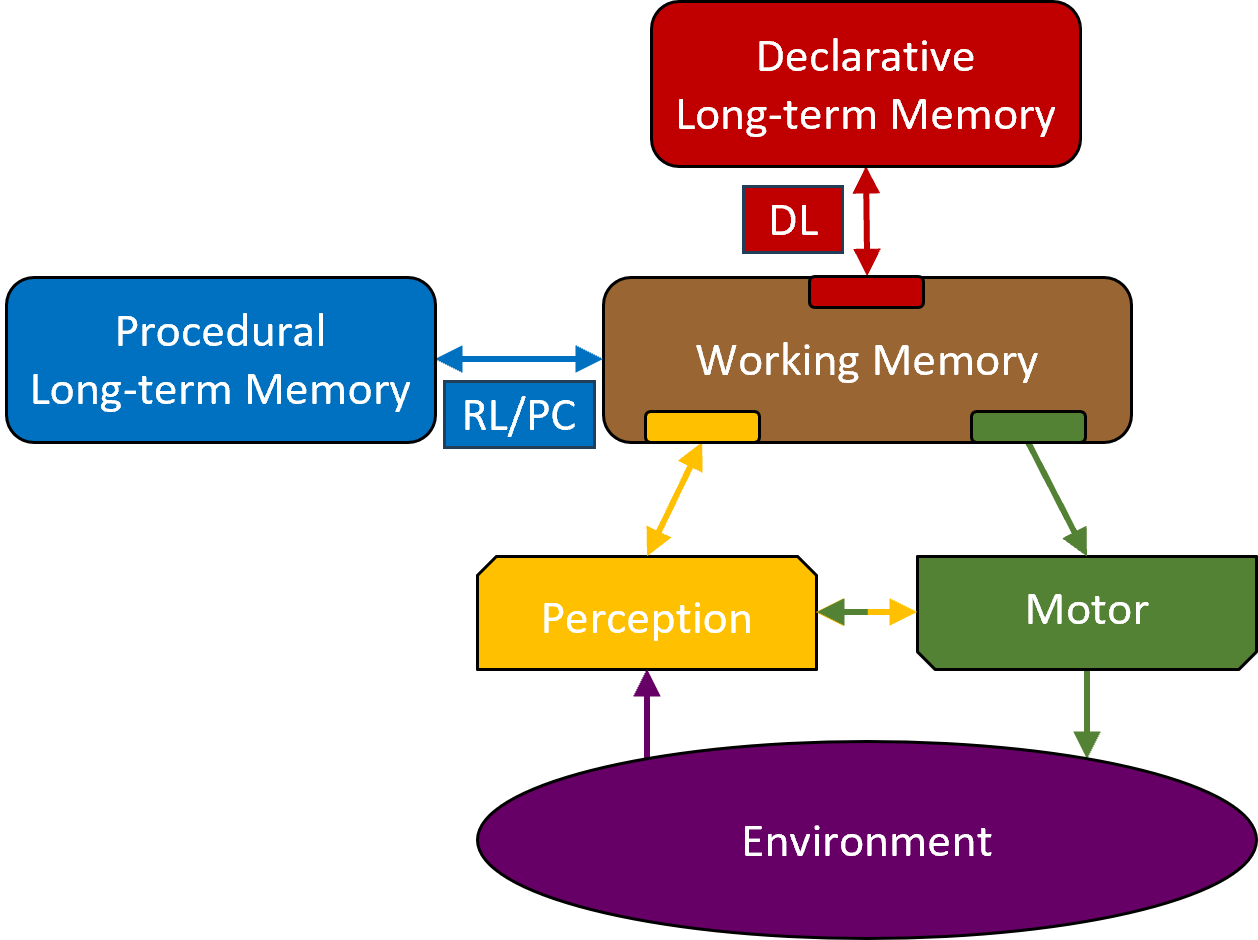
The image is a diagram illustrating the flow of information and actions within a system, likely a cognitive architecture or a model of human behavior. It depicts the interaction between different types of memory (Declarative, Procedural, Working) and processes (Perception, Motor) in relation to an external Environment.
### Components/Axes
* **Nodes:**
* **Declarative Long-term Memory:** Located at the top-center, represented by a red rounded rectangle.
* **Procedural Long-term Memory:** Located on the left, represented by a blue rounded rectangle.
* **Working Memory:** Located in the center, represented by a brown rounded rectangle.
* **Perception:** Located at the bottom-center, represented by a yellow rounded rectangle.
* **Motor:** Located on the right, represented by a green rounded rectangle.
* **Environment:** Located at the bottom, represented by a purple oval.
* **Connectors/Labels:**
* **DL:** A small red rectangle with the label "DL" connects Declarative Long-term Memory and Working Memory, indicating a bidirectional flow.
* **RL/PC:** A small blue rectangle with the label "RL/PC" connects Procedural Long-term Memory and Working Memory, indicating a bidirectional flow.
* Yellow arrows indicate the flow of information from Working Memory to Perception, and between Perception and Motor.
* Green arrows indicate the flow of information from Working Memory to Motor, and from Motor to Environment.
* A purple arrow indicates the flow of information from Environment to Perception.
### Detailed Analysis
* **Declarative Long-term Memory (Red):** Positioned at the top, suggesting a higher-level cognitive function.
* **Procedural Long-term Memory (Blue):** Positioned on the left, interacting with Working Memory.
* **Working Memory (Brown):** Positioned centrally, acting as a hub for information processing. It receives input from both Declarative and Procedural Long-term Memory, and sends output to Perception and Motor.
* **Perception (Yellow):** Positioned below Working Memory, receiving input from the Environment and Working Memory, and sending output to Motor.
* **Motor (Green):** Positioned on the right, receiving input from Working Memory and Perception, and sending output to the Environment.
* **Environment (Purple):** Positioned at the bottom, providing input to Perception and receiving output from Motor.
### Key Observations
* The diagram highlights the central role of Working Memory in integrating information from different memory systems and coordinating actions.
* The bidirectional arrows between memory systems suggest a dynamic interaction and feedback loop.
* The flow of information from the Environment to Perception to Motor to Environment represents a closed-loop system.
### Interpretation
The diagram represents a simplified model of cognitive processing, where information from the environment is perceived, processed in working memory, and used to generate actions. Long-term memory systems (Declarative and Procedural) provide the knowledge and skills necessary for these processes. The "DL" and "RL/PC" labels likely refer to specific mechanisms or processes involved in the interaction between long-term and working memory, such as Declarative Learning and Reinforcement Learning/Procedural Control. The model suggests a continuous cycle of perception, action, and learning, where the system adapts to its environment through experience.