## Diagram: Cognitive Architecture Model
### Overview
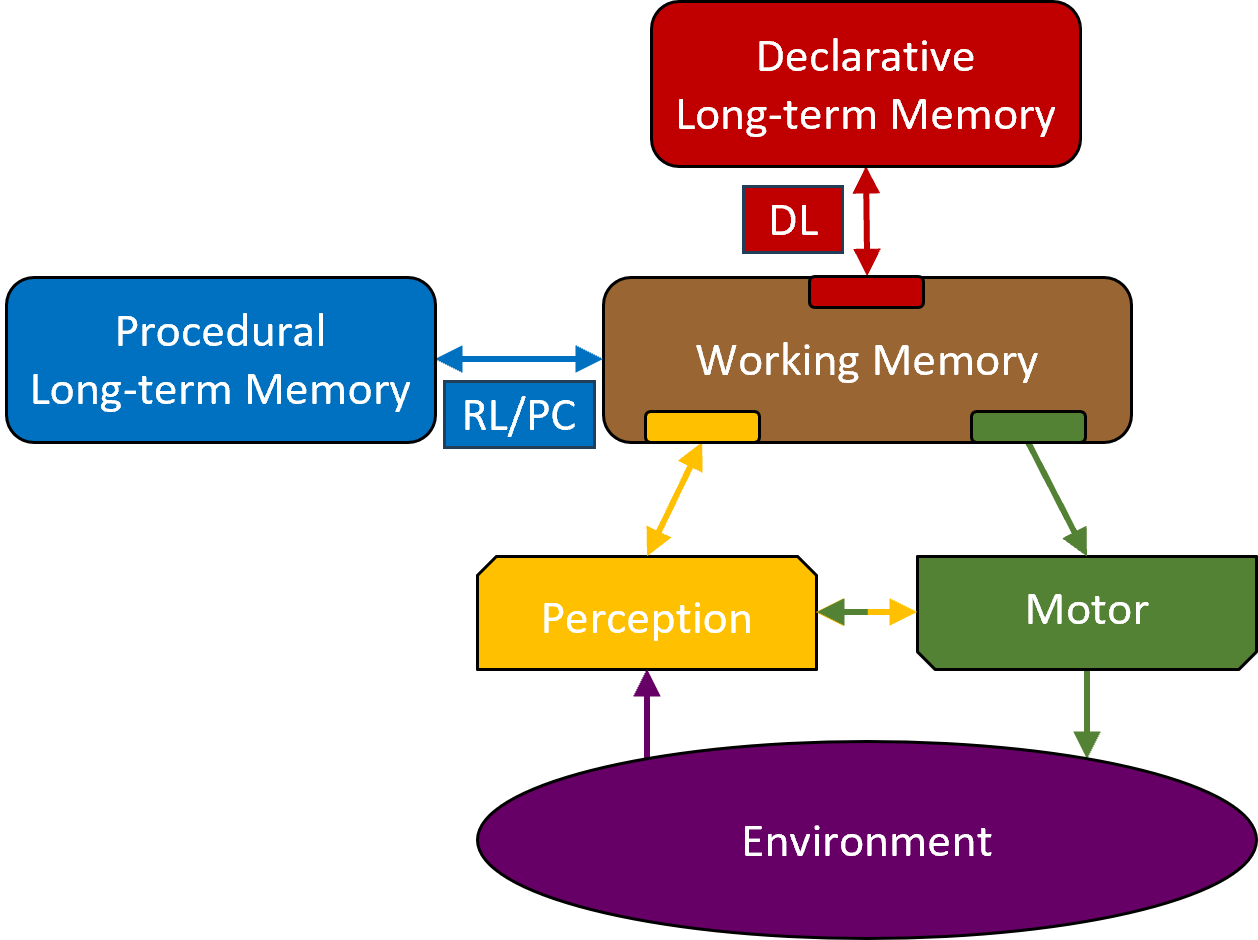
The image is a block diagram illustrating a cognitive architecture model. It depicts the flow of information and interaction between various memory systems (Declarative, Procedural, Working), cognitive processing units (Perception, Motor), and the external environment. The diagram serves as a conceptual framework for how an intelligent agent (human or artificial) processes information, retrieves knowledge, and interacts with its surroundings.
### Components/Axes
The diagram is composed of six primary functional blocks and two interface modules, connected by directional arrows.
**Primary Blocks:**
* **Declarative Long-term Memory (Top):** A red rectangular block.
* **Working Memory (Center):** A brown rectangular block.
* **Procedural Long-term Memory (Left):** A blue rectangular block.
* **Perception (Bottom-Left):** A yellow trapezoidal block.
* **Motor (Bottom-Right):** A green trapezoidal block.
* **Environment (Bottom):** A large purple oval.
**Interface Modules:**
* **DL (Red box):** Located between Declarative Long-term Memory and Working Memory.
* **RL/PC (Blue box):** Located between Procedural Long-term Memory and Working Memory.
### Detailed Analysis
The diagram illustrates a closed-loop system with the following flow and connectivity:
1. **Central Processing (Working Memory):**
* Positioned centrally.
* Acts as the hub for all other components.
* **Connections:**
* **Top:** Connected to "Declarative Long-term Memory" via a red bidirectional arrow passing through the "DL" interface box.
* **Left:** Connected to "Procedural Long-term Memory" via a blue bidirectional arrow passing through the "RL/PC" interface box.
* **Bottom-Left:** Connected to "Perception" via a yellow bidirectional arrow.
* **Bottom-Right:** Connected to "Motor" via a green arrow pointing downward (from Working Memory to Motor).
2. **Input/Output (Perception & Motor):**
* **Perception (Yellow):** Positioned at the bottom-left. It receives input from the "Environment" via a purple arrow pointing upward. It also has a yellow bidirectional arrow connecting it to the "Motor" block.
* **Motor (Green):** Positioned at the bottom-right. It sends output to the "Environment" via a green arrow pointing downward.
3. **Environment (Purple):**
* Positioned at the very bottom. It serves as the source of input (via the purple arrow to Perception) and the destination for output (via the green arrow from Motor).
### Key Observations
* **Centrality of Working Memory:** All cognitive processing and memory retrieval appear to be mediated through the "Working Memory" block, suggesting it is the bottleneck or primary controller of the system.
* **Memory Dichotomy:** The diagram explicitly separates long-term memory into two distinct types: "Declarative" (facts/knowledge) and "Procedural" (skills/actions), which is a standard distinction in cognitive psychology.
* **Closed-Loop Flow:** The system demonstrates a clear cycle: Environment $\rightarrow$ Perception $\rightarrow$ Working Memory $\rightarrow$ Motor $\rightarrow$ Environment.
* **Interface Specialization:** The use of specific interface boxes ("DL" and "RL/PC") suggests that the interaction between Working Memory and Long-term Memory is not direct but requires specific retrieval or processing mechanisms.
### Interpretation
This diagram represents a classic cognitive architecture, likely inspired by models such as ACT-R (Adaptive Control of Thought-Rational).
* **What the data demonstrates:** It illustrates the functional separation of cognitive tasks. "Perception" and "Motor" handle the interface with the physical world, while "Working Memory" handles the immediate processing. The long-term memory stores are "off-line" repositories that are accessed only when needed by the Working Memory.
* **Peircean Investigative Perspective:**
* **The "DL" and "RL/PC" labels:** These are likely abbreviations. "DL" likely stands for "Declarative Learning" or "Declarative Link." "RL/PC" likely stands for "Reinforcement Learning / Procedural Control," suggesting that the procedural memory is updated or accessed via these mechanisms.
* **The Arrows:** The bidirectional arrows (Red, Blue, Yellow) indicate that information can flow both ways (retrieval and storage/updating). The unidirectional arrows (Green, Purple) indicate a specific flow of control or data (e.g., Perception only feeds into the system; Motor only acts upon the environment).
* **System Logic:** The model suggests that an agent cannot act on the environment without first perceiving it and processing that perception through the Working Memory, which is informed by both factual knowledge (Declarative) and skill-based knowledge (Procedural).