\n
## Diagram: Cognitive Architecture Model
### Overview
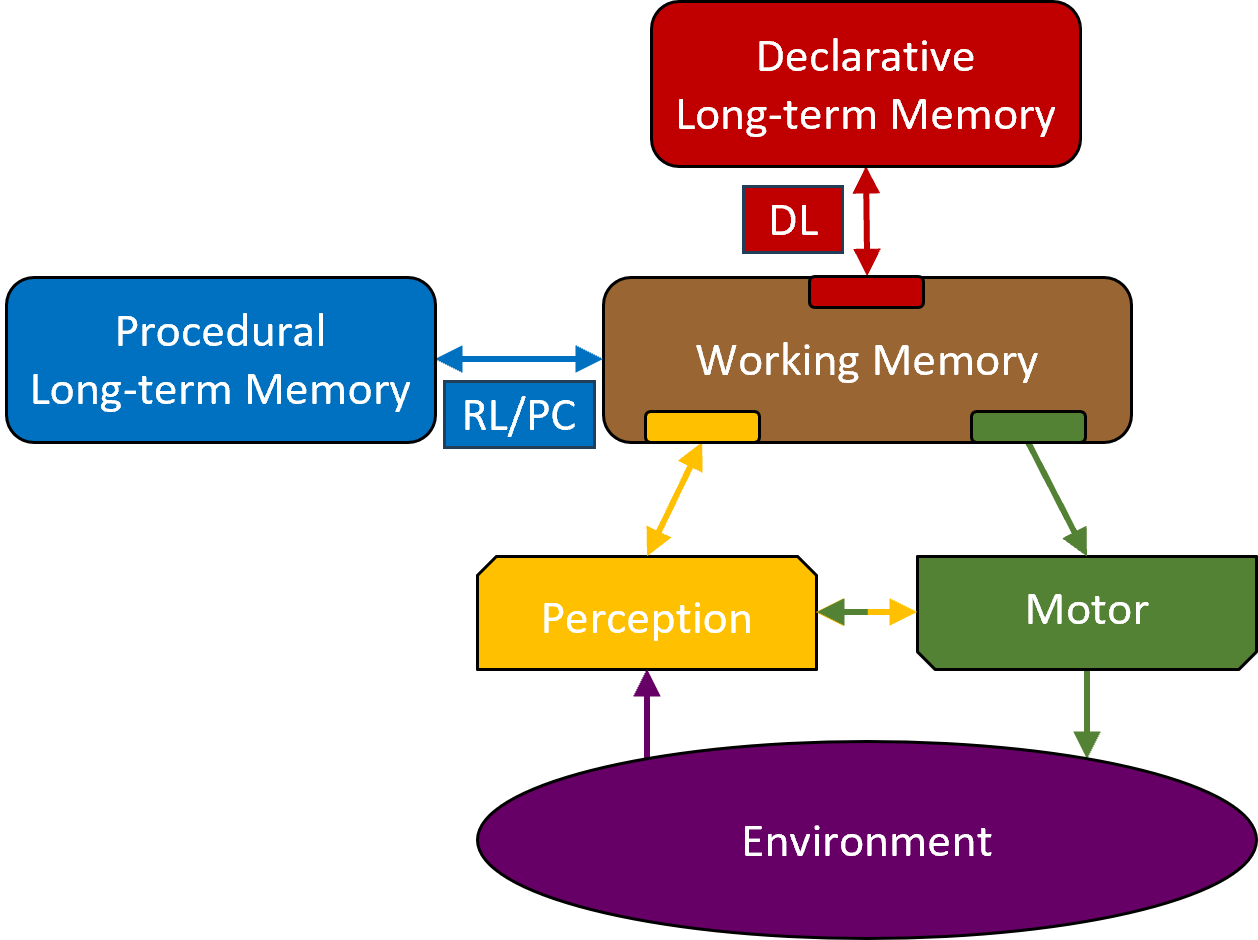
The image depicts a simplified cognitive architecture model illustrating the interaction between different memory systems, perception, motor control, and the environment. It's a flow diagram showing information processing and connections between cognitive components.
### Components/Axes
The diagram consists of the following components:
* **Declarative Long-term Memory:** Represented by a red oval at the top. Contains the label "DL" inside.
* **Procedural Long-term Memory:** Represented by a blue oval on the left. Contains the label "RL/PC" inside.
* **Working Memory:** Represented by a large, light-brown rectangle in the center.
* **Perception:** Represented by a yellow oval below the Working Memory.
* **Motor:** Represented by a green rectangle to the right of Perception.
* **Environment:** Represented by a purple oval at the bottom.
* **Arrows:** Indicate the flow of information between components.
### Detailed Analysis or Content Details
The diagram shows the following connections and information flow:
1. **Declarative Memory to Working Memory:** A red arrow originates from the "Declarative Long-term Memory" (labeled "DL") and points towards the "Working Memory".
2. **Procedural Memory to Working Memory:** A blue arrow originates from the "Procedural Long-term Memory" (labeled "RL/PC") and points towards the "Working Memory".
3. **Working Memory to Perception:** A yellow arrow originates from the "Working Memory" and points towards "Perception".
4. **Perception to Motor:** An orange arrow originates from "Perception" and points towards "Motor".
5. **Motor to Environment:** A green arrow originates from "Motor" and points towards "Environment".
6. **Environment to Perception:** A purple arrow originates from "Environment" and points towards "Perception".
7. **Perception to Working Memory:** A yellow arrow originates from "Perception" and points towards "Working Memory".
8. **Motor to Working Memory:** A green arrow originates from "Motor" and points towards "Working Memory".
### Key Observations
The diagram emphasizes the central role of "Working Memory" as an intermediary between different memory systems ("Declarative" and "Procedural"), sensory input ("Perception"), action output ("Motor"), and the external world ("Environment"). The bidirectional arrows between "Perception" and "Working Memory", and "Motor" and "Working Memory" suggest a feedback loop.
### Interpretation
This diagram illustrates a basic model of human cognition. It suggests that information from the environment is processed through perception, enters working memory, and can then be used to retrieve information from long-term memory (both declarative and procedural). Working memory then influences motor actions, which affect the environment, creating a continuous cycle of perception, cognition, and action. The labels "DL" (Declarative Long-term Memory) and "RL/PC" (Procedural/Reinforcement Learning/Production Component) indicate the types of knowledge stored in long-term memory. The diagram is a high-level representation and doesn't specify the details of the processes within each component. It's a simplified model, likely used for introductory purposes in cognitive science or artificial intelligence. The model suggests a modular architecture where different cognitive functions are handled by distinct components, but these components are highly interconnected.