## Diagram: Cognitive Memory System Architecture
### Overview
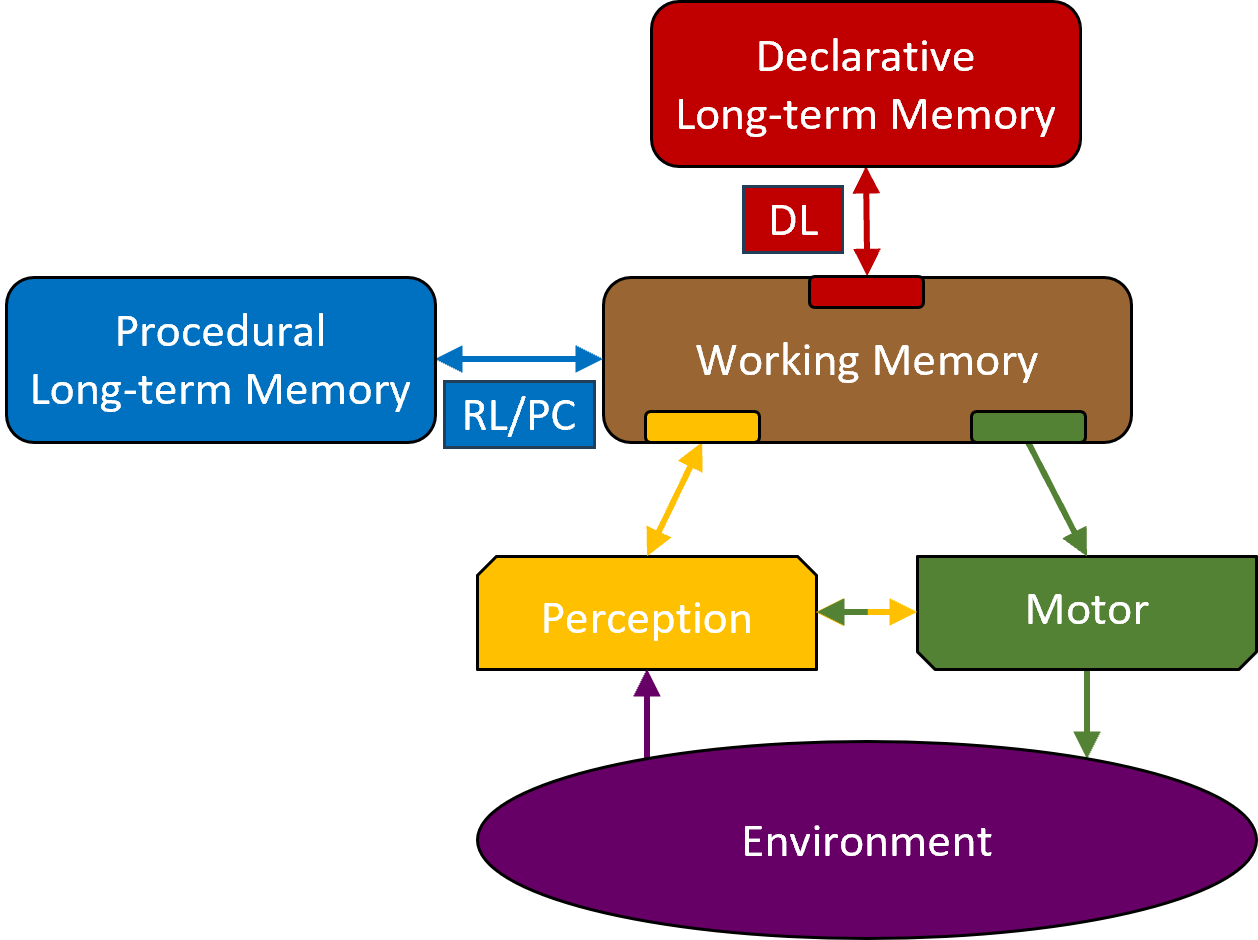
The diagram illustrates a cognitive memory system with interconnected components representing different memory types, perceptual and motor processes, and environmental interactions. Arrows indicate directional relationships and information flow between elements.
### Components/Axes
- **Legend**:
- **Red**: Declarative Long-term Memory (DL)
- **Blue**: Procedural Long-term Memory (RL/PC)
- **Brown**: Working Memory
- **Yellow**: Perception
- **Green**: Motor
- **Purple**: Environment
- **Key Labels**:
- **Declarative Long-term Memory** (top, red box)
- **Procedural Long-term Memory** (left, blue box)
- **Working Memory** (center, brown box)
- **Perception** (yellow box, bottom-center)
- **Motor** (green box, bottom-right)
- **Environment** (purple oval, bottom)
- **Arrows and Connections**:
- **Red arrow**: From Declarative Long-term Memory to Working Memory (labeled "DL").
- **Blue bidirectional arrow**: Between Procedural Long-term Memory and Working Memory (labeled "RL/PC").
- **Yellow arrow**: From Perception to Working Memory.
- **Green arrow**: From Working Memory to Motor.
- **Purple arrow**: From Perception to Environment.
- **Green arrow**: From Motor to Environment.
### Detailed Analysis
- **Declarative Long-term Memory (DL)**:
- Positioned at the top, connected to Working Memory via a red arrow labeled "DL."
- Represents storage of factual knowledge (e.g., semantic memory).
- **Procedural Long-term Memory (RL/PC)**:
- Located on the left, connected to Working Memory via a bidirectional blue arrow labeled "RL/PC."
- Indicates a two-way interaction with Working Memory, likely involving skill-based or habitual memory.
- **Working Memory**:
- Central brown box, acting as a hub for information flow.
- Receives input from Declarative Long-term Memory (red arrow) and Procedural Long-term Memory (blue bidirectional arrow).
- Sends output to Perception (yellow arrow) and Motor (green arrow).
- **Perception**:
- Yellow box at the bottom-center, connected to Working Memory (yellow arrow) and Environment (purple arrow).
- Represents sensory input processing.
- **Motor**:
- Green box at the bottom-right, connected to Working Memory (green arrow) and Environment (green arrow).
- Represents motor output and action execution.
- **Environment**:
- Purple oval at the bottom, connected to Perception (purple arrow) and Motor (green arrow).
- Represents external stimuli and feedback.
### Key Observations
1. **Bidirectional Interaction**: The blue bidirectional arrow between Procedural Long-term Memory and Working Memory suggests a dynamic exchange, possibly involving reinforcement learning (RL) or procedural control (PC).
2. **Unidirectional Flow**: Most arrows (red, yellow, green) indicate one-way information flow, emphasizing hierarchical processing (e.g., perception → working memory → motor).
3. **Environmental Integration**: The Environment is linked to both Perception and Motor, highlighting its role in shaping cognitive processes.
### Interpretation
This diagram models a cognitive architecture where:
- **Declarative and Procedural Memories** feed into **Working Memory**, which integrates and processes information.
- **Perception** and **Motor** systems interact with the **Environment**, creating a feedback loop.
- The **bidirectional link** between Procedural Memory and Working Memory implies that procedural knowledge (e.g., skills) can both influence and be modified by working memory processes.
- The **Environment** acts as an external driver, shaping perception and motor responses, which are then stored in long-term memory systems.
This structure aligns with theories of cognitive processing, emphasizing the interplay between memory, perception, action, and environmental context.