## Diagram: Schematic Layout with Interactive Elements
### Overview
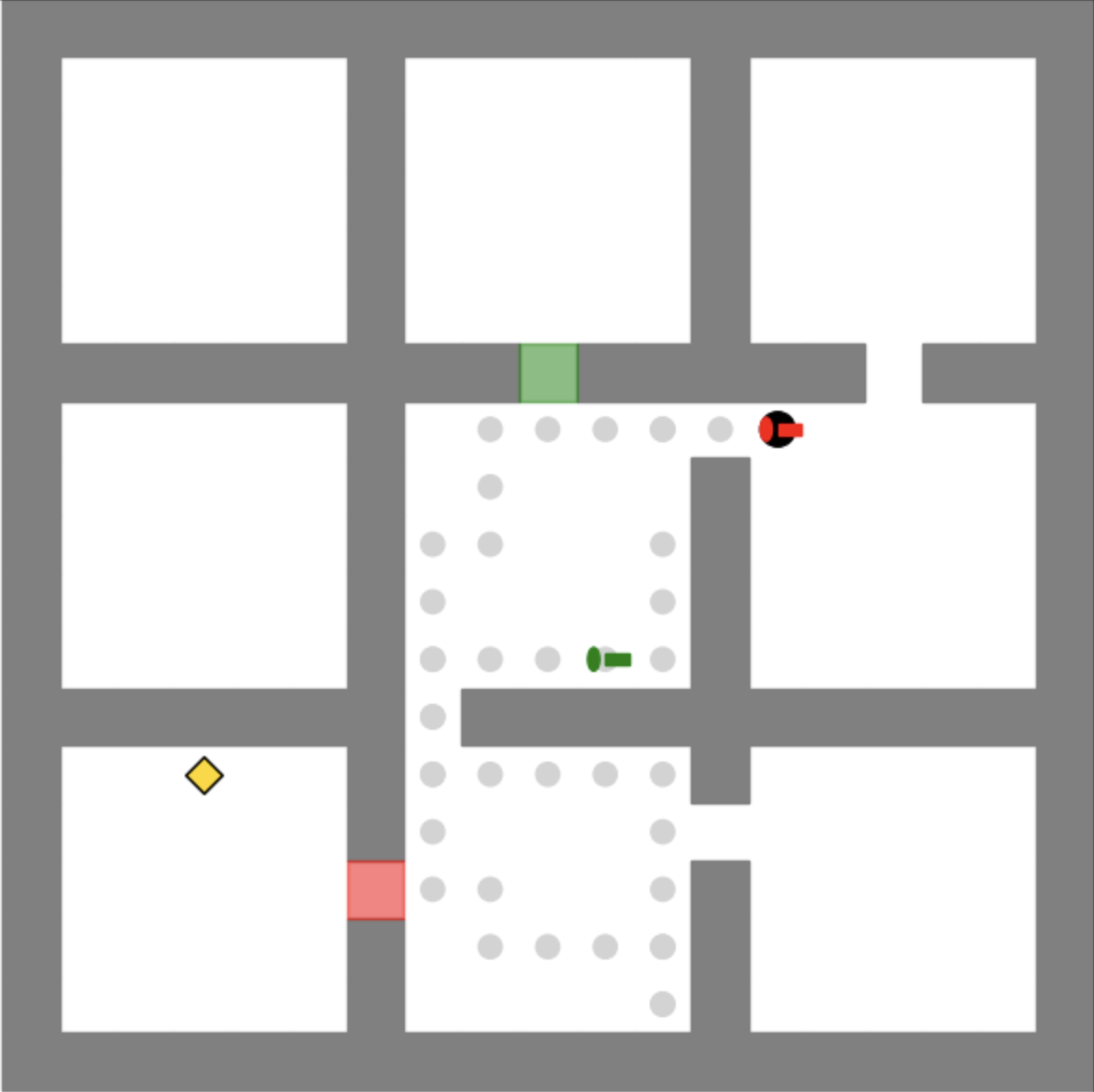
The image displays a top-down schematic diagram, resembling a floor plan, maze, or game level. It consists of a grid of white rectangular "rooms" or areas separated by gray "walls" or pathways. The central room contains a pattern of dots and several colored interactive objects, while other rooms are mostly empty except for one containing a yellow diamond. The layout suggests a navigable space with potential puzzles or tasks involving colored keys, doors, and buttons.
### Components/Axes
* **Grid Structure:** A 3x3 arrangement of white rectangular areas (rooms) set within a darker gray background. The rooms are connected by gray pathways.
* **Central Room:** The most detailed area, containing:
* A pattern of light gray dots arranged in a grid-like formation (approximately 6 columns by 8 rows, though not all positions are filled).
* A **green key-shaped object** positioned horizontally in the lower-middle section of the dot pattern.
* A **red circular object** with a black outline and a small red rectangular protrusion (resembling a button or sensor) located in the upper-right section of the dot pattern.
* **Doors/Barriers:**
* A **green rectangular block** is positioned in the top wall of the central room, connecting it to the room directly above.
* A **red rectangular block** is positioned in the left wall of the central room, connecting it to the room to its left (the bottom-left room).
* **Other Elements:**
* A **yellow diamond shape** is located in the center of the bottom-left room.
* The gray pathways form corridors between the white rooms. Notably, the pathway to the right of the central room has a gap, creating a direct connection between the top-right and middle-right rooms.
### Detailed Analysis
* **Spatial Grounding & Element Placement:**
* **Top-Center:** Green rectangular door/barrier.
* **Bottom-Left (of central room):** Red rectangular door/barrier.
* **Inside Central Room (Upper-Right):** Red circular button/sensor.
* **Inside Central Room (Lower-Middle):** Green key.
* **Bottom-Left Room:** Yellow diamond.
* **Flow and Connectivity:** The diagram implies movement between rooms via the gray pathways and through the colored doors. The green door at the top of the central room and the red door on its left are the only visible connections to adjacent rooms from the central area. The gap in the right-side pathway provides an alternate route between the top-right and middle-right rooms without passing through the central room.
### Key Observations
1. **Color-Coded Interactivity:** The use of distinct colors (green, red, yellow) for specific objects strongly suggests they are interactive elements with related functions. For example, the green key may be used to operate the green door, and the red button may control the red door or another mechanism.
2. **Asymmetrical Layout:** While based on a grid, the layout is not perfectly symmetrical. The central room is the only one with internal details (dots and objects). The pathway on the right has a unique gap, and only two of the central room's walls have doors.
3. **Dot Pattern:** The grid of dots in the central room could represent tiles, a movement grid, positions for object placement, or simply a visual texture to denote a special area.
4. **Isolated Goal/Objective:** The yellow diamond in the otherwise empty bottom-left room stands out as a potential goal, collectible, or point of interest that the user/agent might need to reach.
### Interpretation
This diagram is most likely a **level design for a puzzle game or a navigational task**. The elements suggest a sequence of actions:
* The **green key** inside the central room is probably required to unlock the **green door** above it, granting access to the top-center room.
* The **red button** inside the central room might control the **red door** to its left, or perhaps toggle another element in the environment.
* The **yellow diamond** in the bottom-left room appears to be an objective. Reaching it might require navigating through the red door from the central room.
* The dot grid in the central room may constrain movement or indicate valid positions for the key and button.
The overall flow suggests a player or agent starts in an unknown location (perhaps one of the outer rooms), must enter the central room (possibly via an unseen entrance), acquire the key, use the button, and navigate through the unlocked doors to retrieve the diamond. The gap in the right-side pathway offers an alternative route that bypasses the central room's puzzles, which could be a shortcut or a red herring. The design emphasizes color association and spatial reasoning to progress.