## Diagram: Grid Layout with Colored Markers and Pathways
### Overview
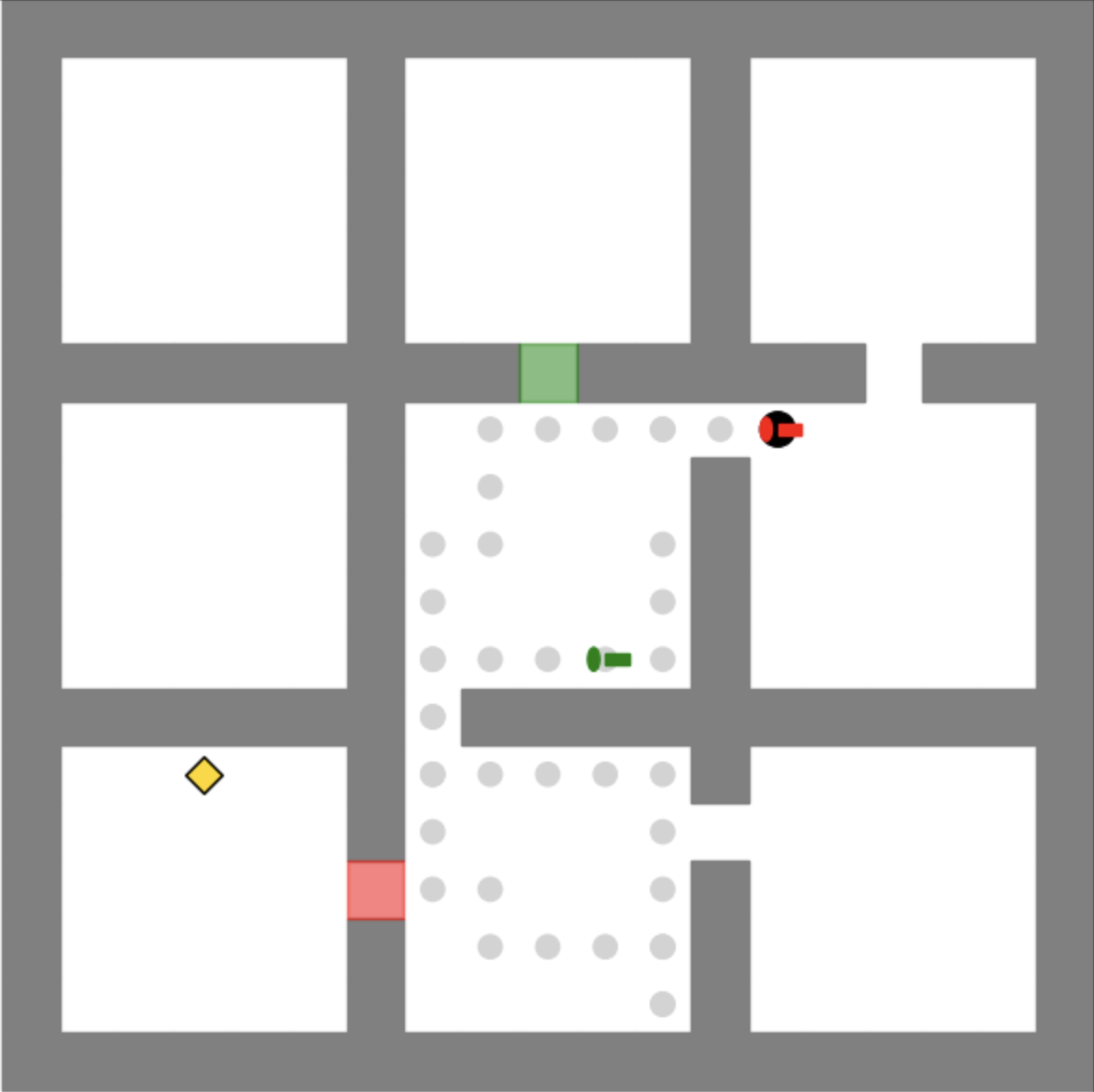
The image depicts a grid-based layout resembling a maze or navigation map. It features interconnected rooms (white squares) separated by gray pathways. Key elements include colored markers (red, green, yellow), gray circular checkpoints, and a black circular start/end point. The layout suggests a structured path or progression system, possibly for a game or instructional diagram.
### Components/Axes
- **Legend** (bottom-left corner):
- **Red**: Person (circular with a black outline and red fill).
- **Green**: Key (small green rectangle).
- **Yellow**: Treasure (small yellow diamond).
- **Gray**: Checkpoints (small gray circles).
- **Black**: Start/End point (large black circle).
- **Grid Structure**:
- **Rooms**: 9 white squares arranged in a 3x3 grid.
- **Pathways**: Gray lines connecting rooms, forming a labyrinthine structure.
- **Checkpoints**: Gray circles clustered along pathways, forming a secondary path.
### Detailed Analysis
1. **Start/End Point**:
- Located at the top-right corner (black circle).
- Connected to a pathway leading to the central cluster of checkpoints.
2. **Checkpoints**:
- Approximately 20 gray circles form a winding path from the start/end point to the green key (middle-left) and yellow treasure (bottom-left).
- The path loops around the grid, suggesting a required sequence to reach the treasure.
3. **Key and Treasure**:
- **Green Key**: Positioned in the middle-left room, adjacent to the checkpoint path.
- **Yellow Treasure**: Located in the bottom-left room, isolated from direct pathways.
4. **Person**:
- Red circular figure positioned near the top-right room, adjacent to the start/end point.
- Appears to be moving toward the checkpoint path.
### Key Observations
- The checkpoint path (gray circles) acts as a secondary route, bypassing some rooms.
- The treasure (yellow diamond) is only accessible via the checkpoint path, not direct pathways.
- The person’s proximity to the start/end point suggests they may be initiating a journey.
### Interpretation
This diagram likely represents a simplified game map or instructional layout. The start/end point (black circle) and checkpoint path (gray circles) imply a structured progression, where the player must collect the green key (middle-left) before accessing the yellow treasure (bottom-left). The person’s position near the start/end point indicates they are at the beginning of this sequence. The absence of direct pathways to the treasure emphasizes the need to follow the checkpoint route, possibly simulating a puzzle or challenge. The grid’s symmetry and labeled elements suggest a focus on spatial reasoning or pathfinding mechanics.