\n
## Diagram: Block Arrangement
### Overview
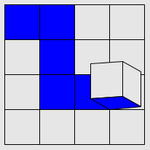
The image depicts a 4x4 grid of squares. Some squares are filled with a solid blue color, while others are left empty (white). A three-dimensional, open-topped cube shape is positioned within the grid, partially overlapping some of the squares. The cube appears to be "cut out" of the grid, creating a visual impression of depth.
### Components/Axes
There are no explicit axes or labels. The grid itself forms the primary structure. The components are:
* **Grid:** A 4x4 arrangement of squares.
* **Filled Squares:** Squares colored solid blue.
* **Empty Squares:** Squares left white.
* **Cube:** A three-dimensional, open-topped cube shape.
### Detailed Analysis or Content Details
The blue filled squares form an "L" shape. The L shape occupies the following grid positions (row, column, starting from 1):
* (1, 1)
* (1, 2)
* (1, 3)
* (2, 3)
* (3, 3)
* (3, 2)
* (3, 1)
The cube is positioned in the bottom-right quadrant of the grid. It occupies the following grid positions:
* (3, 4)
* (4, 4)
* (4, 3)
* (3, 3) - partially overlapping with the blue square.
The cube's edges are defined by darker shading, suggesting a light source from the top-left.
### Key Observations
The blue "L" shape and the cube create a visual contrast. The cube appears to be "removing" or "carving out" space from the grid, as it overlaps with the blue filled square. The arrangement is symmetrical in a way, with the L shape and the cube balancing each other visually.
### Interpretation
This diagram likely represents a spatial reasoning puzzle or a visual demonstration of geometric concepts. The arrangement could illustrate:
* **Subtraction of volume:** The cube represents a volume being removed from a larger structure (the grid).
* **Shape interaction:** The relationship between the "L" shape and the cube demonstrates how different shapes can interact and overlap in space.
* **Perspective and depth:** The shading on the cube creates a sense of three-dimensionality, illustrating how perspective can be used to represent depth on a two-dimensional surface.
The diagram does not contain any numerical data or specific measurements. It is a purely visual representation of spatial relationships. The arrangement is simple, but it effectively conveys concepts related to geometry, volume, and perspective. It could be used as a teaching aid or as part of a more complex puzzle.