## Diagram: 2D Grid with 3D Cube Overlay
### Overview
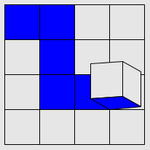
The image depicts a 4x4 grid of squares, with 5 squares colored blue and the remaining 11 in white. A 3D cube is superimposed on the grid, positioned diagonally across the bottom-right quadrant. The cube has a light blue base and a white top, with visible shading to indicate depth. No textual labels, legends, or axis markers are present.
### Components/Axes
- **Grid Structure**:
- 4 rows and 4 columns of squares.
- Squares are uniformly sized, with thin black borders separating them.
- **3D Cube**:
- Positioned diagonally, spanning the intersection of the third and fourth rows/columns.
- Base color: light blue (matching the blue squares in the grid).
- Top face: white, with shading to simulate a light source from the upper-left.
### Detailed Analysis
- **Blue Squares**:
- Located at grid coordinates:
- (1,1), (1,2), (2,2), (3,2), (3,3).
- No discernible pattern (e.g., no diagonal, row, or column alignment).
- **Cube Placement**:
- Overlaps the grid at the intersection of the third and fourth rows/columns.
- Base aligns with the blue square at (3,3), suggesting a connection between the 2D and 3D elements.
### Key Observations
1. The cube’s light blue base matches the color of the blue squares, implying a thematic or functional relationship.
2. The cube’s diagonal orientation creates a sense of depth, contrasting with the flat grid.
3. No explicit labels or legends are present, leaving the purpose of the diagram ambiguous.
### Interpretation
This diagram likely represents a conceptual or abstract visualization, possibly related to:
- **3D Modeling**: Demonstrating how a 2D grid can be extended into 3D space.
- **Data Visualization**: The blue squares might symbolize "active" or "selected" elements, with the cube representing a derived or aggregated value.
- **Interactive Interface**: The cube could symbolize a user action (e.g., selecting a subset of data).
The absence of labels or numerical data prevents definitive conclusions. However, the alignment of the cube’s base with the blue square at (3,3) suggests a deliberate relationship between the 2D and 3D elements, potentially indicating a transformation or projection process.