## Chart/Diagram Type: Comparison of Reasoning Chain Evaluation
### Overview
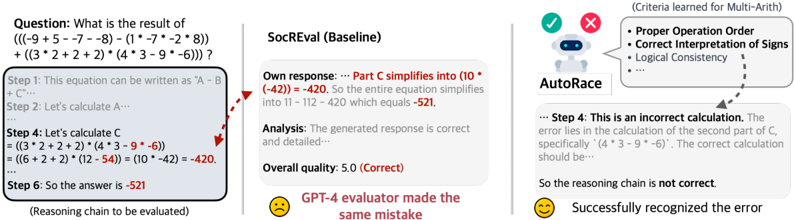
The image presents a comparison of how different systems (SocREval and AutoRace) evaluate the reasoning chain of a solution to a mathematical problem. It highlights a scenario where GPT-4 evaluator made the same mistake.
### Components/Axes
* **Question:** A complex arithmetic expression is presented.
* **Reasoning Chain (Left):** Shows the steps taken to solve the problem, with intermediate calculations.
* **SocREval (Baseline) (Center):** Displays the system's response, analysis, and overall quality assessment.
* **AutoRace (Right):** Shows AutoRace's evaluation, including error detection and reasoning chain assessment.
* **(Criteria learned for Multi-Arith) (Top-Right):** Lists the criteria used for evaluation: Proper Operation Order, Correct Interpretation of Signs, and Logical Consistency.
### Detailed Analysis or ### Content Details
**1. Question and Reasoning Chain (Left):**
* **Question:** What is the result of (((-9+5+-7-8)-(1\*-7\*-2\*8))+((3\*2+2+2)\*(4\*3-9\*-6))) ?
* **Step 1:** This equation can be written as "A - B + C"...
* **Step 2:** Let's calculate A...
* **Step 4:** Let's calculate C = ((3\*2+2+2)\*(4\*3-9\*-6)) = ((6+2+2)\*(12-54)) = (10\*-42) = -420.
* **Step 6:** So the answer is -521
* **(Reasoning chain to be evaluated)**
**2. SocREval (Baseline) (Center):**
* **Own response:** ... Part C simplifies into (10 \* (-42)) = -420. So the entire equation simplifies into 11 - 112 - 420 which equals -521.
* **Analysis:** The generated response is correct and detailed...
* **Overall quality:** 5.0 (Correct)
* **GPT-4 evaluator made the same mistake** (indicated by a sad face emoji)
**3. AutoRace (Right):**
* AutoRace icon with a green checkmark and a red X.
* **(Criteria learned for Multi-Arith):**
* Proper Operation Order
* Correct Interpretation of Signs
* Logical Consistency
* **Step 4:** This is an incorrect calculation. The error lies in the calculation of the second part of C, specifically '(4\*3-9\*-6)'. The correct calculation should be...
* So the reasoning chain is not correct.
* Successfully recognized the error (indicated by a happy face emoji)
### Key Observations
* SocREval incorrectly identifies the solution as correct, despite an error in the intermediate calculation of 'C'.
* AutoRace correctly identifies the error in the calculation of 'C' and flags the reasoning chain as incorrect.
* GPT-4 evaluator made the same mistake as SocREval.
### Interpretation
The image demonstrates a scenario where a baseline system (SocREval) fails to identify an error in a complex arithmetic problem, while another system (AutoRace) successfully detects the mistake. This highlights the importance of robust error detection mechanisms in automated reasoning systems. The fact that GPT-4 evaluator made the same mistake as SocREval suggests that even advanced models can be susceptible to similar errors. The criteria listed (Proper Operation Order, Correct Interpretation of Signs, Logical Consistency) are crucial for accurate evaluation of mathematical reasoning.