## Bar Chart: Instances of Correct and Incorrect Labels
### Overview
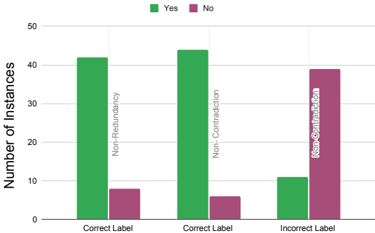
This bar chart displays the number of instances categorized by whether a label was deemed "Yes" or "No," further broken down by whether the label was "Correct Label" or "Incorrect Label." The chart also includes annotations indicating "Non-Redundancy" and "Non-Contradiction."
### Components/Axes
* **Y-axis Title:** "Number of Instances"
* **Y-axis Scale:** Ranges from 0 to 50, with major tick marks at 0, 10, 20, 30, 40, and 50.
* **X-axis Categories:**
* "Correct Label" (appears twice)
* "Incorrect Label"
* **Legend:** Located at the top-center of the chart.
* Green square: "Yes"
* Purple square: "No"
* **Annotations:**
* "Non-Redundancy" (positioned vertically between the first two "Correct Label" bars)
* "Non-Contradiction" (positioned vertically between the second "Correct Label" bar and the "Incorrect Label" bar)
* "Non-Contradiction" (positioned vertically on top of the purple bar for "Incorrect Label")
### Detailed Analysis
The chart presents three main groups of bars along the x-axis:
1. **First "Correct Label" Group:**
* **"Yes" (Green Bar):** Approximately 42 instances. This bar is annotated with "Non-Redundancy."
* **"No" (Purple Bar):** Approximately 8 instances.
2. **Second "Correct Label" Group:**
* **"Yes" (Green Bar):** Approximately 44 instances. This bar is annotated with "Non-Contradiction."
* **"No" (Purple Bar):** Approximately 5 instances.
3. **"Incorrect Label" Group:**
* **"Yes" (Green Bar):** Approximately 11 instances.
* **"No" (Purple Bar):** Approximately 39 instances. This bar is annotated with "Non-Contradiction."
### Key Observations
* For "Correct Label" instances, the "Yes" category significantly outnumbers the "No" category in both occurrences.
* The "Incorrect Label" category shows a stark reversal, with the "No" category having a much higher number of instances than the "Yes" category.
* The annotations "Non-Redundancy" and "Non-Contradiction" are associated with "Correct Label" instances and one "Incorrect Label" instance, respectively.
### Interpretation
This chart appears to be analyzing the outcomes of a labeling process, likely in a machine learning or data annotation context.
* **High "Yes" for Correct Labels:** The high number of "Yes" instances when the label is "Correct Label" suggests that the labeling system or process is generally accurate and produces the expected outcome when it is correct. The "Non-Redundancy" annotation on the first "Correct Label" group might imply that these instances are unique and not repetitive, while "Non-Contradiction" on the second "Correct Label" group could indicate that these correct labels do not conflict with other information or rules.
* **Low "No" for Correct Labels:** The low number of "No" instances for "Correct Label" suggests that when the label is indeed correct, the system rarely fails to identify it as such.
* **Reversal for Incorrect Labels:** The dramatic shift in the "Incorrect Label" category, with a high number of "No" instances and a low number of "Yes" instances, indicates that the system is much more likely to classify an incorrect label as "No" rather than "Yes." This could be interpreted as a form of robustness or a bias towards caution when dealing with potentially incorrect information.
* **"Non-Contradiction" on Incorrect Label:** The "Non-Contradiction" annotation on the "No" bar for "Incorrect Label" is particularly interesting. It suggests that even when a label is incorrect, the system's classification of it as "No" does not lead to a contradiction within the system's overall logic or data. This could imply that the system is designed to handle incorrect inputs gracefully without creating inconsistencies.
In essence, the data suggests that the system is effective at identifying correct labels (mostly resulting in "Yes") and is also adept at flagging incorrect labels (mostly resulting in "No"), thereby avoiding contradictions. The distribution implies a system that is either well-trained to recognize correct patterns or has a conservative approach to classifying labels.