\n
## Bar Chart: Label Consistency Analysis
### Overview
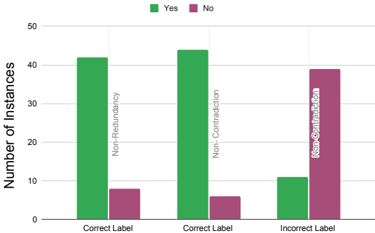
This is a bar chart comparing the number of instances of "Non-Redundancy", "Non-Contradiction", and "Non-Contradiction" across "Correct Label" and "Incorrect Label" categories. The chart uses green bars to represent "Yes" instances and purple bars to represent "No" instances. The y-axis represents the "Number of Instances", ranging from 0 to 50. The x-axis represents the categories being compared.
### Components/Axes
* **X-axis:** Label Consistency - Categories: "Correct Label", "Correct Label", "Incorrect Label". Each category has two sub-categories: "Non-Redundancy", "Non-Contradiction", and "Non-Contradiction".
* **Y-axis:** Number of Instances (Scale: 0 to 50, increments of 10).
* **Legend:**
* Green: Yes
* Purple: No
* **Chart Title:** (Not explicitly present, but implied to be related to label consistency)
### Detailed Analysis
The chart consists of three sets of paired bars, one for each category on the x-axis.
* **Correct Label - Non-Redundancy:** The green bar (Yes) reaches approximately 43 instances. The purple bar (No) reaches approximately 10 instances. The green bar is significantly taller than the purple bar.
* **Correct Label - Non-Contradiction:** The green bar (Yes) reaches approximately 46 instances. The purple bar (No) reaches approximately 8 instances. The green bar is significantly taller than the purple bar.
* **Incorrect Label - Non-Contradiction:** The green bar (Yes) reaches approximately 15 instances. The purple bar (No) reaches approximately 39 instances. The purple bar is significantly taller than the green bar.
### Key Observations
* For both "Correct Label" categories ("Non-Redundancy" and "Non-Contradiction"), the number of "Yes" instances is substantially higher than the number of "No" instances.
* For the "Incorrect Label" category ("Non-Contradiction"), the number of "No" instances is substantially higher than the number of "Yes" instances.
* The difference between "Yes" and "No" instances is most pronounced in the "Incorrect Label" category.
### Interpretation
The data suggests a strong correlation between label correctness and consistency. When labels are correct, instances of non-redundancy and non-contradiction are prevalent ("Yes" instances dominate). Conversely, when labels are incorrect, instances of non-contradiction are rare ("No" instances dominate). This indicates that incorrect labels are often associated with contradictory information. The chart demonstrates that label quality is a critical factor in maintaining data consistency. The large difference in the "Incorrect Label" category suggests that incorrect labels are a significant source of inconsistency. This could be due to errors in the labeling process or inherent ambiguity in the data itself. Further investigation into the reasons for incorrect labeling is warranted.