## Grouped Bar Chart: Instance Counts by Label Correctness and Condition
### Overview
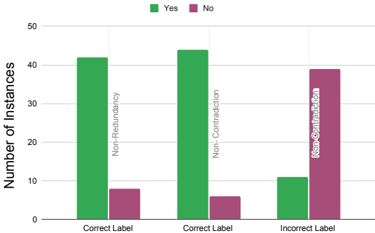
The image displays a grouped bar chart comparing the number of instances labeled "Yes" (green) versus "No" (purple) across three distinct categories. The categories are defined by the correctness of a label ("Correct Label" or "Incorrect Label") and a specific condition ("Non-Redundancy" or "Non-Contradiction"). The chart visually demonstrates a strong relationship between label correctness and the frequency of "Yes" responses.
### Components/Axes
* **Chart Type:** Grouped Bar Chart.
* **Y-Axis:**
* **Label:** "Number of Instances"
* **Scale:** Linear scale from 0 to 50, with major tick marks at intervals of 10 (0, 10, 20, 30, 40, 50).
* **X-Axis:**
* **Primary Categories (Groups):** Three groups are displayed from left to right.
1. "Correct Label" (with vertical annotation: "Non-Redundancy")
2. "Correct Label" (with vertical annotation: "Non-Contradiction")
3. "Incorrect Label" (with vertical annotation: "Non-Contradiction")
* **Sub-Categories (Bars within groups):** Each group contains two bars.
* **Legend:**
* **Position:** Top center of the chart area.
* **Items:**
* Green square: "Yes"
* Purple square: "No"
* **Annotations:** Vertical text is placed within each group, between the two bars, specifying the condition being measured.
### Detailed Analysis
**Group 1: Correct Label (Non-Redundancy)**
* **"Yes" (Green Bar):** The bar extends to approximately **42** on the Y-axis.
* **"No" (Purple Bar):** The bar is significantly shorter, reaching approximately **8**.
* **Trend:** A strong majority of instances are classified as "Yes" for Non-Redundancy when the label is correct.
**Group 2: Correct Label (Non-Contradiction)**
* **"Yes" (Green Bar):** This is the tallest green bar, reaching approximately **44**.
* **"No" (Purple Bar):** This is the shortest purple bar, at approximately **6**.
* **Trend:** An even stronger majority of "Yes" instances for Non-Contradiction under correct labeling compared to the Non-Redundancy condition.
**Group 3: Incorrect Label (Non-Contradiction)**
* **"Yes" (Green Bar):** This is the shortest green bar, at approximately **11**.
* **"No" (Purple Bar):** This is the tallest purple bar, reaching approximately **39**.
* **Trend:** The pattern reverses dramatically. When the label is incorrect, the vast majority of instances are classified as "No" for Non-Contradiction.
### Key Observations
1. **Inverse Relationship:** There is a clear inverse relationship between the "Yes" and "No" counts across the "Correct Label" and "Incorrect Label" conditions. Correct labels correlate with high "Yes" counts, while incorrect labels correlate with high "No" counts.
2. **Condition Comparison:** For correct labels, the "Non-Contradiction" condition shows a slightly higher "Yes" count (~44) and a lower "No" count (~6) than the "Non-Redundancy" condition (~42 and ~8, respectively).
3. **Dominant Series:** The "Yes" series (green) dominates the first two groups, while the "No" series (purple) dominates the third group.
4. **Data Range:** All data points fall between approximately 6 and 44 instances.
### Interpretation
The data suggests that the process of assigning a "Correct Label" is highly effective at identifying instances that satisfy the conditions of "Non-Redundancy" and, especially, "Non-Contradiction." Conversely, an "Incorrect Label" is strongly associated with a failure to meet the "Non-Contradiction" condition.
This chart likely evaluates the performance of a labeling system, model, or human annotators. The high "Yes" counts for correct labels indicate good precision for those conditions. The stark reversal in the "Incorrect Label" group acts as a validation check, showing that when the label is wrong, the underlying condition (Non-Contradiction) is also frequently not met. The minor difference between the two "Correct Label" groups might indicate that ensuring "Non-Contradiction" is slightly more straightforward or consistently achieved than ensuring "Non-Redundancy" within this dataset. The chart effectively communicates that label correctness is a strong predictor of the instance's status regarding these specific logical conditions.