## Bar Chart: Number of Instances
### Overview
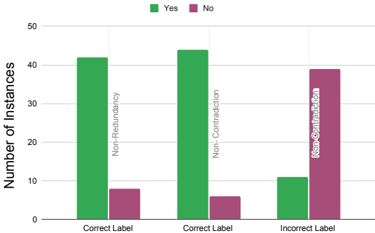
The bar chart displays the number of instances of three different categories: Correct Label, Non-Redundancy, Non-Contradiction, and Incorrect Label. The categories are represented by two bars each, one for "Yes" and one for "No".
### Components/Axes
- **Y-axis**: Number of Instances
- **X-axis**: Categories (Correct Label, Non-Redundancy, Non-Contradiction, Incorrect Label)
- **Legend**: Two bars for "Yes" and "No" in green and purple, respectively.
### Detailed Analysis or ### Content Details
- **Correct Label**: The bar for "Yes" is significantly higher than the "No" bar, indicating a higher number of instances with the correct label.
- **Non-Redundancy**: The "Yes" bar is slightly higher than the "No" bar, suggesting a higher number of instances with non-redundant labels.
- **Non-Contradiction**: The "Yes" bar is the highest, indicating the most instances with non-contradictory labels.
- **Incorrect Label**: The "No" bar is the highest, suggesting the most instances with incorrect labels.
### Key Observations
- The "Correct Label" category has the highest number of instances, followed by "Non-Contradiction".
- The "Non-Redundancy" category has the second highest number of instances.
- The "Incorrect Label" category has the lowest number of instances.
### Interpretation
The data suggests that the majority of instances are correctly labeled, with non-contradictory labels being the most common. The number of instances with non-redundant labels is slightly higher than those with incorrect labels. This could indicate that the labeling process is generally accurate, but there may be some instances where the labels are not as precise as desired.