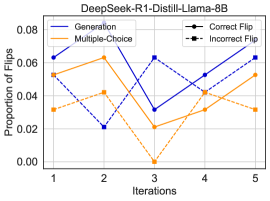
## Chart Type: Line Chart: Proportion of Flips over Iterations for DeepSeek-R1-Distill-Llama-8B
### Overview
This image displays a line chart illustrating the "Proportion of Flips" across five "Iterations" for a model identified as "DeepSeek-R1-Distill-Llama-8B". Four distinct metrics are tracked: "Generation", "Multiple-Choice", "Correct Flip", and "Incorrect Flip", each represented by a unique line style and marker. The chart shows how these proportions change over sequential iterations, highlighting trends and specific data points for each metric.
### Components/Axes
The chart is a 2D line plot with the following components:
* **Title**: "DeepSeek-R1-Distill-Llama-8B"
* **X-axis**: Labeled "Iterations".
* Markers are numerical: 1, 2, 3, 4, 5.
* **Y-axis**: Labeled "Proportion of Flips".
* Markers are numerical, ranging from 0.00 to 0.08, with major grid lines at 0.00, 0.02, 0.04, 0.06, and 0.08. Minor grid lines are also present, suggesting increments of approximately 0.004.
* **Legend**: Located within the top-left and top-right areas of the plot.
* **Top-left legend**:
* A solid blue line with square markers represents "Generation".
* A solid orange line with square markers represents "Multiple-Choice".
* **Top-right legend**:
* A solid black line with circle markers represents "Correct Flip".
* A dashed black line with circle markers represents "Incorrect Flip".
### Detailed Analysis
The chart presents four data series, each showing its "Proportion of Flips" across five iterations:
1. **Generation (Solid Blue Line, Square Markers)**:
* **Trend**: Starts high, dips significantly at Iteration 3, then recovers.
* **Data Points**:
* Iteration 1: Approximately 0.062
* Iteration 2: Approximately 0.072
* Iteration 3: Approximately 0.032
* Iteration 4: Approximately 0.052
* Iteration 5: Approximately 0.062
2. **Multiple-Choice (Solid Orange Line, Square Markers)**:
* **Trend**: Follows a similar pattern to "Generation", starting mid-range, dipping at Iteration 3, and then recovering.
* **Data Points**:
* Iteration 1: Approximately 0.054
* Iteration 2: Approximately 0.062
* Iteration 3: Approximately 0.021
* Iteration 4: Approximately 0.042
* Iteration 5: Approximately 0.054
3. **Correct Flip (Solid Black Line, Circle Markers)**:
* **Trend**: Starts mid-range, dips, peaks at Iteration 3, dips again, and then reaches its highest point at Iteration 5.
* **Data Points**:
* Iteration 1: Approximately 0.054
* Iteration 2: Approximately 0.042
* Iteration 3: Approximately 0.063
* Iteration 4: Approximately 0.042
* Iteration 5: Approximately 0.072
4. **Incorrect Flip (Dashed Black Line, Circle Markers)**:
* **Trend**: Starts low, dips to near zero at Iteration 3, then rises and remains stable.
* **Data Points**:
* Iteration 1: Approximately 0.032
* Iteration 2: Approximately 0.021
* Iteration 3: Approximately 0.000 (on the x-axis)
* Iteration 4: Approximately 0.032
* Iteration 5: Approximately 0.032
### Key Observations
* **Iteration 3 Anomaly**: Iteration 3 stands out as a critical point. Both "Generation" and "Multiple-Choice" proportions drop significantly to their lowest points (0.032 and 0.021 respectively). Concurrently, "Correct Flip" peaks at 0.063, and "Incorrect Flip" drops to its absolute minimum, approximately 0.000.
* **Inverse Relationship at Iteration 3**: There appears to be an inverse relationship between the "Generation"/"Multiple-Choice" metrics and the "Flip" metrics at Iteration 3. When "Generation" and "Multiple-Choice" are low, "Correct Flip" is high and "Incorrect Flip" is very low.
* **Overall Trends**:
* "Generation" and "Multiple-Choice" generally follow similar patterns, with "Generation" consistently showing a slightly higher proportion of flips than "Multiple-Choice" across most iterations.
* "Correct Flip" shows an increasing trend from Iteration 4 to 5, reaching the highest proportion among all metrics at Iteration 5 (0.072).
* "Incorrect Flip" remains relatively low throughout, with its lowest point at Iteration 3.
### Interpretation
The chart likely illustrates the performance or behavior of the "DeepSeek-R1-Distill-Llama-8B" model over a series of training or evaluation "Iterations". The "Proportion of Flips" could refer to a specific type of model output change, a correction mechanism, or a measure of instability/error.
* **"Generation" and "Multiple-Choice"**: These likely represent two different task types or evaluation modes for the language model. The "Proportion of Flips" in these contexts might indicate the rate at which the model changes its output or prediction for a given input across iterations, possibly related to confidence or stability. The similar trends suggest that whatever phenomenon "flips" represent, it affects both generation and multiple-choice tasks in a comparable manner.
* **"Correct Flip" and "Incorrect Flip"**: These metrics strongly suggest a mechanism where the model's "flips" are categorized as either correct or incorrect. This could be related to self-correction, re-evaluation, or a specific type of error analysis.
* **The Significance of Iteration 3**: The most striking observation is the behavior at Iteration 3. The sharp decrease in "Generation" and "Multiple-Choice" flips, coupled with a peak in "Correct Flip" and a near-zero "Incorrect Flip", suggests that at this iteration, the model was highly effective at making *correct* changes or corrections, while minimizing *incorrect* ones. This might indicate a phase where the model achieved optimal self-correction or stability for the "flip" mechanism. If "flips" are generally undesirable (e.g., indicating instability), then Iteration 3 represents a point of high control over these flips, where only necessary and correct changes were made. Conversely, if "flips" are a desired behavior (e.g., adapting to new information), then Iteration 3 shows a highly efficient and accurate adaptation.
* **Post-Iteration 3 Behavior**: After Iteration 3, the "Proportion of Flips" for "Generation" and "Multiple-Choice" increases again, while "Correct Flip" dips before rising to its highest point at Iteration 5. "Incorrect Flip" also rises from zero. This could imply that the model's "flip" behavior becomes more active again, but with varying degrees of correctness. The high "Correct Flip" at Iteration 5, despite increased "Incorrect Flip" and overall "Generation"/"Multiple-Choice" flips, suggests continued refinement in making beneficial changes, even if accompanied by some errors.
In essence, the chart provides insights into the dynamic behavior of the DeepSeek-R1-Distill-Llama-8B model, particularly concerning its ability to make "flips" (changes or corrections) and the correctness of these actions over a developmental or evaluative timeline. Iteration 3 appears to be a critical point of high accuracy and control over these "flips".