## Diagram: Directed Relationship Network with Weighted Edges
### Overview
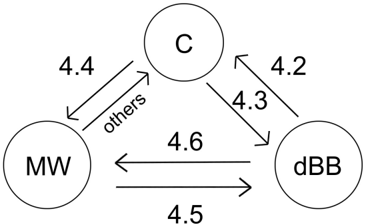
The image displays a directed graph or network diagram consisting of three circular nodes connected by six directed edges (arrows). Each edge is labeled with a numerical value, and one edge has an additional text label. The diagram appears to represent relationships, transitions, or flows between three entities labeled "C", "MW", and "dBB".
### Components/Axes
* **Nodes (Circles):**
* **Node C:** Positioned at the top center of the diagram.
* **Node MW:** Positioned at the bottom left of the diagram.
* **Node dBB:** Positioned at the bottom right of the diagram.
* **Edges (Arrows) and Labels:**
* An arrow points from **C** to **MW**. It is labeled with the number **4.4**.
* An arrow points from **MW** to **C**. It is labeled with the text **others**.
* An arrow points from **C** to **dBB**. It is labeled with the number **4.3**.
* An arrow points from **dBB** to **C**. It is labeled with the number **4.2**.
* An arrow points from **MW** to **dBB**. It is labeled with the number **4.5**.
* An arrow points from **dBB** to **MW**. It is labeled with the number **4.6**.
### Detailed Analysis
The diagram defines a closed system of three entities with specific, directed interactions. The numerical labels on five of the six edges suggest quantified relationships, such as weights, probabilities, costs, or transition strengths. The single text label "others" on the edge from MW to C indicates a categorical or qualitative relationship for that specific direction.
**Edge List with Spatial Grounding:**
1. **C → MW:** Arrow originates from the bottom of circle C and points to the top of circle MW. Label: `4.4`.
2. **MW → C:** Arrow originates from the top-right of circle MW and points to the bottom-left of circle C. Label: `others`. This label is placed along the shaft of the arrow.
3. **C → dBB:** Arrow originates from the bottom-right of circle C and points to the top-left of circle dBB. Label: `4.3`.
4. **dBB → C:** Arrow originates from the top-left of circle dBB and points to the bottom-right of circle C. Label: `4.2`.
5. **MW → dBB:** Arrow originates from the right side of circle MW and points to the left side of circle dBB. This is the lower of the two horizontal arrows between these nodes. Label: `4.5`.
6. **dBB → MW:** Arrow originates from the left side of circle dBB and points to the right side of circle MW. This is the upper of the two horizontal arrows between these nodes. Label: `4.6`.
### Key Observations
* **Bidirectional Connectivity:** All three nodes are connected to each other in both directions, forming a fully connected triad.
* **Numerical Consistency:** Five of the six connections are quantified with numbers in a similar range (4.2 to 4.6). The values are close, suggesting a balanced or similarly scaled system of interactions.
* **Asymmetry in Labeling:** The connection from MW to C is uniquely labeled with the text "others," breaking the pattern of numerical labels. This highlights it as a special or different type of relationship.
* **Horizontal Flow:** The strongest numerical values (4.5 and 4.6) are on the direct horizontal links between MW and dBB, which may indicate a primary or more intense channel of interaction compared to the diagonal links involving C.
### Interpretation
This diagram models a system where three components (C, MW, dBB) interact through defined pathways. The numbers likely represent the strength, rate, probability, or cost of moving from one component to another. For example, in a state transition model, the value 4.6 could be the probability of transitioning from dBB to MW.
The label "others" on the MW → C path is significant. It implies that the relationship from MW back to C is not captured by a single numerical metric like the others. It may represent an aggregate of multiple minor pathways, a default fallback transition, or a qualitatively different type of influence that is not directly comparable to the quantified edges.
The structure suggests a system with feedback loops. For instance, C influences dBB (4.3), and dBB influences C (4.2), creating a direct reciprocal relationship. The presence of the "others" label introduces an element of uncertainty or categorization into an otherwise numerically defined network, indicating that not all relationships in the system are homogeneous or easily quantifiable.