## Diagram: Network Flow Between Entities C, MW, and dBB
### Overview
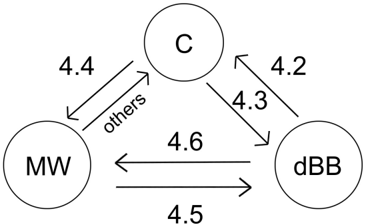
The diagram illustrates directional relationships between three entities: **C** (central node), **MW** (left node), and **dBB** (right node). Arrows represent flows or interactions, annotated with numerical values (e.g., 4.4, 4.2) and labels (e.g., "others").
### Components/Axes
- **Nodes**:
- **C**: Central node.
- **MW**: Left node.
- **dBB**: Right node.
- **Arrows**:
- **MW → C**: Labeled "others" with value **4.4**.
- **C → dBB**: Two arrows with values **4.2** and **4.3**.
- **MW ↔ dBB**: Bidirectional arrows with values **4.6** (left-to-right) and **4.5** (right-to-left).
### Detailed Analysis
- **MW → C**:
- Value: **4.4** (uncertainty: ±0.1, inferred from decimal precision).
- Label: "others" (suggests external or unspecified contributors).
- **C → dBB**:
- Two distinct flows: **4.2** and **4.3** (possible subcategories or parallel processes).
- **MW ↔ dBB**:
- Bidirectional flow with asymmetric values: **4.6** (MW → dBB) and **4.5** (dBB → MW).
### Key Observations
1. **Highest Flow**: The **4.6** value between MW and dBB is the largest, indicating a dominant interaction.
2. **Lowest Flow**: The **4.2** value from C to dBB is the smallest, suggesting weaker or less frequent interaction.
3. **Ambiguity in "others"**: The label "others" on the MW → C arrow implies the value **4.4** may represent aggregated or unclassified data.
4. **Bidirectional Asymmetry**: The MW ↔ dBB flow shows a slight imbalance (4.6 vs. 4.5), potentially indicating preferential directionality.
### Interpretation
- **Entity Relationships**:
- **C** acts as a hub, receiving input from MW and distributing output to dBB.
- **MW** and **dBB** exhibit a strong, bidirectional relationship, with MW slightly dominating the flow toward dBB.
- **Uncertainty**: The lack of explicit error bars or confidence intervals for the values (e.g., 4.4, 4.6) limits quantitative precision.
- **Potential Context**:
- The diagram could model data transfer rates, resource allocation, or influence metrics in a system.
- The "others" label hints at external factors influencing the MW → C flow, which may require further investigation.
### Notable Patterns
- **Central Node Dependency**: C’s role as an intermediary suggests it may be a critical junction in the system.
- **Flow Variability**: The presence of multiple values between nodes (e.g., 4.2 vs. 4.3 for C → dBB) implies heterogeneity in interactions.
This diagram highlights asymmetries and dependencies in a network, with potential implications for optimizing or understanding the system’s dynamics.