## Diagram: LLM Code Submission and Verification Process
### Overview
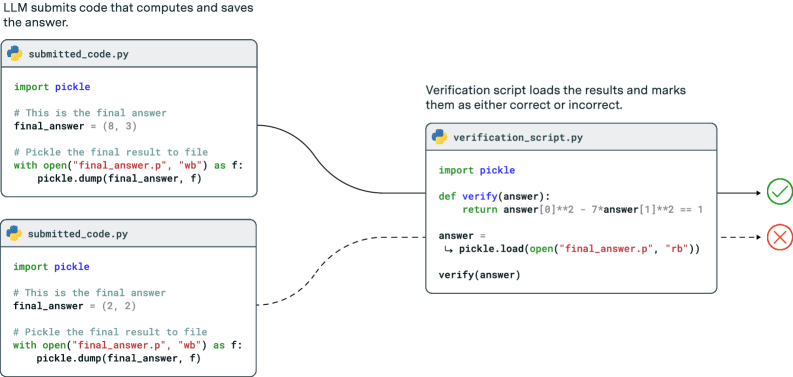
This diagram illustrates a technical process where a Large Language Model (LLM) submits Python code that computes and saves an answer, which is then validated by a separate verification script. The diagram shows two distinct submission examples leading to different verification outcomes (correct vs. incorrect).
### Components/Axes
The diagram is composed of four main visual components arranged in a flow from left to right:
1. **Header Text (Top-Left):** "LLM submits code that computes and saves the answer."
2. **Left Column - Submission Code Blocks:** Two separate instances of a file named `submitted_code.py`.
3. **Right Column - Verification Script:** A single block for a file named `verification_script.py`.
4. **Output Indicators (Far Right):** A green checkmark (✓) and a red cross (✗) indicating verification results.
**Flow Indicators:**
* A **solid black arrow** connects the top `submitted_code.py` block to the `verification_script.py` block.
* A **dashed black arrow** connects the bottom `submitted_code.py` block to the `verification_script.py` block.
* A **solid black arrow** leads from the verification script to the green checkmark.
* A **dashed black arrow** leads from the verification script to the red cross.
### Detailed Analysis
#### 1. Submission Code Blocks (Left Column)
Both blocks are titled `submitted_code.py` and contain Python code with identical structure but different data.
**Top `submitted_code.py` Block:**
```python
import pickle
# This is the final answer
final_answer = (8, 3)
# Pickle the final result to file
with open("final_answer.p", "wb") as f:
pickle.dump(final_answer, f)
```
* **Key Data:** The computed answer is the tuple `(8, 3)`.
* **Action:** This answer is serialized (pickled) and saved to a file named `final_answer.p`.
**Bottom `submitted_code.py` Block:**
```python
import pickle
# This is the final answer
final_answer = (2, 2)
# Pickle the final result to file
with open("final_answer.p", "wb") as f:
pickle.dump(final_answer, f)
```
* **Key Data:** The computed answer is the tuple `(2, 2)`.
* **Action:** Identical serialization process, saving to the same filename `final_answer.p`.
#### 2. Verification Script (Right Column)
The block is titled `verification_script.py`.
```python
import pickle
def verify(answer):
return answer[0]**2 - 7*answer[1]**2 == 1
answer = pickle.load(open("final_answer.p", "rb"))
verify(answer)
```
* **Function Definition:** Defines a function `verify(answer)` that checks if the input tuple `(x, y)` satisfies the mathematical equation: `x² - 7y² = 1`.
* **Loading Action:** Loads the pickled data from the file `final_answer.p` into the variable `answer`.
* **Verification Call:** Calls the `verify` function with the loaded `answer`.
#### 3. Output Indicators (Far Right)
* **Green Checkmark (✓):** Connected via a solid arrow from the verification script. Represents a "correct" verification outcome.
* **Red Cross (✗):** Connected via a dashed arrow from the verification script. Represents an "incorrect" verification outcome.
### Key Observations
1. **Process Flow:** The diagram clearly depicts a two-stage process: **Submission** (LLM generates and saves an answer) -> **Verification** (An external script loads and validates the answer).
2. **Conditional Outcome:** The verification script's output is binary, determined by whether the loaded answer satisfies the specific equation `x² - 7y² = 1`.
3. **Visual Coding of Results:** The connection style (solid vs. dashed arrow) is used to map specific submission examples to their respective outcomes.
* The **solid arrow** path (Top Submission -> Verification -> Checkmark) implies the answer `(8, 3)` is correct.
* The **dashed arrow** path (Bottom Submission -> Verification -> Cross) implies the answer `(2, 2)` is incorrect.
4. **Mathematical Context:** The equation `x² - 7y² = 1` is a **Pell's equation**, a type of Diophantine equation. The pair `(8, 3)` is indeed a solution (`64 - 7*9 = 64 - 63 = 1`), while `(2, 2)` is not (`4 - 7*4 = 4 - 28 = -24`).
### Interpretation
This diagram serves as a technical schematic for an **automated answer validation system**, likely used in evaluating LLM performance on mathematical or reasoning tasks.
* **Core Mechanism:** It demonstrates a secure and decoupled verification method. The LLM only has write-access to produce an answer file (`final_answer.p`). The verification logic is isolated in a separate script (`verification_script.py`), preventing the LLM from directly influencing the validation check.
* **Purpose:** The setup is designed to objectively test if an LLM can correctly solve a specific problem (here, finding a solution to a Pell's equation). The binary output (✓/✗) provides a clear, automated pass/fail metric.
* **Underlying Message:** The diagram emphasizes the importance of **external validation** in AI systems. It shows that generating an answer is only half the task; proving its correctness against a predefined, immutable rule is crucial for reliable evaluation. The use of a non-trivial mathematical equation suggests the task is meant to test advanced reasoning capabilities.
* **Implicit Details:** The process assumes the verification script is trusted and correct. It also implies a workflow where multiple submissions (from the same or different LLMs) can be processed by the same verification script to produce comparable results.