## Bar Chart: Token Count by Data Type
### Overview
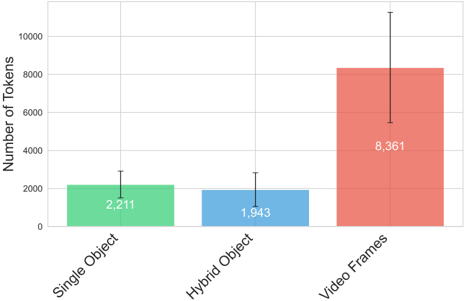
The image displays a vertical bar chart comparing the "Number of Tokens" across three distinct data categories. The chart includes error bars for each category, indicating variability or uncertainty in the measurements. The visual presentation uses distinct colors for each bar and includes the exact numerical value within each bar.
### Components/Axes
* **Y-Axis (Vertical):**
* **Label:** "Number of Tokens"
* **Scale:** Linear scale from 0 to 10,000.
* **Major Tick Marks:** 0, 2000, 4000, 6000, 8000, 10000.
* **X-Axis (Horizontal):**
* **Categories (from left to right):**
1. "Single Object"
2. "Hybrid Object"
3. "Video Frames"
* **Data Series (Bars):**
* **Bar 1 (Left):** Color: Green. Label: "Single Object". Value: 2,211. Error bar present.
* **Bar 2 (Center):** Color: Blue. Label: "Hybrid Object". Value: 1,943. Error bar present.
* **Bar 3 (Right):** Color: Red/Salmon. Label: "Video Frames". Value: 8,361. Error bar present.
* **Error Bars:** Each bar has a vertical black line (whisker) extending above and below the top of the bar, indicating a range of uncertainty or standard deviation around the central value.
### Detailed Analysis
* **Single Object (Green Bar):**
* **Central Value:** 2,211 tokens.
* **Visual Trend:** The bar height corresponds to just above the 2,000 mark on the y-axis.
* **Error Bar Range (Approximate):** The lower whisker extends down to approximately 1,500. The upper whisker extends up to approximately 2,900.
* **Hybrid Object (Blue Bar):**
* **Central Value:** 1,943 tokens.
* **Visual Trend:** This is the shortest bar, sitting slightly below the 2,000 mark.
* **Error Bar Range (Approximate):** The lower whisker extends down to approximately 1,200. The upper whisker extends up to approximately 2,700.
* **Video Frames (Red Bar):**
* **Central Value:** 8,361 tokens.
* **Visual Trend:** This bar is dramatically taller than the other two, extending well past the 8,000 mark.
* **Error Bar Range (Approximate):** This bar has the largest error range. The lower whisker extends down to approximately 5,500. The upper whisker extends up to approximately 11,200 (exceeding the top of the chart's labeled scale).
### Key Observations
1. **Dominant Category:** The "Video Frames" category has a token count (8,361) that is more than four times greater than either the "Single Object" (2,211) or "Hybrid Object" (1,943) categories.
2. **Relative Magnitude:** "Single Object" and "Hybrid Object" have comparable token counts, with "Single Object" being approximately 14% higher than "Hybrid Object".
3. **Variability:** The magnitude of the error bars correlates with the central value. The "Video Frames" category shows the greatest absolute variability (a range of ~5,700 tokens), while the other two show smaller, similar ranges (~1,400-1,500 tokens).
4. **Data Ordering:** The categories are not ordered by value (ascending or descending) on the x-axis.
### Interpretation
This chart likely illustrates the computational or representational cost (measured in "tokens," a common unit in machine learning for processing data) associated with different types of input data.
* **Core Finding:** Processing or representing **video data ("Video Frames") is significantly more token-intensive** than processing static images of single or hybrid objects. This aligns with the inherent complexity of video, which contains sequential frames, motion, and temporal information.
* **Relationship Between Static Types:** The similar token counts for "Single Object" and "Hybrid Object" suggest that, within this specific context or model, the complexity added by a "hybrid" object (which might imply multiple objects or a composite scene) does not drastically increase the token requirement compared to a single object. The slightly higher value for "Single Object" could be an artifact of the specific dataset or an indication that the "Hybrid Object" category was, on average, simpler in this sample.
* **Uncertainty Implication:** The large error bar for "Video Frames" indicates high variability in the token count for video data. This could be due to factors like varying video length, resolution, scene complexity, or motion density across different video samples. The smaller error bars for the static image categories suggest more consistent token usage for those data types.
* **Practical Implication:** For a system processing these data types, allocating resources (memory, processing time) based on token count would require a substantially larger budget for video data compared to static image data. The variability also suggests that video processing requires more flexible or robust resource allocation.