## Diagram: Geometric Pattern Grid
### Overview
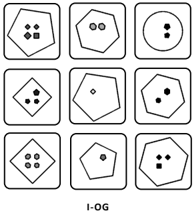
The image displays a 3x3 grid of geometric shapes, each contained within a square border. The shapes vary in type (polygons, circles), size, and internal symbols (dots, squares, triangles). No textual labels, legends, or axis markers are present.
### Components/Axes
- **Grid Structure**:
- 3 rows × 3 columns of squares.
- Each square contains a distinct geometric shape with embedded symbols.
- **Shape Types**:
- Polygons: pentagons, hexagons, diamonds, circles.
- Symbols: dots (circles), squares, triangles, single dots.
- **Spatial Layout**:
- Top row: Pentagon (squares/circles), hexagon (circles), circle (triangles).
- Middle row: Diamond (dots/squares), pentagon (single dot), hexagon (dots/squares).
- Bottom row: Diamond (circles), pentagon (single dot), hexagon (dots/squares).
### Detailed Analysis
- **Shape-Symbol Relationships**:
- Symbols are positioned asymmetrically within shapes (e.g., top-left, bottom-right).
- No consistent pattern in symbol quantity or placement across the grid.
- **Size Variation**:
- Shapes range from small (e.g., bottom-middle pentagon) to large (e.g., bottom-right hexagon).
- **Color**:
- All elements are monochromatic (black outlines, white backgrounds).
### Key Observations
1. **No Textual Data**: The image contains no labels, legends, or axis titles.
2. **Symbol Diversity**: Symbols (dots, squares, triangles) are distributed unevenly across shapes.
3. **Size-Form Correlation**: Larger shapes (e.g., bottom-right hexagon) often contain multiple symbols, while smaller shapes (e.g., middle-left diamond) have fewer.
4. **Asymmetry**: Symbols are not uniformly aligned within shapes (e.g., top-left pentagon has symbols clustered in the upper half).
### Interpretation
The grid appears to function as a **visual classification system** or **cognitive test** for pattern recognition. The absence of text suggests the focus is on spatial reasoning or symbolic interpretation. Possible applications include:
- **Educational Tools**: Teaching geometry or symbolic logic.
- **Psychological Testing**: Assessing visual perception or problem-solving skills.
- **Design Principles**: Demonstrating balance, asymmetry, or minimalism.
Notable anomalies include the inconsistent symbol placement and the lack of a clear organizational rule. The grid may intentionally avoid patterns to test observational skills or highlight the importance of context in interpretation.