## Dependency Parse Diagram
### Overview
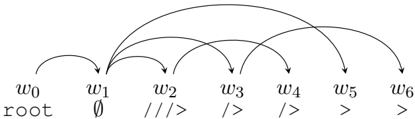
The image depicts a dependency parse diagram for a sentence. It shows the relationships between words in the sentence, with arrows indicating the direction of dependency. The diagram includes word tokens labeled w0 through w6, along with their corresponding part-of-speech tags or grammatical roles.
### Components/Axes
* **Nodes:** The nodes represent words in the sentence, labeled as w0, w1, w2, w3, w4, w5, and w6.
* **Labels:** Each word node has a label below it indicating its role or part-of-speech:
* w0: root
* w1: Ø
* w2: ////>
* w3: />
* w4: />
* w5: >
* w6: >
* **Edges:** The edges are represented by curved arrows, indicating the dependency relationships between the words. The arrow points from the head (governor) to the dependent.
### Detailed Analysis
The dependency relationships are as follows:
* w0 (root) depends on w1.
* w1 depends on w2.
* w1 depends on w3.
* w1 depends on w4.
* w1 depends on w5.
* w1 depends on w6.
* w2 depends on w3.
* w2 depends on w4.
* w2 depends on w5.
### Key Observations
* The word "w1" appears to be the central node, with multiple words depending on it.
* The "root" node (w0) depends on "w1", indicating that "w1" is the main verb or head of the sentence.
* The diagram shows a hierarchical structure, with dependencies flowing from the root to the other words.
### Interpretation
The dependency parse diagram visually represents the grammatical structure of a sentence. It shows how words are related to each other and how they depend on each other to form a coherent meaning. The diagram highlights the importance of "w1" as the central element of the sentence, with other words modifying or complementing its meaning. The specific labels (Ø, ////>, /> , >) likely represent specific grammatical categories or features, which would require additional context to fully understand.