## Flowchart: Process Flow with Branching Nodes
### Overview
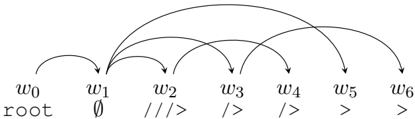
The image depicts a hierarchical flowchart with seven nodes (w₀ to w₆) connected by directional arrows. The structure combines branching paths from a root node and sequential connections between subsequent nodes. Symbols (∅, >) are embedded in node labels, suggesting categorical or hierarchical relationships.
### Components/Axes
- **Nodes**:
- w₀: Labeled "root" (starting point).
- w₁: Contains ∅ (empty set symbol).
- w₂: Contains "////>" (four forward slashes and a greater-than symbol).
- w₃: Contains "/>" (one forward slash and a greater-than symbol).
- w₄: Contains "/>" (same as w₃).
- w₅: Contains ">" (greater-than symbol).
- w₆: Contains ">" (same as w₅).
- **Arrows**:
- w₀ → w₁, w₂, w₃, w₄, w₅, w₆ (root branches to all nodes).
- w₁ → w₂ (sequential connection).
- w₂ → w₃ (sequential connection).
- w₃ → w₄ (sequential connection).
- w₄ → w₅ (sequential connection).
- w₅ → w₆ (sequential connection).
### Detailed Analysis
- **Node Labels**:
- w₀: "root" (explicitly labeled).
- w₁: ∅ (Unicode U+2205, symbolizing emptiness or null state).
- w₂: "////>" (possibly indicating a path with four steps or layers).
- w₃–w₆: "/>" and ">" (simplified path representations, with decreasing complexity).
- **Arrow Patterns**:
- Root node (w₀) distributes to all other nodes, suggesting a central decision point.
- Sequential arrows (w₁→w₂→w₃→w₄→w₅→w₆) imply a linear progression after initial branching.
### Key Observations
1. **Hierarchical Branching**: The root node (w₀) splits into six paths, with w₁–w₆ representing distinct outcomes or states.
2. **Symbolic Encoding**:
- ∅ in w₁ may denote a terminal or invalid state.
- Increasing density of ">" symbols (w₂: "////>", w₃–w₆: "/>" or ">") could represent depth or complexity of paths.
3. **Sequential Flow**: After the root, nodes w₁–w₆ form a linear chain, suggesting a forced progression post-branching.
### Interpretation
The flowchart likely models a decision tree or process flow where:
- **w₀** represents an initial choice or root decision.
- **w₁–w₆** are potential outcomes, with w₁ (∅) possibly indicating a "no-path" or error state.
- The sequential arrows (w₁→w₂→...→w₆) suggest a fallback or recovery mechanism after the initial branching.
- Symbolic labels (∅, >) may encode metadata about path validity, depth, or priority.
This structure could represent algorithms (e.g., tree traversal), workflows, or error-handling logic. The absence of explicit numerical data limits quantitative analysis, but the symbolic encoding implies a focus on qualitative relationships between states.