## Diagram: Transformation from Linear to Tree Structure
### Overview
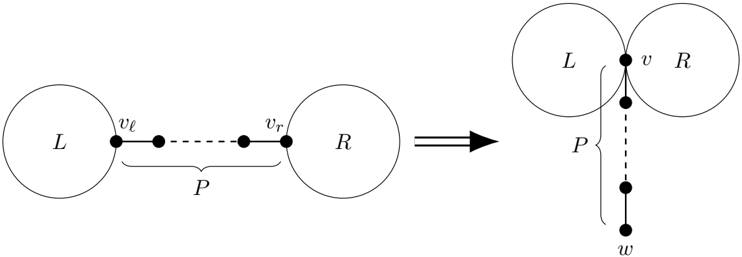
The image depicts a transformation process from a linear structure (left) to a tree-like structure (right). The left diagram shows two connected nodes labeled **L** and **R** with intermediate points **vₗ** and **vᵣ** on a dashed line labeled **P**. The right diagram shows a hierarchical structure where **L** and **R** are connected through a central node **v**, with an additional node **w** below. A vertical dashed line labeled **P** connects these nodes.
### Components/Axes
- **Left Diagram**:
- Two circles labeled **L** (left) and **R** (right).
- Dashed line **P** connecting **L** and **R**, with labeled points **vₗ** (near **L**) and **vᵣ** (near **R**).
- **Right Diagram**:
- Tree structure with **L** and **R** as leaf nodes connected to a central node **v**.
- Vertical dashed line **P** connecting **v** to a new node **w** below.
- **Arrow**: Indicates transformation direction from left to right.
### Detailed Analysis
- **Left Diagram**:
- **L** and **R** are positioned at the ends of the dashed line **P**.
- **vₗ** and **vᵣ** are intermediate points on **P**, suggesting a parameterized path or function between **L** and **R**.
- **Right Diagram**:
- **L** and **R** are now leaf nodes in a tree, connected to a shared parent node **v**.
- Node **w** is introduced below **v**, connected via the same dashed line **P**, implying an extension or modification of the original path.
- **Dashed Lines**: Likely represent abstract or variable relationships (e.g., probabilistic, optional, or dynamic connections).
### Key Observations
1. **Structural Shift**: The transformation replaces a linear path (**P**) with a hierarchical tree, introducing a new node **w**.
2. **Node Reuse**: **L** and **R** retain their labels but change roles from endpoints to leaves in the tree.
3. **Dashed Line Continuity**: The line **P** persists in both diagrams, suggesting it retains significance across transformations.
### Interpretation
This diagram likely represents a computational or mathematical process where a linear relationship (e.g., a function, path, or dependency) is restructured into a hierarchical or branched form. The introduction of **w** could indicate:
- A new variable or constraint added during transformation.
- A decomposition of the original path into modular components.
- A representation of uncertainty or variability (e.g., **w** as an alternative outcome).
The reuse of **P** implies that the transformation preserves some core relationship (e.g., a shared parameter or rule) while adapting its structure. The absence of numerical values suggests the focus is on topological or logical relationships rather than quantitative data.