## 3D Renderings: Two Objects Displayed in Graphics Pipeline Windows
### Overview
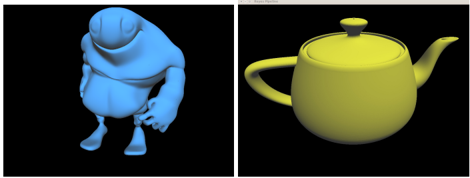
The image displays two distinct 3D rendered objects, each presented within what appears to be a separate application window, against a solid black background. The objects are a stylized blue creature and a classic yellow teapot, both rendered with smooth shading. The right window's title bar explicitly identifies the application as "Mesa Pipeline".
### Components/Axes
The image is composed of two primary display regions, each representing a graphical output window:
1. **Left Display Region (Left Window)**:
* **Content**: A 3D model of a stylized, bipedal creature.
* **Background**: Solid black.
* **Window Frame**: A thin, light grey border is visible along the top and left edges, indicating a window boundary. The window title bar is present at the very top, but no text is clearly legible within it.
2. **Right Display Region (Right Window)**:
* **Content**: A 3D model of a teapot.
* **Background**: Solid black.
* **Window Frame**: A thin, light grey border is visible along the top and right edges, indicating a window boundary.
* **Window Title**: Located centrally within the top window frame, the text "Mesa Pipeline" is clearly legible.
### Detailed Analysis
**Left Display Region (Stylized Creature Model):**
* **Object Description**: The object is a 3D model of a creature, rendered in a uniform light blue color. It has a bulky, somewhat hunched posture.
* **Body Shape**: The torso is large and rounded, with visible folds or rolls suggesting a soft, fleshy form. The head is integrated into the upper torso, featuring what appear to be closed eyes or prominent brow ridges.
* **Limbs**: It possesses short, thick legs ending in broad, flat feet. The arms are also short and thick, with large, somewhat simplified hands.
* **Surface Properties**: The surface is smooth and matte, with subtle shading indicating curvature and depth. Highlights suggest a primary light source from the upper-left or front-left direction, casting soft shadows that define the contours of the body.
* **Positioning**: The creature is centered horizontally within its display region and occupies approximately 70-80% of the vertical space. It appears to be standing on an implied ground plane.
**Right Display Region (Teapot Model):**
* **Object Description**: The object is a 3D model of a teapot, rendered in a uniform light yellow color. This model is consistent with the "Utah Teapot," a standard reference object in computer graphics.
* **Body Shape**: The main body is spherical. It features a distinct lid with a small, rounded knob on top. A curved handle extends from the left side of the body, and a tapered spout extends from the right side.
* **Surface Properties**: Similar to the creature model, the teapot has a smooth, matte surface with subtle shading. Highlights and shadows indicate a primary light source from the upper-left or front-left, consistent with the lighting of the creature model.
* **Positioning**: The teapot is centered horizontally within its display region and occupies approximately 70-80% of the vertical space. It appears to be resting on an implied ground plane.
### Key Observations
* Both 3D models are rendered using a smooth shading technique (e.g., Gouraud or Phong shading), without visible textures or complex materials, suggesting a focus on geometric form and basic lighting.
* The lighting conditions appear consistent across both renderings, implying they might be generated by the same rendering engine or pipeline configuration.
* The black background provides a stark contrast, making the rendered objects stand out clearly.
* The presence of "Mesa Pipeline" in the title bar of the right window is a significant piece of information, indicating the software or graphics library used for rendering. Mesa is an open-source implementation of the OpenGL specification.
### Interpretation
The image serves as a demonstration of basic 3D rendering capabilities, likely showcasing the output of a graphics pipeline such as Mesa. The two distinct objects—a complex organic model (the creature) and a classic geometric primitive (the Utah Teapot)—illustrate the pipeline's ability to render different types of 3D geometry.
The consistent lighting and shading across both windows suggest that these are not merely static images but active renderings from a graphics application. The "Mesa Pipeline" label strongly implies that these are real-time or near real-time renders produced by the Mesa 3D Graphics Library, which is commonly used for software rendering or as an open-source driver for hardware acceleration. This type of output is typical for testing, development, or educational demonstrations of 3D graphics programming and rendering techniques. The simplicity of the rendering (smooth shading, no textures) points towards a focus on the underlying geometry processing and lighting calculations rather than advanced material properties or photorealism.