## 3D Model Render: Blue Character and Yellow Teapot
### Overview
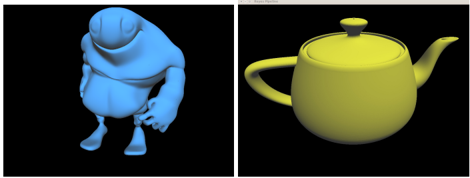
The image displays two distinct 3D models rendered against a solid black background. The models are presented side-by-side in separate panels, suggesting a comparison or showcase of different 3D assets. There is no embedded text, labels, axes, or data charts within the image itself. The content is purely visual, consisting of two geometrically complex objects.
### Components/Axes
* **Left Panel:** Contains a 3D model of a stylized, muscular humanoid character.
* **Right Panel:** Contains a 3D model of a classic teapot, specifically the iconic "Utah Teapot" often used as a standard reference object in computer graphics.
* **Background:** Uniform black (#000000) for both panels, providing high contrast for the models.
* **Text/Labels:** None present in the image.
### Detailed Analysis
**Left Model (Blue Character):**
* **Color:** Uniform light blue, with shading indicating a single, likely directional, light source from the upper left.
* **Form:** A stylized, cartoonish humanoid figure with exaggerated proportions.
* **Key Features:**
* **Head:** Large, bulbous, and smooth with a pronounced brow ridge. No distinct facial features (eyes, nose, mouth) are visible.
* **Torso:** Extremely muscular and broad, tapering to a narrow waist. The chest and abdominal muscles are defined.
* **Arms:** Thick and muscular, ending in large, clenched fists.
* **Legs:** Relatively short and thin compared to the torso, ending in simple, foot-like forms.
* **Pose:** Standing upright, facing slightly towards the right of the frame, with arms held slightly away from the body.
**Right Model (Yellow Teapot):**
* **Color:** Uniform matte yellow, with soft shading indicating a similar light source direction as the left model.
* **Form:** The classic Utah Teapot geometry, a standard test model in 3D graphics.
* **Key Features:**
* **Body:** A rounded, bulbous main chamber.
* **Spout:** A curved spout extending from the side.
* **Handle:** A looped handle on the opposite side from the spout.
* **Lid:** A domed lid with a small knob on top.
* **Pose:** Oriented in a standard three-quarter view, showcasing its profile.
### Key Observations
1. **Lack of Textual Data:** The image contains zero textual information—no titles, annotations, measurements, or labels.
2. **Contrast in Complexity:** The left model is a custom, organic character design, while the right model is a standardized, geometric primitive used for technical benchmarking.
3. **Uniform Material:** Both models appear to use a simple, non-textured Lambertian or similar diffuse shader, emphasizing form over surface detail.
4. **Spatial Grounding:** The two models are presented in distinct, adjacent rectangular frames with a thin white border separating them. The blue character occupies the left frame, and the yellow teapot occupies the right frame.
### Interpretation
This image is a technical render, likely from a 3D modeling, animation, or computer graphics pipeline. Its primary purpose is to display the geometry and basic shading of two different types of 3D assets.
* **The Blue Character** represents a custom, artistic asset, possibly a character concept or a base mesh for further sculpting and texturing. Its exaggerated, muscular form suggests it could be for a stylized game or animation.
* **The Yellow Teapot** is a fundamental reference object in the history of computer graphics. Its presence indicates this render might be part of a lighting test, a shader development exercise, or a demonstration of a rendering engine's capability to handle standard geometry. The Utah Teapot is often used to check for correct rendering of curves, shadows, and self-occlusion.
The side-by-side presentation invites comparison between a "real-world" artistic asset and a canonical technical test object. The uniform black background and simple lighting are chosen to isolate and clearly evaluate the models' forms without environmental distraction. The absence of any data or text confirms this is a visual output for assessment, not an informational chart or diagram.