## 3D Model Renderings: Abstract Creature and Teapot
### Overview
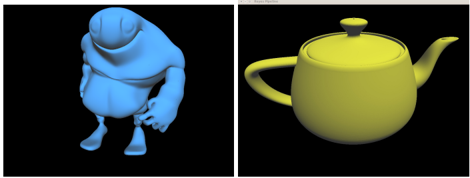
The image contains two side-by-side 3D models rendered in solid colors against a black background. The left model depicts an abstract, humanoid-like creature with exaggerated proportions, while the right model shows a stylized teapot. No textual annotations, labels, or legends are present in the image.
### Components/Axes
- **Left Model (Creature)**:
- Color: Cyan (#00FFFF)
- Shape: Humanoid silhouette with a rounded head, elongated torso, and disproportionately long limbs.
- Features: No distinct facial features, hands, or feet; limbs taper to blunt ends.
- **Right Model (Teapot)**:
- Color: Yellow (#FFFF00)
- Shape: Classic teapot form with a rounded body, curved spout, single handle, and lid with a knob.
- Features: Smooth, symmetrical surfaces with no visible seams or textures.
### Detailed Analysis
- **Creature Model**:
- Positioned slightly left-of-center in the left panel.
- Proportions suggest a stylized, non-realistic design (e.g., oversized torso, short legs).
- Lighting creates subtle shading on the torso and limbs, emphasizing curvature.
- **Teapot Model**:
- Centered in the right panel.
- Proportions align with standard 3D modeling benchmarks (e.g., teapot test models).
- Lid knob and spout are proportionally accurate to typical teapot designs.
### Key Observations
1. **Color Contrast**: The cyan creature and yellow teapot are visually distinct due to complementary hues.
2. **Abstraction vs. Realism**: The creature model leans toward abstract art, while the teapot adheres to a recognizable real-world object.
3. **Background**: The black background isolates the models, eliminating contextual distractions.
### Interpretation
These models likely serve as test renders for 3D rendering software, evaluating lighting, shading, and geometric accuracy. The creature’s abstract form may test organic shape rendering, while the teapot—a classic 3D benchmark—validates standard object fidelity. The absence of text or annotations suggests the focus is purely on visual and geometric properties rather than functional or categorical data.
## No textual information, labels, or data points are present in the image.