## Conceptual Diagram: Class-Subclass Hierarchy and Relationships
### Overview
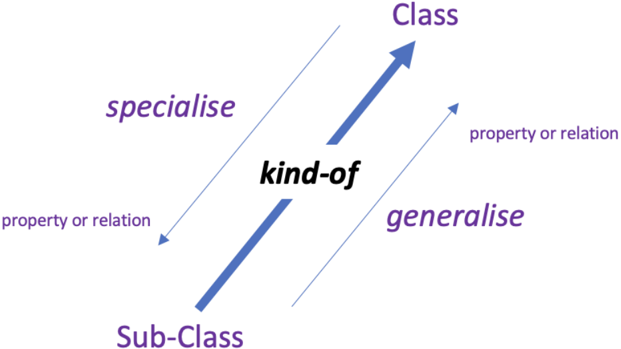
The image is a conceptual diagram illustrating the hierarchical and relational dynamics between a "Class" and a "Sub-Class" in a knowledge representation or ontology context. It uses text labels and directional arrows to define the processes of specialization and generalization, as well as the foundational "kind-of" relationship.
### Components/Axes
The diagram is composed of text labels and arrows arranged on a plain white background. There are no traditional chart axes. The key components are:
1. **Primary Nodes (Text Labels):**
* **Class**: Located in the top-right quadrant.
* **Sub-Class**: Located in the bottom-left quadrant.
* **kind-of**: Located centrally, in bold black font, acting as the core relational descriptor.
2. **Process/Relationship Labels (Text):**
* **specialise**: Located in the upper-left area, associated with a thin arrow.
* **generalise**: Located in the lower-right area, associated with a thin arrow.
* **property or relation**: Appears twice. Once in the lower-left, associated with a thin arrow pointing towards "Sub-Class". Once in the upper-right, associated with a thin arrow pointing towards "Class".
3. **Arrows (Visual Connectors):**
* A **thick, blue arrow** points diagonally upward from "Sub-Class" to "Class". The label "kind-of" is positioned directly over this arrow's midpoint.
* A **thin, blue arrow** points diagonally upward from "Sub-Class" to "Class", running parallel and to the left of the thick arrow. The label "specialise" is placed above this arrow.
* A **thin, blue arrow** points diagonally downward from "Class" to "Sub-Class", running parallel and to the right of the thick arrow. The label "generalise" is placed below this arrow.
* Two additional **thin, blue arrows** are present:
* One points from the lower-left margin towards "Sub-Class", labeled "property or relation".
* One points from the upper-right margin towards "Class", labeled "property or relation".
### Detailed Analysis
The diagram establishes a clear directional flow and set of relationships:
* **Core Relationship:** The fundamental link is that a **Sub-Class** *is-a* **Class**. This is represented by the central, bold "kind-of" label and the thick arrow pointing from Sub-Class to Class.
* **Directional Processes:**
* **Specialisation:** The process of moving from a general "Class" to a more specific "Sub-Class" is labeled "specialise". This is represented by the thin arrow pointing from the general area of "Class" down towards "Sub-Class" (though the arrow's tail is not explicitly attached to "Class").
* **Generalisation:** The process of moving from a specific "Sub-Class" to a more general "Class" is labeled "generalise". This is represented by the thin arrow pointing from the general area of "Sub-Class" up towards "Class" (though the arrow's tail is not explicitly attached to "Sub-Class").
* **Attributes:** Both the "Class" and "Sub-Class" entities can have associated "property or relation" attributes, as indicated by the two side arrows pointing towards each node.
### Key Observations
1. **Visual Hierarchy:** The use of a **thick arrow** for the core "kind-of" relationship gives it visual primacy over the thinner arrows representing the processes of specialisation and generalisation.
2. **Symmetry and Duality:** The diagram presents a symmetrical duality. "Specialise" and "generalise" are opposing processes. The "property or relation" labels are applied symmetrically to both ends of the hierarchy.
3. **Spatial Grounding:** The layout is diagonal. "Sub-Class" is anchored at the bottom-left, and "Class" at the top-right, with all relational arrows following this diagonal axis. The "kind-of" label is the central focal point.
4. **Color Consistency:** All arrows are the same shade of blue, and all text (except the bold "kind-of") is the same shade of purple. This color coding groups all relational/process elements together visually.
### Interpretation
This diagram is a foundational model for **ontological engineering** and **object-oriented design**. It visually explains how knowledge is structured through inheritance.
* **What it demonstrates:** It shows that a "Sub-Class" inherits the characteristics of its parent "Class" (the "kind-of" relationship). The processes of **specialisation** (creating a more specific subclass from a general class) and **generalisation** (abstracting a general class from specific subclasses) are the primary operations for building and navigating this hierarchy.
* **Relationship between elements:** The "property or relation" arrows indicate that both classes and subclasses can have their own attributes or relationships, which is a key principle in encapsulation. The diagram separates the *is-a* relationship (inheritance) from the *has-a* or *uses-a* relationships (properties/relations).
* **Underlying Logic:** The diagram argues that classification is not static but a dynamic process involving movement along a spectrum of specificity. The central placement of "kind-of" asserts that this inheritance link is the most critical concept, upon which the processes of specialisation and generalisation depend. It provides a visual grammar for discussing how categories are formed and related.