## Diagram: Class-Subclass Relationships
### Overview
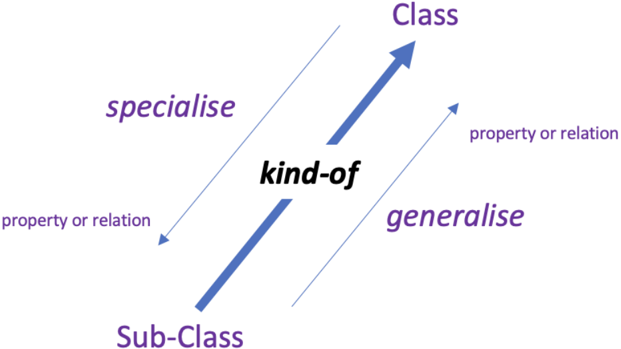
The diagram illustrates the hierarchical and associative relationships between "Class" and "Sub-Class" in object-oriented programming. It uses directional arrows and labels to depict specialization, generalization, and property/relation connections.
### Components/Axes
- **Nodes**:
- "Class" (top node)
- "Sub-Class" (bottom node)
- **Arrows**:
- **Specialise**: Leftward arrow from "Class" to "Sub-Class" (purple text).
- **Generalise**: Rightward arrow from "Sub-Class" to "Class" (purple text).
- **Property or Relation**: Two bidirectional arrows (dashed lines) connecting "Class" and "Sub-Class" to the central line.
- **Central Line**:
- Labeled "kind-of" (black text), connecting "Class" and "Sub-Class" diagonally.
- **Legend**: No explicit legend, but arrow styles and labels imply relationships.
### Detailed Analysis
- **Specialise/Generalise**:
- The "specialise" arrow indicates that a "Sub-Class" is a specialized instance of a "Class."
- The "generalise" arrow shows the inverse relationship, where a "Class" can be generalized into multiple "Sub-Classes."
- **Property or Relation**:
- Dashed arrows labeled "property or relation" suggest associations between classes (e.g., attributes or methods shared or inherited).
- **Kind-of**:
- The central line represents the inheritance relationship ("kind-of"), a core concept in class hierarchies.
### Key Observations
- The diagram emphasizes bidirectional relationships: specialization/generalization and property/relation associations.
- The "kind-of" label explicitly defines the inheritance hierarchy, while "property or relation" implies composition or aggregation.
- No numerical data or trends are present; the focus is on conceptual relationships.
### Interpretation
This diagram models foundational object-oriented principles:
1. **Inheritance**: The "kind-of" relationship (central line) represents "is-a" hierarchies, where subclasses inherit properties from parent classes.
2. **Association**: The "property or relation" arrows suggest "has-a" or "uses-a" relationships, indicating how classes interact through shared attributes or methods.
3. **Bidirectional Flow**: The opposing arrows for "specialise" and "generalise" highlight that specialization and generalization are inverse operations in class design.
The diagram underscores the duality of class relationships: hierarchical (inheritance) and associative (composition). It serves as a visual guide for understanding how classes can be structured to model real-world entities and their interactions.