TECHNICAL ASSET FINGERPRINT
401a265b44181348201fc906
Click to view fullscreen
Press ESC or click to close
FOUND IN PAPERS
EXPERT: healer-alpha-free VERSION 1
RUNTIME: free/openrouter/healer-alpha
INTEL_VERIFIED
## Bar Chart Grid: Language Performance Scores by AI Model
### Overview
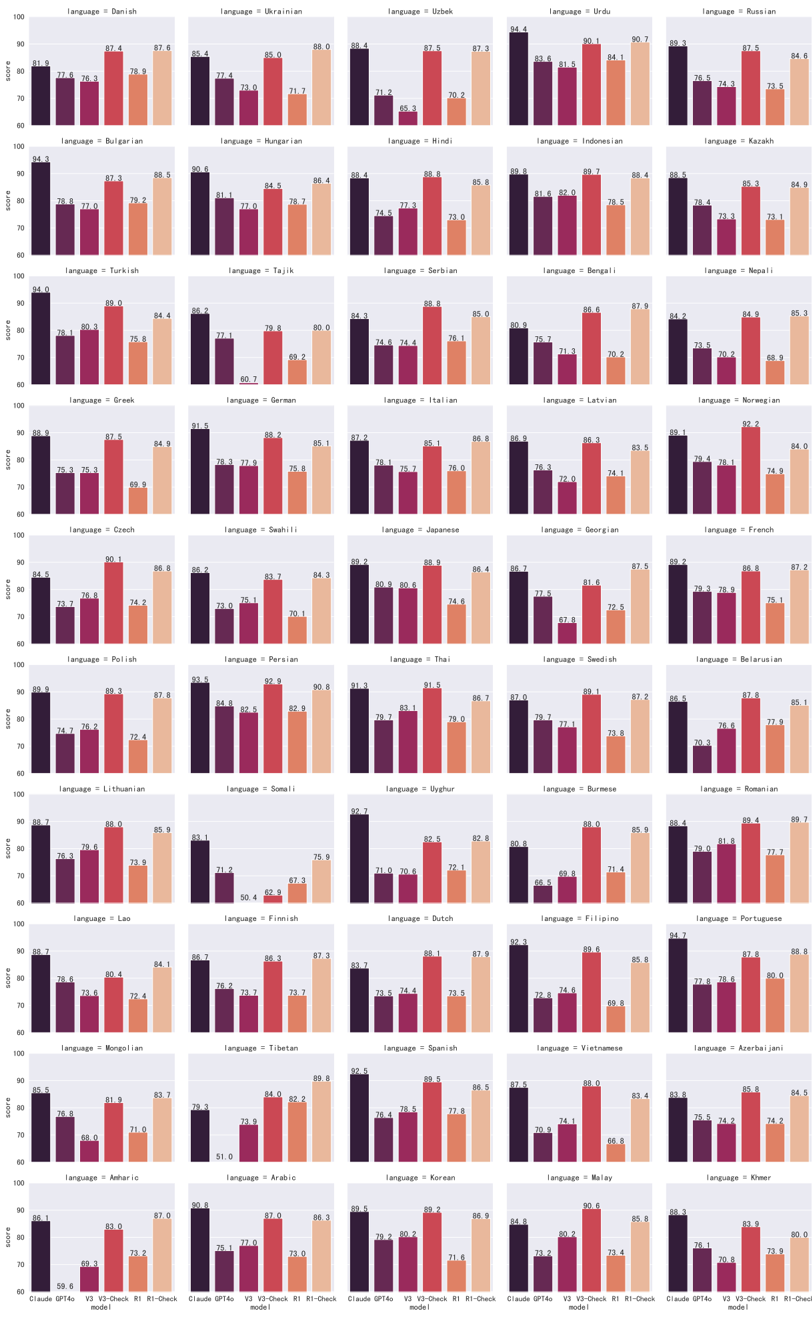
The image is a large grid of 50 individual bar charts, arranged in 10 rows and 5 columns. Each chart displays the performance scores (y-axis: "score") of five different AI models (x-axis) for a specific language. The overall purpose is to compare model performance across a wide variety of languages.
### Components/Axes
* **Chart Titles:** Each of the 50 charts has a title in the format `language = [Language Name]`. The languages represented are (reading left-to-right, top-to-bottom):
* Row 1: Danish, Ukrainian, Uzbek, Urdu, Russian
* Row 2: Bulgarian, Hungarian, Hindi, Indonesian, Kazakh
* Row 3: Turkish, Tajik, Serbian, Bengali, Nepali
* Row 4: Greek, German, Italian, Latvian, Norwegian
* Row 5: Czech, Swahili, Japanese, Georgian, French
* Row 6: Polish, Persian, Thai, Swedish, Belarusian
* Row 7: Lithuanian, Somali, Uyghur, Burmese, Romanian
* Row 8: Lao, Finnish, Dutch, Filipino, Portuguese
* Row 9: Mongolian, Tibetan, Spanish, Vietnamese, Azerbaijani
* Row 10: Amharic, Arabic, Korean, Malay, Khmer
* **Y-Axis:** Labeled "score" on the leftmost charts of each row. The scale runs from 60 to 100, with major tick marks at 60, 70, 80, 90, and 100.
* **X-Axis:** Each chart has five bars representing different AI models. The model names are listed at the very bottom of the entire grid, aligned with the columns.
* **Legend:** Located at the bottom center of the entire image. It maps colors to model names:
* Dark Purple: `Claude GPT4o`
* Dark Red/Maroon: `V3`
* Red: `V3-Check`
* Orange: `R1`
* Light Orange/Peach: `R1-Check`
* **Spatial Layout:** The legend is positioned below the main grid of charts. Each individual chart is a self-contained unit with its own title and axes. The charts are densely packed with minimal spacing.
### Detailed Analysis
Each chart contains five bars. The approximate score for each model in each language can be read from the y-axis. Below is a summary of the general trends observed across the grid, followed by specific data points for selected languages to illustrate the pattern.
**General Trend Verification:**
* **Claude GPT4o (Dark Purple):** This bar is frequently the tallest or among the tallest in each chart, indicating consistently high performance. Its trend is generally stable at a high level.
* **V3 (Dark Red):** This bar is often the shortest or among the shortest, showing lower performance relative to the other models. Its trend is consistently lower.
* **V3-Check (Red):** This bar typically shows a significant improvement over the V3 model, often reaching scores comparable to or exceeding Claude GPT4o. Its trend is a sharp upward step from V3.
* **R1 (Orange):** This bar usually shows a drop in performance compared to V3-Check, often falling to a level similar to or slightly above V3. Its trend is a downward step from V3-Check.
* **R1-Check (Light Orange):** This bar shows a dramatic improvement over R1, frequently achieving the highest or second-highest score in the chart. Its trend is a very sharp upward step from R1.
**Sample Data Points (Approximate Values):**
* **Danish (Top-Left Chart):**
* Claude GPT4o: ~81.9
* V3: ~77.6
* V3-Check: ~87.4
* R1: ~78.9
* R1-Check: ~87.6
* **German (Row 4, Column 2):**
* Claude GPT4o: ~91.5
* V3: ~78.3
* V3-Check: ~89.2
* R1: ~79.8
* R1-Check: ~85.1
* **Japanese (Row 5, Column 3):**
* Claude GPT4o: ~89.2
* V3: ~80.5
* V3-Check: ~88.8
* R1: ~74.6
* R1-Check: ~86.4
* **Spanish (Row 9, Column 3):**
* Claude GPT4o: ~92.5
* V3: ~76.9
* V3-Check: ~89.5
* R1: ~77.8
* R1-Check: ~86.5
* **Arabic (Row 10, Column 2):**
* Claude GPT4o: ~90.8
* V3: ~79.1
* V3-Check: ~87.0
* R1: ~73.0
* R1-Check: ~86.3
### Key Observations
1. **Consistent Model Hierarchy:** A clear performance pattern is visible across nearly all 50 languages: `R1-Check` ≥ `V3-Check` ≥ `Claude GPT4o` > `R1` ≥ `V3`. The "Check" variants consistently outperform their base counterparts.
2. **High Baseline for Claude GPT4o:** The `Claude GPT4o` model maintains a high and relatively stable score (often between 85-95) across all languages, suggesting strong general multilingual capability.
3. **Significant Impact of "Check" Mechanism:** The most striking observation is the substantial score increase from `V3` to `V3-Check` and from `R1` to `R1-Check`. This suggests the "Check" process is highly effective at improving performance.
4. **Language Variance:** While the pattern holds, the absolute scores vary. For example, scores for languages like Urdu, Indonesian, and Spanish appear very high (many bars above 90), while scores for languages like Finnish, Lao, and Somali show more variation and slightly lower peaks.
5. **Anomaly - Finnish (Row 8, Column 2):** The `V3` score for Finnish is exceptionally low (~50.4), creating a very large gap to its `V3-Check` counterpart (~86.3). This is one of the most dramatic improvements shown.
### Interpretation
This grid of charts provides a comprehensive benchmark of AI language model performance. The data strongly suggests that the evaluated models (`V3`, `R1`) have a base performance level that is significantly enhanced by a secondary process or model variant labeled "Check." The `Claude GPT4o` model serves as a high-performing baseline that the "Check" variants often match or exceed.
The consistency of the pattern across 50 diverse languages—from European to Asian to African languages—indicates that the performance characteristics and the effectiveness of the "Check" mechanism are not language-specific but are general properties of the model architectures or training processes being tested. The outlier in Finnish for the `V3` model might indicate a specific weakness in that base model for certain linguistic features, which the "Check" process successfully corrects.
For a technical document, this image demonstrates the importance of evaluation across a broad language set and highlights the potential of post-processing or verification steps ("Check") to dramatically boost the reliability and accuracy of AI language models. The clear visual pattern makes a compelling case for the efficacy of the "Check" approach without needing to parse every individual number.
DECODING INTELLIGENCE...