## Chart: 1-day Accuracy vs. Search Time
### Overview
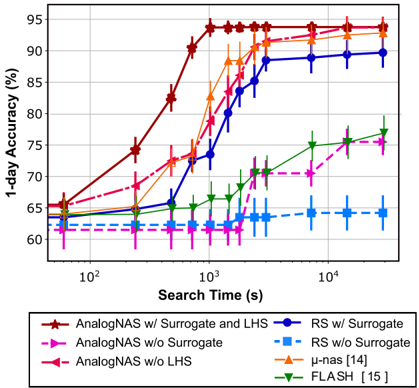
The image is a line chart comparing the 1-day accuracy (%) of different neural architecture search (NAS) algorithms against search time (s). The x-axis (Search Time) is on a logarithmic scale. Error bars are present on each data point, indicating variability.
### Components/Axes
* **Y-axis:** 1-day Accuracy (%), linear scale from 60% to 95%. Axis markers are present at 60, 65, 70, 75, 80, 85, 90, and 95.
* **X-axis:** Search Time (s), logarithmic scale (base 10). Axis markers are present at 10<sup>2</sup>, 10<sup>3</sup>, and 10<sup>4</sup>.
* **Legend:** Located at the bottom of the chart, it identifies each line by algorithm name and color/linestyle.
* AnalogNAS w/ Surrogate and LHS (brown line with cross markers)
* AnalogNAS w/o Surrogate (magenta dashed line with triangle markers)
* AnalogNAS w/o LHS (orange dash-dot line with triangle markers)
* RS w/ Surrogate (blue line with circle markers)
* RS w/o Surrogate (light blue dashed line with square markers)
* μ-nas [14] (orange line with triangle markers)
* FLASH [15] (green line with inverted triangle markers)
### Detailed Analysis
* **AnalogNAS w/ Surrogate and LHS (brown line with cross markers):** The accuracy increases rapidly from approximately 65% at 10<sup>2</sup> seconds to approximately 93% at 10<sup>3</sup> seconds. It then plateaus around 94% at 10<sup>4</sup> seconds.
* (10<sup>2</sup>, 65%)
* (10<sup>3</sup>, 93%)
* (10<sup>4</sup>, 94%)
* **AnalogNAS w/o Surrogate (magenta dashed line with triangle markers):** The accuracy starts at approximately 63% at 10<sup>2</sup> seconds, increases to approximately 70% at 10<sup>3</sup> seconds, and then decreases to approximately 67% at 10<sup>4</sup> seconds.
* (10<sup>2</sup>, 63%)
* (10<sup>3</sup>, 70%)
* (10<sup>4</sup>, 67%)
* **AnalogNAS w/o LHS (orange dash-dot line with triangle markers):** The accuracy starts at approximately 65% at 10<sup>2</sup> seconds, increases to approximately 90% at 10<sup>3</sup> seconds, and then plateaus around 93% at 10<sup>4</sup> seconds.
* (10<sup>2</sup>, 65%)
* (10<sup>3</sup>, 90%)
* (10<sup>4</sup>, 93%)
* **RS w/ Surrogate (blue line with circle markers):** The accuracy starts at approximately 64% at 10<sup>2</sup> seconds, increases to approximately 89% at 10<sup>3</sup> seconds, and then plateaus around 90% at 10<sup>4</sup> seconds.
* (10<sup>2</sup>, 64%)
* (10<sup>3</sup>, 89%)
* (10<sup>4</sup>, 90%)
* **RS w/o Surrogate (light blue dashed line with square markers):** The accuracy remains relatively constant around 62-64% across the entire search time range.
* (10<sup>2</sup>, 62%)
* (10<sup>3</sup>, 64%)
* (10<sup>4</sup>, 63%)
* **μ-nas [14] (orange line with triangle markers):** The accuracy starts at approximately 65% at 10<sup>2</sup> seconds, increases to approximately 72% at 10<sup>3</sup> seconds, and then increases to approximately 77% at 10<sup>4</sup> seconds.
* (10<sup>2</sup>, 65%)
* (10<sup>3</sup>, 72%)
* (10<sup>4</sup>, 77%)
* **FLASH [15] (green line with inverted triangle markers):** The accuracy starts at approximately 64% at 10<sup>2</sup> seconds, increases to approximately 66% at 10<sup>3</sup> seconds, and then increases to approximately 71% at 10<sup>4</sup> seconds.
* (10<sup>2</sup>, 64%)
* (10<sup>3</sup>, 66%)
* (10<sup>4</sup>, 71%)
### Key Observations
* AnalogNAS w/ Surrogate and LHS achieves the highest accuracy and plateaus quickly.
* RS w/o Surrogate performs the worst, with almost no improvement in accuracy over time.
* The error bars indicate some variability in the accuracy of each algorithm at different search times.
* The performance of AnalogNAS is significantly better with the surrogate model and LHS.
### Interpretation
The chart demonstrates the performance of different NAS algorithms in terms of 1-day accuracy as a function of search time. The results suggest that using a surrogate model and LHS (Latin Hypercube Sampling) significantly improves the performance of AnalogNAS. RS (Random Search) without a surrogate model is the least effective. The μ-nas and FLASH algorithms show a gradual increase in accuracy with increasing search time, but they do not reach the same level of performance as AnalogNAS with surrogate and LHS. The error bars suggest that the performance of each algorithm can vary, which could be due to the stochastic nature of the search process or the variability in the datasets used for evaluation.