\n
## Diagram: Mastermind Evaluation Comparison
### Overview
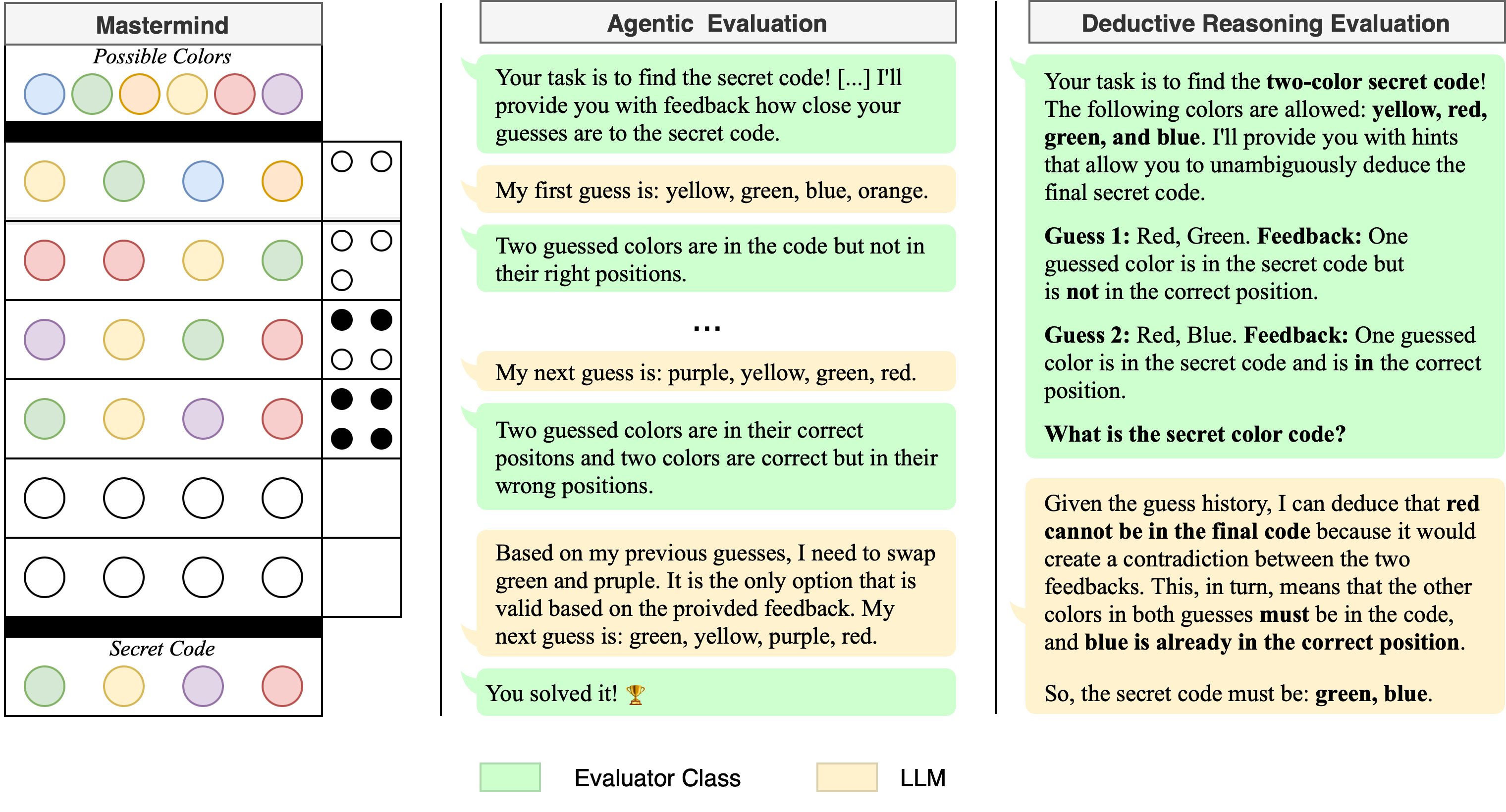
This diagram presents a comparison of two evaluation methods – Agentic Evaluation and Deductive Reasoning Evaluation – in the context of the Mastermind game. The Mastermind section on the left displays the possible colors and the secret code. The diagram illustrates the process of guessing the secret code and the feedback provided, comparing how an agentic approach and a deductive reasoning approach perform.
### Components/Axes
The diagram is divided into three main columns:
1. **Mastermind Possible Colors:** Displays the possible colors for the Mastermind game (yellow, red, green, blue, purple, orange). The bottom row shows the "Secret Code".
2. **Agentic Evaluation:** Describes the process of an agent attempting to solve the code through iterative guesses and feedback.
3. **Deductive Reasoning Evaluation:** Demonstrates how deductive reasoning can be used to solve the code with minimal guesses, given feedback.
A legend at the bottom indicates the color coding:
* **Green:** Evaluator Class
* **LLM:** LLM (Large Language Model)
### Content Details
**Mastermind Possible Colors:**
* Six colors are available: yellow, red, green, blue, purple, and orange.
* The "Secret Code" consists of four colors: yellow, green, purple, and blue.
**Agentic Evaluation:**
* **Task:** "Your task is to find the secret code! [...] I’ll provide you with feedback how close your guesses are to the secret code."
* **First Guess:** yellow, green, blue, orange.
* **Feedback 1:** "Two guessed colors are in the code but not in their right positions."
* **Second Guess:** purple, yellow, green, red.
* **Feedback 2:** "Two guessed colors are in their correct positions and two colors are correct but in their wrong positions."
* **Next Guess:** green, yellow, purple, red.
* **Outcome:** "You solved it!"
**Deductive Reasoning Evaluation:**
* **Task:** "Your task is to find the two-color secret code! The following colors are allowed: yellow, red, green, and blue. I’ll provide you with hints that allow you to unambiguously deduce the final secret code."
* **Guess 1:** Red, Green.
* **Feedback 1:** "One guessed color is in the secret code but is not in the correct position."
* **Guess 2:** Red, Blue.
* **Feedback 2:** "One guessed color is in the secret code and is in the correct position."
* **Question:** "What is the secret color code?"
* **Deduction:** "Given the guess history, I can deduce that red cannot be in the final code because it would create a contradiction between the two feedbacks. This, in turn, means that the other colors in both guesses must be in the code, and blue is already in the correct position."
* **Solution:** "So, the secret code must be: green, blue."
### Key Observations
* The Agentic Evaluation demonstrates an iterative process of guessing and refining based on feedback. It requires multiple guesses to arrive at the solution.
* The Deductive Reasoning Evaluation showcases a more efficient approach, solving the code in only two guesses by logically eliminating possibilities based on the feedback.
* The Deductive Reasoning example simplifies the color palette to yellow, red, green, and blue.
* The Agentic Evaluation uses all six colors.
### Interpretation
The diagram highlights the difference between two problem-solving approaches. The Agentic Evaluation represents a trial-and-error method, akin to how a reinforcement learning agent might explore a solution space. It relies on repeated attempts and learning from feedback. The Deductive Reasoning Evaluation, on the other hand, demonstrates the power of logical deduction. By carefully analyzing the feedback, it can systematically eliminate incorrect possibilities and arrive at the correct solution with minimal effort.
The contrast between the two evaluations suggests that deductive reasoning is more effective for solving the Mastermind game, particularly when the number of possible colors is limited. The Agentic Evaluation, while eventually successful, requires more steps and is less efficient. The diagram effectively illustrates the benefits of a structured, logical approach versus a more exploratory one. The simplification of the color palette in the Deductive Reasoning example likely contributes to its efficiency, reducing the complexity of the search space.