## Diagram Type: Flowchart
### Overview
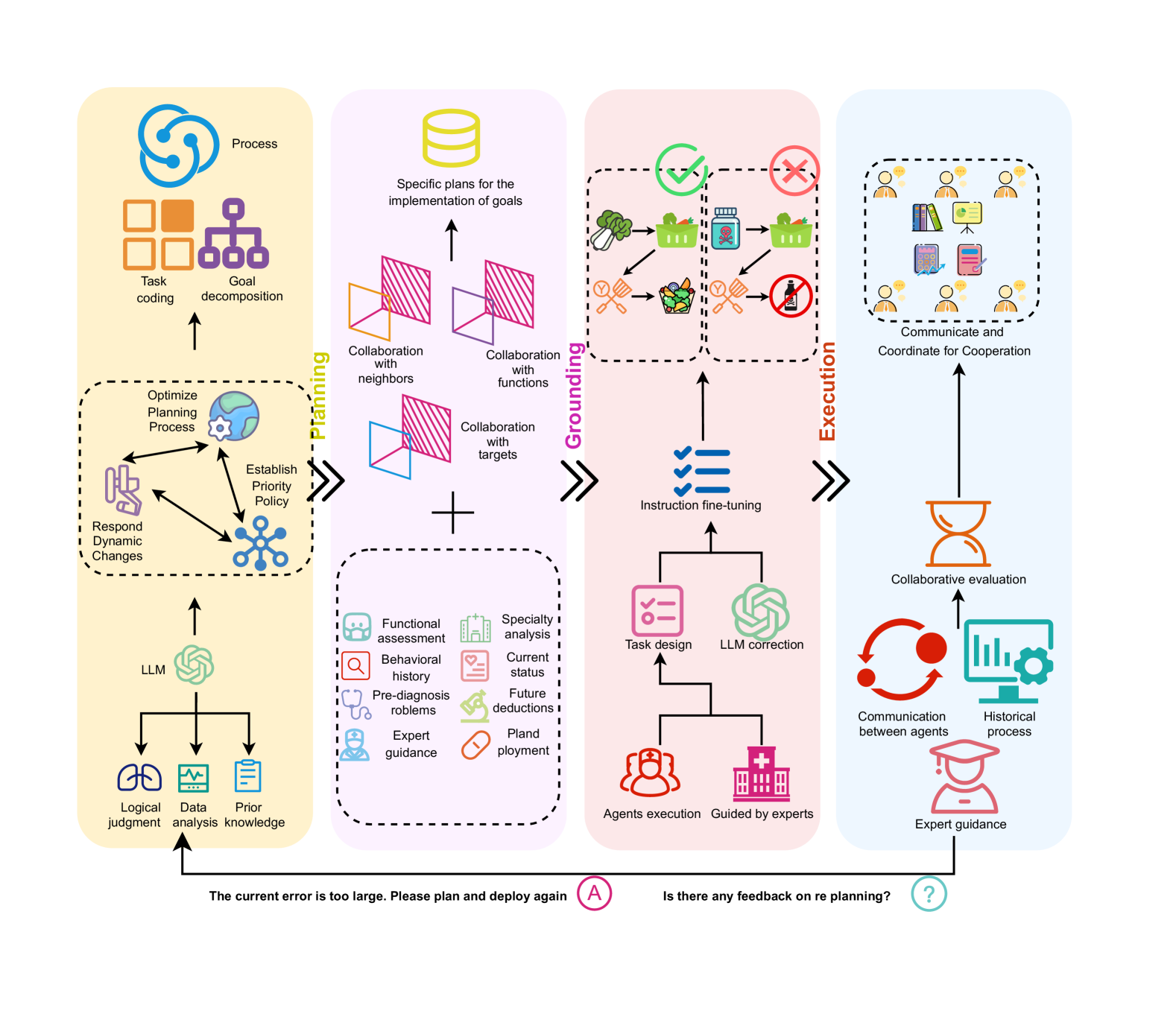
The flowchart illustrates the process of planning, grounding, execution, and evaluation in a collaborative environment. It shows how tasks are planned, executed, and evaluated, with feedback loops to improve future planning.
### Components/Axes
- **Planning**: This section includes tasks such as goal decomposition, collaboration with neighbors, and establishing priority policy.
- **Grounding**: This section involves functional assessment, pre-diagnosis problems, and expert guidance.
- **Execution**: This section includes task design, LLM correction, and agents execution.
- **Evaluation**: This section includes collaborative evaluation, communication between agents, and historical process.
### Detailed Analysis or ### Content Details
- **Planning**: The process starts with goal decomposition, followed by collaboration with neighbors and establishing priority policy.
- **Grounding**: This section involves functional assessment, pre-diagnosis problems, and expert guidance.
- **Execution**: The execution phase includes task design, LLM correction, and agents execution.
- **Evaluation**: The evaluation phase includes collaborative evaluation, communication between agents, and historical process.
### Key Observations
- The flowchart shows a cyclical process with feedback loops.
- The process starts with planning, followed by grounding, execution, and evaluation.
- The process includes collaboration with neighbors, expert guidance, and feedback loops to improve future planning.
### Interpretation
The flowchart demonstrates the process of planning, grounding, execution, and evaluation in a collaborative environment. It shows how tasks are planned, executed, and evaluated, with feedback loops to improve future planning. The process includes collaboration with neighbors, expert guidance, and feedback loops to improve future planning. The flowchart illustrates the importance of collaboration, expert guidance, and feedback loops in achieving successful outcomes.