## Process Diagram: LLM-Driven Task Execution
### Overview
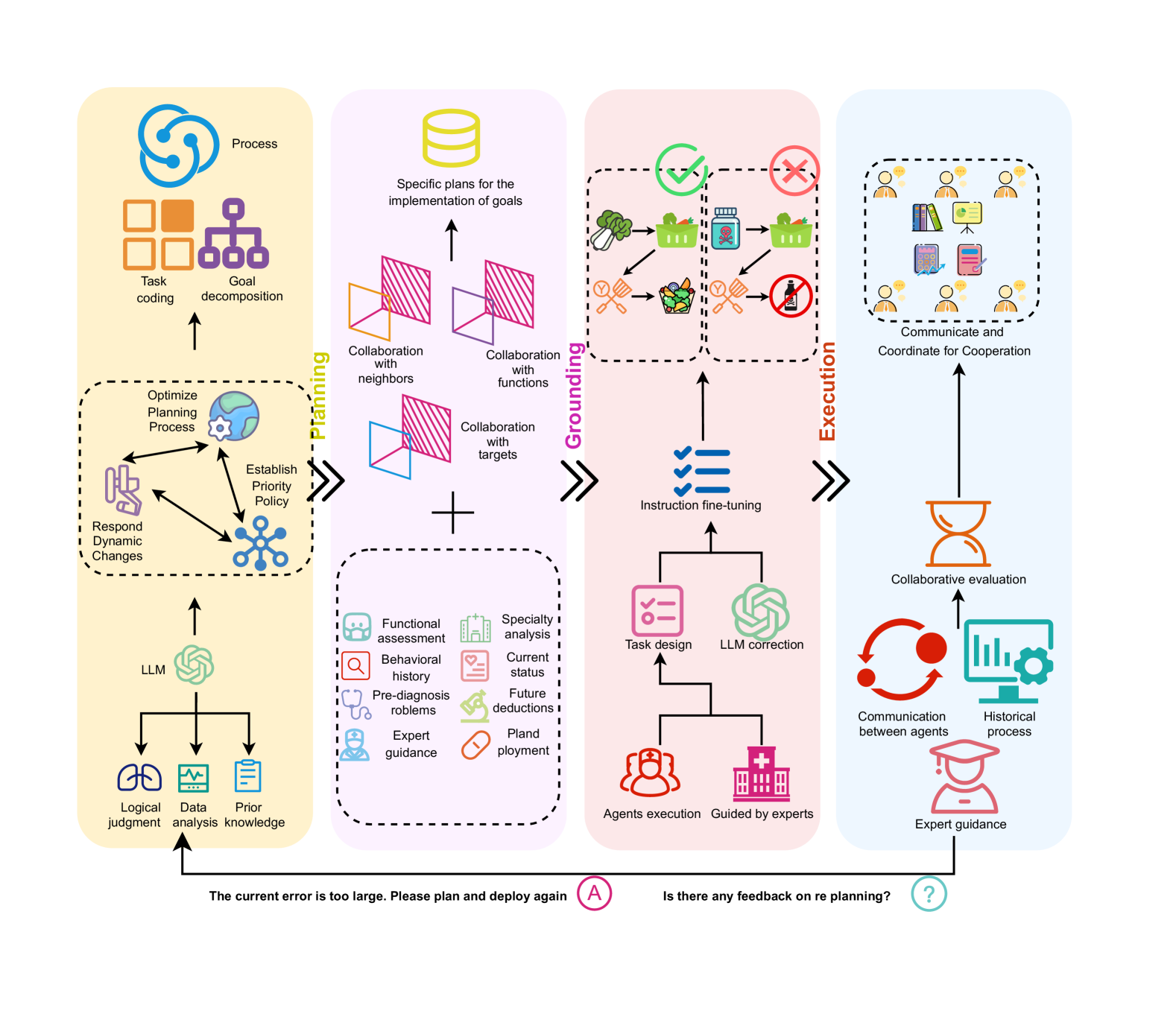
The image is a process diagram illustrating a workflow that involves planning, grounding, and execution, potentially driven by a Large Language Model (LLM). It shows the flow of information and actions between different stages, including task decomposition, collaboration, instruction fine-tuning, and expert guidance.
### Components/Axes
* **Stages:** The diagram is divided into three main stages: Planning, Grounding, and Execution.
* **Elements:** Each stage contains several elements representing specific tasks, processes, or data sources.
* **Arrows:** Arrows indicate the flow of information or actions between elements.
* **Text Labels:** Labels describe the purpose or function of each element.
### Detailed Analysis
**1. Planning Stage (Top-Left, Yellow Background):**
* **Process:** Starts with a "Process" icon (blue intertwined circles).
* **Task Coding:** Followed by "Task coding" (orange squares) and "Goal decomposition" (purple shapes).
* **LLM Input:** An arrow points from "LLM" (green icon) to the "Task coding" and "Goal decomposition" elements.
* **LLM Output:** The LLM receives input from "Logical judgment," "Data analysis," and "Prior knowledge."
* **Planning Loop:** A dashed box encloses "Optimize Planning Process" (globe icon), "Establish Priority Policy" (blue asterisk), and "Respond Dynamic Changes" (purple icon). Arrows indicate a feedback loop between these elements.
**2. Grounding Stage (Center, No Background):**
* **Specific Plans:** Starts with "Specific plans for the implementation of goals" (yellow cylinder).
* **Collaboration:** Includes "Collaboration with neighbors" (orange/purple grid), "Collaboration with functions" (purple grid), and "Collaboration with targets" (blue/purple grid). These are combined with a "+" symbol.
* **LLM Input:** The LLM receives input from a dashed box containing:
* "Functional assessment" (building icon)
* "Behavioral history" (magnifying glass icon)
* "Pre-diagnosis problems" (stethoscope icon)
* "Expert guidance" (doctor icon)
* "Specialty analysis" (building icon)
* "Current status" (heart rate monitor icon)
* "Future deductions" (leaf icon)
* "Planned ployment" (pill icon)
**3. Execution Stage (Top-Right, Light Blue Background):**
* **Instruction Fine-Tuning:** Starts with "Instruction fine-tuning" (blue checklist icon).
* **Task Design and LLM Correction:** "Task design" (pink checklist icon) and "LLM correction" (green intertwined circles) feed into "Instruction fine-tuning."
* **Agents Execution:** "Agents execution" (red people icon) and "Guided by experts" (pink building icon) feed into "Task design."
* **Communication and Coordination:** Leads to "Communicate and Coordinate for Cooperation" (people icons).
* **Collaborative Evaluation:** Involves "Collaborative evaluation" (orange hourglass icon), "Communication between agents" (red circular arrows), "Historical process" (computer screen with graph icon), and "Expert guidance" (graduate icon).
**4. Data Flow and Decision Points:**
* **Planning to Grounding:** A double arrow indicates the transition from Planning to Grounding.
* **Grounding to Execution:** A double arrow indicates the transition from Grounding to Execution.
* **Execution Feedback:** A double arrow indicates the transition from Execution back to the start.
* **Checkmarks and X Marks:** In the "Execution" stage, there are checkmarks and X marks above the food icons, indicating success or failure.
**5. Text at the Bottom:**
* "The current error is too large. Please plan and deploy again" (A, pink circle).
* "Is there any feedback on re planning?" (question mark, light blue circle).
### Key Observations
* The diagram illustrates a cyclical process involving planning, grounding, and execution.
* The LLM plays a central role in both planning and grounding, receiving input from various sources and providing guidance.
* Expert guidance is present in both the grounding and execution stages, suggesting human oversight.
* The feedback loop from execution to planning indicates an iterative process of refinement.
### Interpretation
The diagram represents a system where an LLM is used to drive task execution, with human experts providing guidance and feedback. The planning stage involves decomposing goals and establishing priorities. The grounding stage involves gathering information and collaborating with various entities. The execution stage involves fine-tuning instructions, executing tasks, and coordinating cooperation. The feedback loop ensures that the system can adapt to changing conditions and improve its performance over time. The questions at the bottom suggest a focus on error handling and continuous improvement. The checkmarks and X marks in the "Execution" stage suggest a binary outcome for each task, which could be a simplification of a more complex reality.