\n
## Diagram: LLM-Based Agent Workflow
### Overview
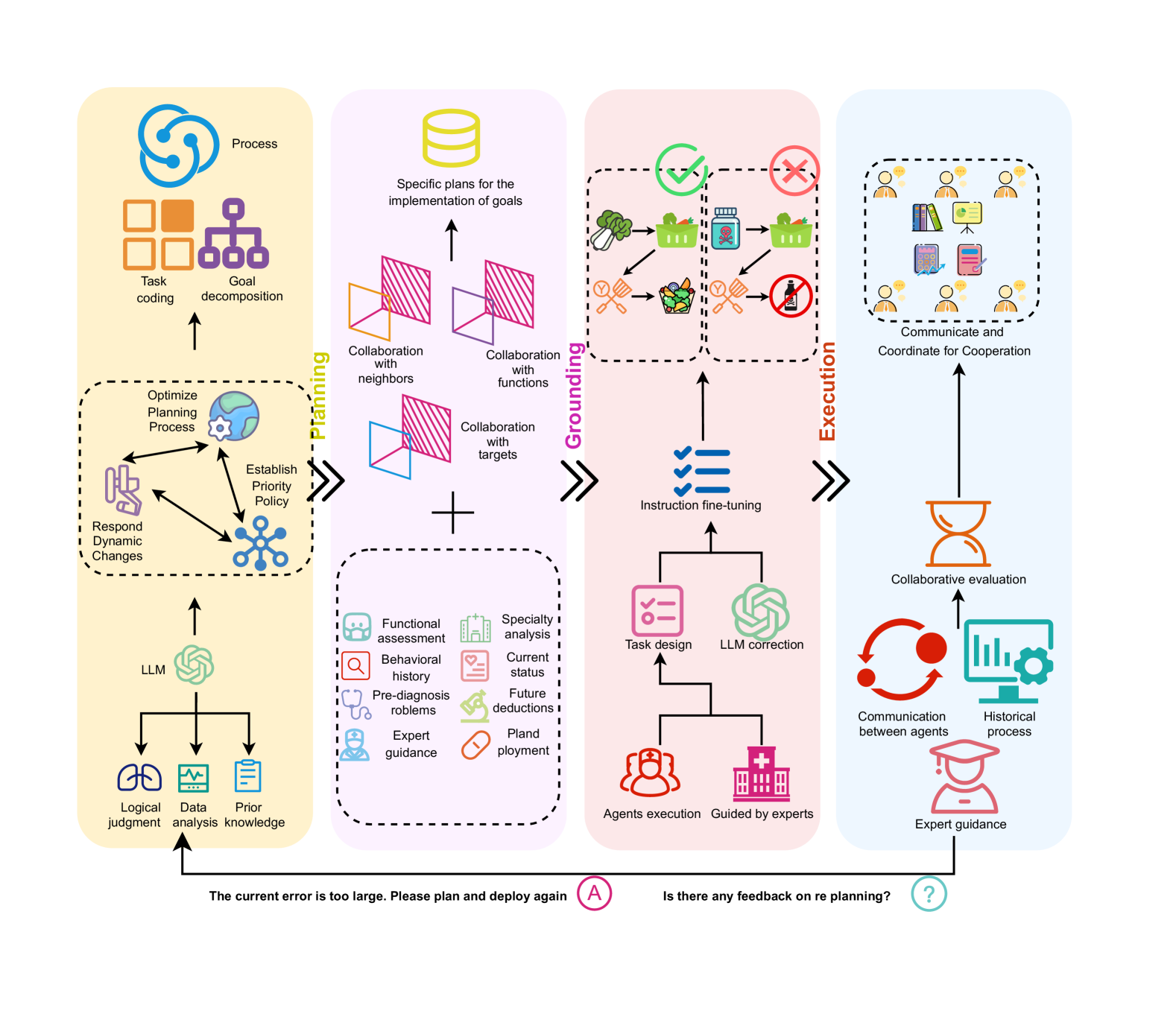
This diagram illustrates a workflow for an LLM-based agent, broken down into three main stages: Planning, Grounding, and Execution. The diagram depicts a cyclical process with feedback loops and interactions between various components. The overall flow is from left to right, with iterative refinement and guidance.
### Components/Axes
The diagram is divided into three main colored sections:
* **Planning (Pink):** Focuses on goal decomposition and strategy formulation.
* **Grounding (Green):** Focuses on connecting the plan to real-world information and refining instructions.
* **Execution (Orange):** Focuses on carrying out the plan and evaluating results.
Key components within each stage include:
* **Process (Top-Left, Cyan):** Includes Task Coding and Goal Decomposition.
* **LLM (Bottom-Left, Grey):** Receives input from Logical Alignment, Data Analysis, and Prior Knowledge.
* **Planning:** Collaboration with Neighbors, Collaboration with Functions, Collaboration with Targets.
* **Grounding:** Functional Assessment, Specialty Analysis, Current Status, Future Deductions, Deployment, Expert Guidance.
* **Execution:** Communicate and Coordinate for Cooperation, Collaborative Evaluation, Communication between Agents, Historical Process, Expert Guidance.
There are two text boxes at the bottom:
* "The current error is too large. Please plan and deploy again" (labeled 'A')
* "Is there any feedback on re-planning?" (labeled with a question mark)
Arrows indicate the flow of information and control between components.
### Detailed Analysis or Content Details
**Process (Cyan):**
* A circular arrow indicates a continuous process.
* Task Coding is represented by a grid of squares.
* Goal Decomposition is represented by a branching tree structure.
* An arrow points from "Process" to "Optimize Planning Process".
* An arrow points from "Optimize Planning Process" to "Respond Dynamic Changes".
* An arrow points from "Respond Dynamic Changes" to the LLM.
**LLM (Grey):**
* The LLM receives input from three sources: Logical Alignment, Data Analysis, and Prior Knowledge.
* An arrow points from the LLM to "Establish Priority Policy".
**Planning (Pink):**
* "Collaboration with Neighbors" is represented by interconnected pyramids.
* "Collaboration with Functions" is represented by interconnected rectangles.
* "Collaboration with Targets" is represented by interconnected squares.
* A plus sign connects the Planning stage to the Grounding stage.
**Grounding (Green):**
* "Functional Assessment" is represented by a magnifying glass over a document.
* "Behavioral History" is represented by a chart.
* "Pre-diagnosis problems" is represented by a question mark in a circle.
* "Specialty Analysis" is represented by a bar graph.
* "Current Status" is represented by a clock.
* "Future Deductions" is represented by a crystal ball.
* "Deployment" is represented by a safe.
* "Expert Guidance" is represented by a person speaking.
* An arrow points from "Grounding" to "Instruction fine-tuning".
* An arrow points from "Instruction fine-tuning" to "Task design".
* An arrow points from "Task design" to "LLM correction".
**Execution (Orange):**
* "Communicate and Coordinate for Cooperation" is represented by multiple people icons.
* "Collaborative Evaluation" is represented by a scale.
* "Communication between Agents" is represented by a circular chart.
* "Historical Process" is represented by a bar graph.
* "Expert Guidance" is represented by a person speaking.
* An arrow points from "LLM correction" to "Agents execution Guided by experts".
* An arrow points from "Agents execution Guided by experts" to "Execution".
**Feedback Loops:**
* A dashed arrow points from "Execution" back to "Grounding".
* A dashed arrow points from "Grounding" back to "Planning".
* A dashed arrow points from "Planning" back to "Process".
### Key Observations
* The diagram emphasizes a cyclical and iterative process.
* The LLM plays a central role in coordinating the workflow.
* Expert guidance is integrated into both the Grounding and Execution stages.
* The feedback loops suggest continuous refinement and adaptation.
* The error message "The current error is too large. Please plan and deploy again" indicates a potential issue with the planning or execution stages.
* The question "Is there any feedback on re-planning?" highlights the importance of incorporating feedback into the process.
### Interpretation
This diagram represents a sophisticated agent workflow leveraging the capabilities of a Large Language Model (LLM). The three stages – Planning, Grounding, and Execution – represent a clear division of labor, mirroring cognitive processes. The Planning stage focuses on defining the problem and formulating a strategy. The Grounding stage connects the plan to the real world, ensuring it is feasible and informed. The Execution stage carries out the plan and evaluates the results.
The feedback loops are crucial, suggesting a system designed for continuous learning and improvement. The integration of expert guidance indicates a human-in-the-loop approach, where human expertise is used to refine the agent's behavior. The error message and question at the bottom suggest that the system is capable of detecting and responding to errors, and that feedback is actively sought to improve the planning process.
The diagram suggests a complex system designed to address challenges that require both strategic thinking and real-world awareness. The use of visual metaphors (e.g., magnifying glass for assessment, crystal ball for future deductions) adds a layer of intuitiveness to the diagram, making it easier to understand the overall workflow. The diagram is a high-level overview and does not provide specific details about the algorithms or techniques used in each stage. However, it provides a valuable framework for understanding the key components and interactions within the system.