## Flowchart: Collaborative AI-Agent Workflow with Feedback Loops
### Overview
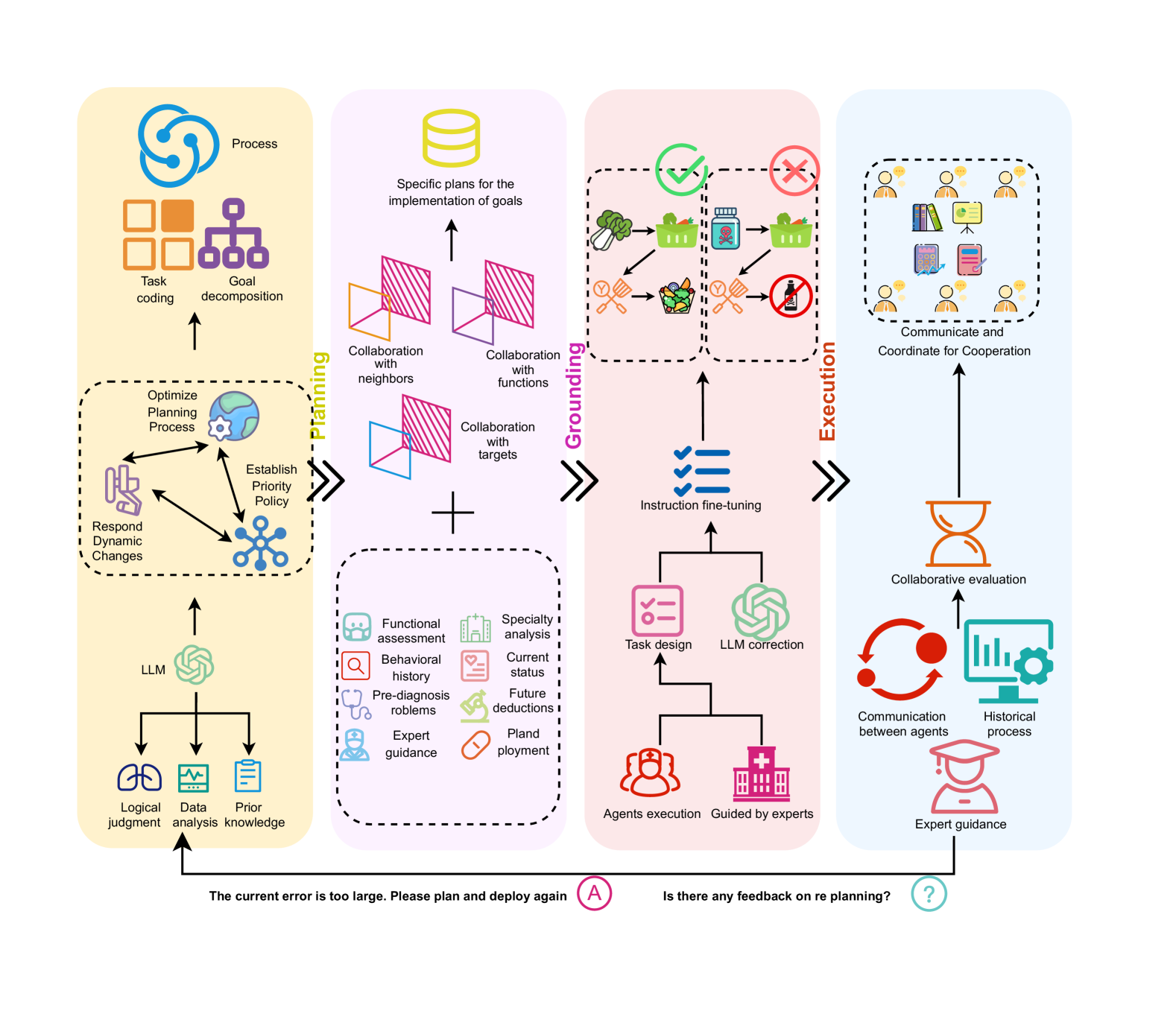
The flowchart illustrates a multi-stage collaborative workflow for AI agents, emphasizing iterative planning, grounding, execution, and feedback-driven adaptation. Four vertical sections represent distinct phases, interconnected by bidirectional arrows and decision nodes.
---
### Components/Axes
1. **Process Section** (Leftmost, Yellow):
- **Labels**:
- "Process" (top)
- "Task coding" (orange grid)
- "Goal decomposition" (purple tree)
- "Optimize Planning Process" (blue globe)
- "Establish Priority Policy" (blue star)
- "Respond Dynamic Changes" (purple robot)
- "LLM" (green knot)
- "Logical judgment" (blue lungs)
- "Data analysis" (green chart)
- "Prior knowledge" (blue clipboard)
- **Flow**:
- Task coding → Goal decomposition → Optimize Planning Process → Establish Priority Policy → Respond Dynamic Changes → LLM → Logical judgment/Data analysis/Prior knowledge (feedback loop).
2. **Planning Section** (Second, Purple):
- **Labels**:
- "Specific plans for the implementation of goals" (top)
- "Collaboration with neighbors" (pink cube)
- "Collaboration with functions" (pink cube)
- "Collaboration with targets" (pink cube)
- "Functional assessment" (green face)
- "Specialty analysis" (green hospital)
- "Current status" (pink heart)
- "Pre-diagnosis problems" (pink stethoscope)
- "Expert guidance" (pink doctor)
- "Future deductions" (green microscope)
- "Pland deployment" (pink pill)
- **Flow**:
- Top-down hierarchy with lateral connections between collaboration types. Feedback loops to "LLM correction" and "Task design."
3. **Grounding Section** (Third, Pink):
- **Labels**:
- "Instruction fine-tuning" (blue checkmarks)
- "Task design" (pink checklist)
- "LLM correction" (green knot)
- "Agents execution" (pink hospital)
- "Guided by experts" (pink doctor)
- **Flow**:
- Top-down with bidirectional arrows between "Task design" and "LLM correction." Feedback to "Planning" and "Execution."
4. **Execution Section** (Rightmost, Blue):
- **Labels**:
- "Coordinate for Cooperation" (top)
- "Collaborative evaluation" (orange hourglass)
- "Communication between agents" (red arrows)
- "Historical process" (blue monitor)
- "Expert guidance" (pink graduate)
- **Flow**:
- Top-down with feedback loops to "Grounding" and "Planning."
---
### Detailed Analysis
- **Feedback Mechanisms**:
- All sections include feedback loops (marked by dashed arrows) to earlier stages, enabling iterative refinement.
- Decision nodes (circles with "A" and "?") trigger re-planning or grounding based on error magnitude or feedback availability.
- **Collaboration Patterns**:
- Collaboration occurs at three levels: neighbors (spatial), functions (operational), and targets (goal-oriented).
- Expert guidance is integrated at multiple stages (Planning, Grounding, Execution).
- **LLM Role**:
- Central to all phases, with corrections and optimizations feeding back into task design and planning.
---
### Key Observations
1. **Iterative Nature**: Feedback loops dominate, emphasizing adaptability over linear execution.
2. **Expert Integration**: Human expertise is embedded in problem diagnosis, guidance, and evaluation.
3. **Collaboration Granularity**: Collaboration is stratified (neighbors → functions → targets), suggesting hierarchical coordination.
4. **LLM as Conductor**: The LLM orchestrates workflows but relies on external inputs (data, knowledge, expert feedback).
---
### Interpretation
This workflow models a **closed-loop AI system** where collaboration and feedback are critical. The emphasis on "grounding" (real-world validation via experts) and iterative correction suggests a focus on robustness and alignment with human goals. The stratification of collaboration implies scalability, while the LLM’s central role highlights its function as a dynamic coordinator rather than a static planner. The decision nodes ("A" and "?") introduce uncertainty management, critical for real-world deployment where errors and feedback variability are inevitable.